
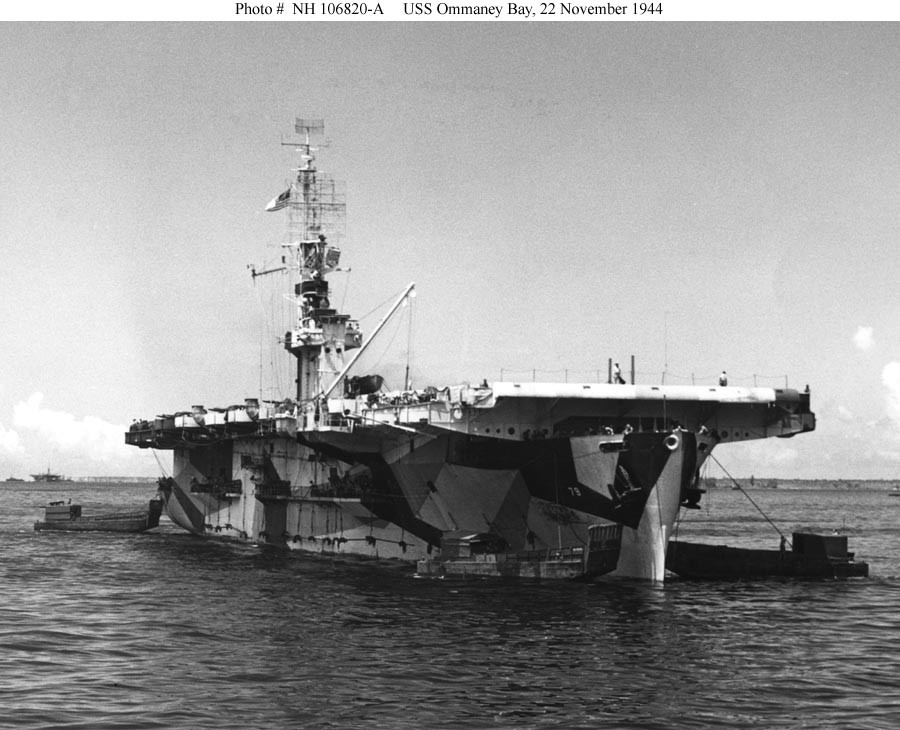
US Navy Escort Carrier USS Ommaney Bay (CVE-79)
USS Ommaney Bay was a United States Navy escort carrier of the Casablanca class, built during the rapid wartime expansion of American naval aviation in the Second World War. She was laid down in 1943 by the Kaiser Shipbuilding Company at Vancouver, Washington, and commissioned in January 1944. Like other Casablanca class carriers, Ommaney Bay was designed for mass production, modest speed, and flexibility rather than fleet carrier performance.
Following shakedown training, Ommaney Bay joined the Pacific Fleet, where she operated primarily as part of escort carrier task groups. Her early duties included providing air cover for amphibious operations and conducting strikes against Japanese positions. During the campaign in the Netherlands East Indies, her aircraft supported landings on Leyte and later operations around Luzon. The carrier’s air group typically consisted of Grumman FM-2 Wildcat fighters and Grumman TBM Avenger torpedo bombers, well suited to ground attack and anti-shipping roles.
On 15 December 1944 while operating in support of the Philippines campaign (off Mindoro), the carrier’s anti-aircraft batteries engaged multiple Japanese aircraft. A Yokosuka P1Y “Frances” bomber attempted a kamikaze-type suicide attack on Ommaney Bay and was set afire by American anti-aircraft fire and crashed into the sea nearby instead of striking the ship
Ommaney Bay met her end during the Philippines campaign in January 1945. On 4 January, while operating in the Sulu Sea, she was attacked by a Japanese kamikaze aircraft. The aircraft struck the flight deck, triggering explosions and intense fires that quickly spread through the hangar deck. Despite determined damage control efforts, the fires proved uncontrollable due to detonating ammunition and aviation fuel.
With the situation hopeless, the order was given to abandon ship. Most of the crew were rescued by accompanying destroyers, though casualties were sustained. USS Ommaney Bay was subsequently scuttled by torpedoes to prevent capture.


