
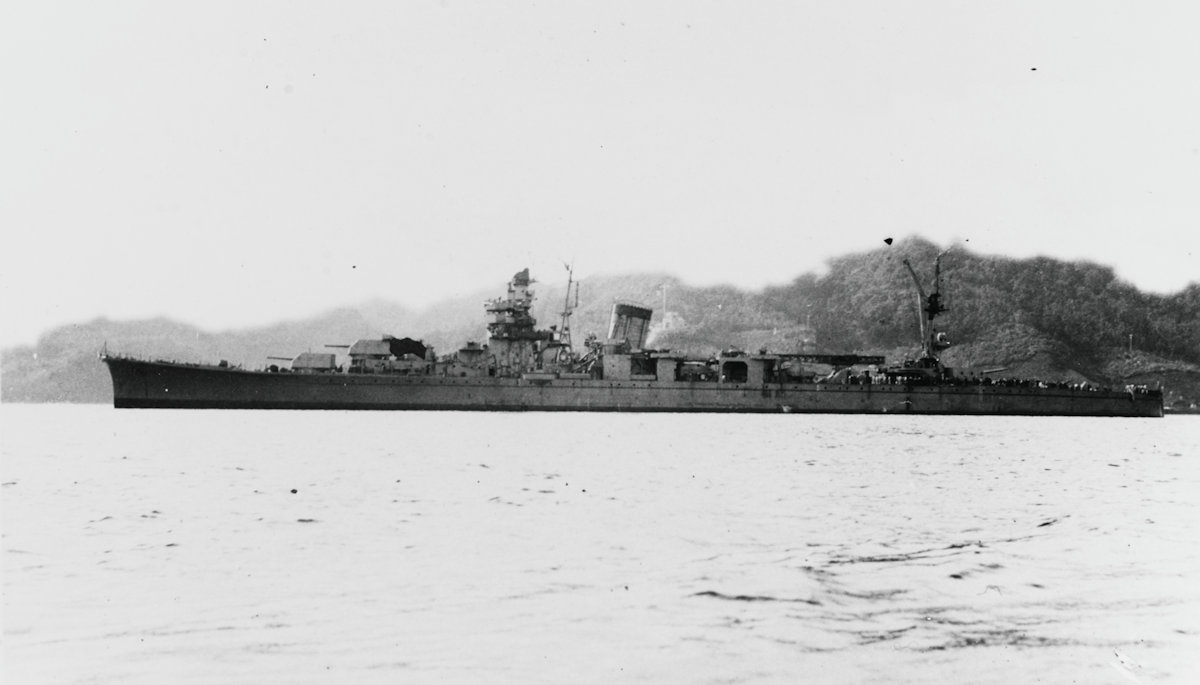
Japanese Light Cruiser Sakawa
The Imperial Japanese Navy light cruiser Sakawa was the fourth and final unit of the Agano-class, a group of fast light cruisers intended to act as flotilla flagships for destroyer squadrons during the Second World War. Conceived in the late 1930s, the class reflected Japanese naval doctrine that emphasised speed, long range, and command capability rather than heavy armour or gun power (GlobalSecurity.org, n.d.). Sakawa was completed too late to influence the course of the war, and her short career illustrates the constraints faced by Japan’s surface fleet in its final months.
Sakawa was laid down at the Sasebo Naval Arsenal on 21 November 1942, launched on 9 April 1944, and commissioned on 30 November 1944 (Wikipedia, n.d.). She was named after the Sakawa River in Kyūshū, following Imperial Japanese Navy naming conventions for light cruisers. By the time of her completion, Japan’s industrial capacity and access to fuel had been severely degraded by Allied air and submarine attacks, limiting the operational use of newly built warships (CombinedFleet.com, n.d.).
In terms of design, Sakawa displaced approximately 6,652 tonnes standard and 8,534 tonnes at full load. She measured 174.1 metres in length, with a beam of 15.2 metres and a draft of 5.63 metres (Wikipedia, n.d.). Propulsion was provided by four geared steam turbines supplied by six boilers, generating 100,000 shaft horsepower and allowing a maximum speed of 35 knots. At an economical speed of 18 knots, her range was about 6,300 nautical miles, making her well suited for operations across the Pacific (GlobalSecurity.org, n.d.).
Her main armament consisted of six 15 cm guns mounted in three twin turrets, supported by 8 cm dual-purpose guns and an increasing number of 25 mm anti-aircraft weapons as the air threat intensified late in the war. Sakawa also carried eight 61 cm torpedo tubes, consistent with Japanese emphasis on torpedo warfare, and was equipped with depth charges for anti-submarine defence (Wikipedia, n.d.). Aviation facilities allowed the operation of two floatplanes, used primarily for reconnaissance and artillery spotting.
Operationally, Sakawa saw no combat action. Following commissioning, she remained largely in home waters due to fuel shortages and the deteriorating strategic situation (CombinedFleet.com, n.d.). At the time of Japan’s surrender in August 1945, she was located at Maizuru, having spent most of her service life inactive.
After the war, Sakawa was briefly employed in repatriation duties, transporting Japanese soldiers and civilians back to the home islands (Everything Explained Today, n.d.). In early 1946, she was transferred to United States control and selected as a target ship for Operation Crossroads, the atomic bomb tests conducted at Bikini Atoll. During Test Able on 1 July 1946, Sakawa was struck by an aerial nuclear detonation and sank the following day (Wikipedia, n.d.).


References
CombinedFleet.com. (n.d.). Sakawa – Born too little, too late. http://www.combinedfleet.com/Sakawa-Story.htm
Everything Explained Today. (n.d.). Japanese cruiser Sakawa explained. https://everything.explained.today/Japanese_cruiser_Sakawa/
GlobalSecurity.org. (n.d.). IJN Agano class light cruisers. https://www.globalsecurity.org/military/world/japan/agano-cl.htm
Wikipedia. (n.d.). Japanese cruiser Sakawa. https://en.wikipedia.org/wiki/Japanese_cruiser_Sakawa