
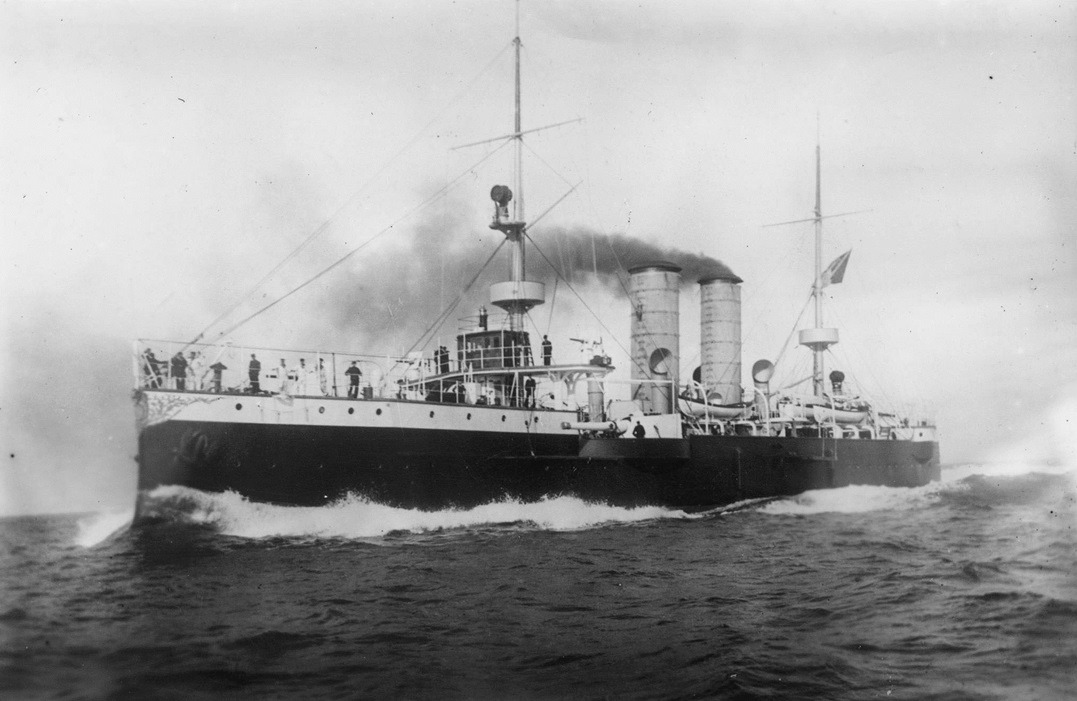
Portuguese Ironclad Vasco Da Gama
The ironclad Vasco da Gama was the most powerful warship operated by the Portuguese Navy in the late nineteenth century and remained in service, in modified form, into the twentieth century. Built during a period when Portugal sought to modernise its small fleet, the vessel reflected contemporary European naval design trends while also demonstrating the limitations imposed by national finances and industrial capacity.
Vasco da Gama was laid down in 1875 at the Thames Ironworks shipyard in London and launched in 1876. She entered Portuguese service in 1878 as the navy’s principal armoured warship. Constructed of iron and protected by a central armoured citadel, the ship was classified as an ironclad battery ship. Her design emphasised coastal defence and the protection of Lisbon rather than long oceanic operations. The vessel displaced about 2,400 tons and measured roughly 61 metres in length, making her relatively small compared with the ironclads then entering service in larger European navies.
The ship’s armament consisted primarily of two large-calibre guns mounted in an armoured central battery. These heavy muzzle-loading weapons were supported by smaller guns intended for close defence. Armour plating along the waterline and around the battery provided protection against naval artillery typical of the 1870s. Vasco da Gama was powered by a steam engine driving a single screw propeller, allowing a speed of approximately 10 knots. Although modest, this performance was adequate for her defensive mission along the Portuguese coast and in colonial waters.
For two decades, Vasco da Gama served as the core of Portugal’s naval deterrent. She participated in training cruises, ceremonial duties, and occasional deployments to demonstrate Portuguese authority overseas. By the 1890s, however, rapid technological change had rendered most early ironclads obsolete. Steel warships with breech-loading artillery, improved armour, and more efficient engines had replaced earlier designs across Europe. Portugal faced the choice of replacing the vessel or reconstructing her.
Between 1901 and 1903, Vasco da Gama underwent a major reconstruction in Italy at the Orlando shipyard in Livorno. This rebuild significantly altered her appearance and capabilities. The ship was lengthened by inserting a new midsection, increasing displacement to over 3,000 tons and improving stability. Her propulsion system was replaced with more modern machinery, raising her speed to about 15 knots. The original muzzle-loading guns were removed and replaced with modern breech-loading artillery mounted in sponsons, providing wider firing arcs and greater effectiveness.
The reconstruction extended the vessel’s service life by several decades. After returning to Portugal, Vasco da Gama continued to operate as a coastal defence ship and training vessel. She remained symbolically important to the navy, representing Portugal’s efforts to maintain a credible maritime force despite limited resources.
During the political unrest of the early twentieth century, the ship played a minor but notable role. In 1913, elements of her crew became involved in a naval mutiny during a period of instability in the Portuguese First Republic. Government forces suppressed the uprising, and the vessel returned to normal service soon afterward.
By the time of the First World War, Vasco da Gama was thoroughly outdated, though still useful for secondary duties. She remained in commission for training and harbour defence until the early 1930s. The ship was finally decommissioned and scrapped in 1936, ending nearly sixty years of service.


