
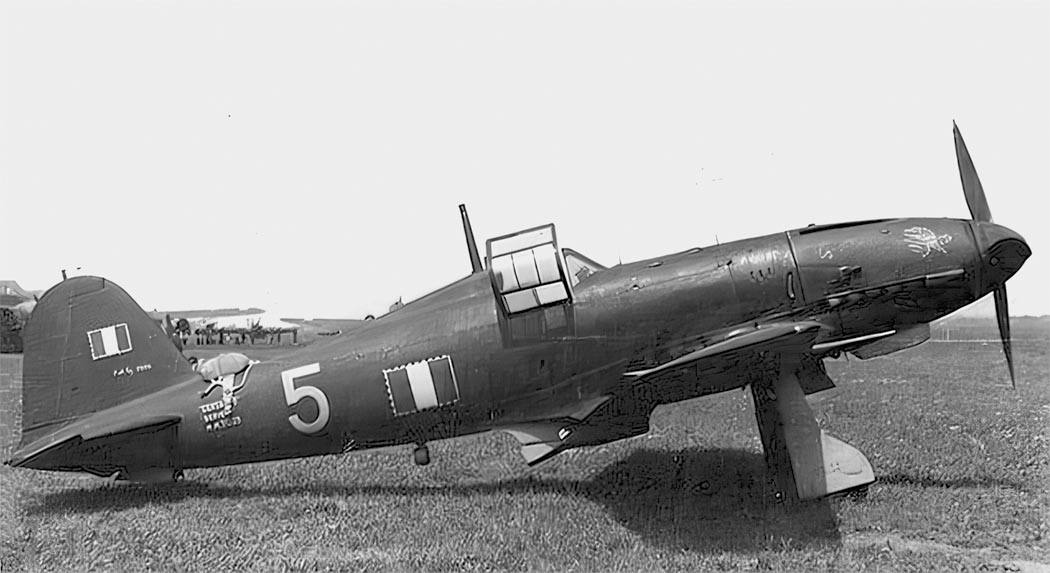
Fiat G.55 Centauro
The Fiat G.55 Centauro was among the most capable Italian fighters of the Second World War. Designed by Giuseppe Gabrielli, it first flew on 30 April 1942 and was powered by the license-built Daimler-Benz DB 605A (Fiat RA.1050 R.C.58 Tifone). It combined a robust airframe with heavy armament, typically three 20 mm MG 151/20 cannon and two 12.7 mm Breda-SAFAT machine guns. In comparative Luftwaffe trials during early 1943, the G.55 was judged highly competitive with contemporary German types, particularly at medium to high altitude (Green, 1961; Dunning, 2000).
G.55S Torpedo Fighter
The G.55S was a single prototype adapted for maritime strike. It featured a lengthened rear fuselage for improved directional stability and was modified to carry a standard Italian aerial torpedo under the fuselage. Tested in 1944, it demonstrated adequate handling but offered no decisive advantage over existing torpedo platforms, and no production followed (Green, 1961; Angelucci & Matricardi, 1978).
Fiat G.56
The G.56 represented an advanced development powered by the German DB 603A engine. First flown in March 1944, it exhibited markedly improved climb and speed, reportedly exceeding 680 km/h. Luftwaffe evaluations considered it superior in some respects to the Bf 109G and competitive with the Fw 190D, but industrial constraints and Germany’s strategic situation precluded series production (Dunning, 2000).
Fiat G.59
Post-war, Fiat adapted the G.55 into the G.59, powered by the Rolls-Royce Merlin. It served primarily as an advanced trainer and light fighter. Production continued into the early 1950s, including export variants (Angelucci & Matricardi, 1978).
Operators
Regia Aeronautica
The G.55 entered service in 1943 with the Regia Aeronautica, equipping units such as 51° Stormo. It saw combat during the defence of Italian cities against Allied bombing and against USAAF heavy bombers. Pilots valued its high-altitude performance and firepower (Dunning, 2000).
Aeronautica Nazionale Repubblicana
Following the September 1943 armistice, the ANR operated the G.55 under German supervision in northern Italy. It became one of the ANR’s principal interceptors in 1944–45 (Rossi, 1988).
Germany
The Luftwaffe evaluated the type extensively in 1943. Although admired, Germany prioritised domestic production types, limiting further procurement (Green, 1961).
UK – Evaluation Only
A captured G.55 was tested by the Royal Aircraft Establishment at Farnborough. British reports noted excellent manoeuvrability and armament, though production standards varied (Green, 1961).
Italy – Post-war
The Aeronautica Militare Italiana operated surviving G.55s briefly before transitioning to the Merlin-powered G.59, which became a significant post-war trainer (Angelucci & Matricardi, 1978).
Argentina
Argentina acquired G.55 and later G.59 aircraft post-war, using them primarily as advanced trainers during its transitional modernisation phase (Angelucci & Matricardi, 1978).
Egypt
Egypt operated surplus Italian G.55s in the late 1940s, reportedly employing them during the 1948 Arab–Israeli War (Dunning, 2000).
Syria
Syria also obtained ex-Italian G.55s, using them operationally in the 1948 conflict before replacing them with more modern types (Dunning, 2000).
Photographs of the Fiat G.55 and Derivatives
Click on the pictures or links below to go to the relevant page for more photos.
- Argentina
- Egypt
- Germany
- Italy
- Syria
- United Kingdom (for evaluation)
Versions
- Fiat G.55S
- Fiat G.56
- Fiat G.59
Argentina

Egypt

Germany

Italy
Aeronautica Nazionale Republicana

Regia Aeronautica

Italian Air Force

Syria

United Kingdom

Versions
Fiat G.55S Torpedo Fighter

Fiat G.56

Fiat G.59
References
Angelucci, E., & Matricardi, P. (1978). World Aircraft: World War II, Volume 1. London: Sampson Low.
Dunning, C. (2000). Courage Alone: The Italian Air Force 1940–1943. Atglen, PA: Schiffer.
Green, W. (1961). War Planes of the Second World War, Volume Two: Fighters. London: Macdonald.
Rossi, E. (1988). La Aeronautica Nazionale Repubblicana. Parma: Albertelli.