
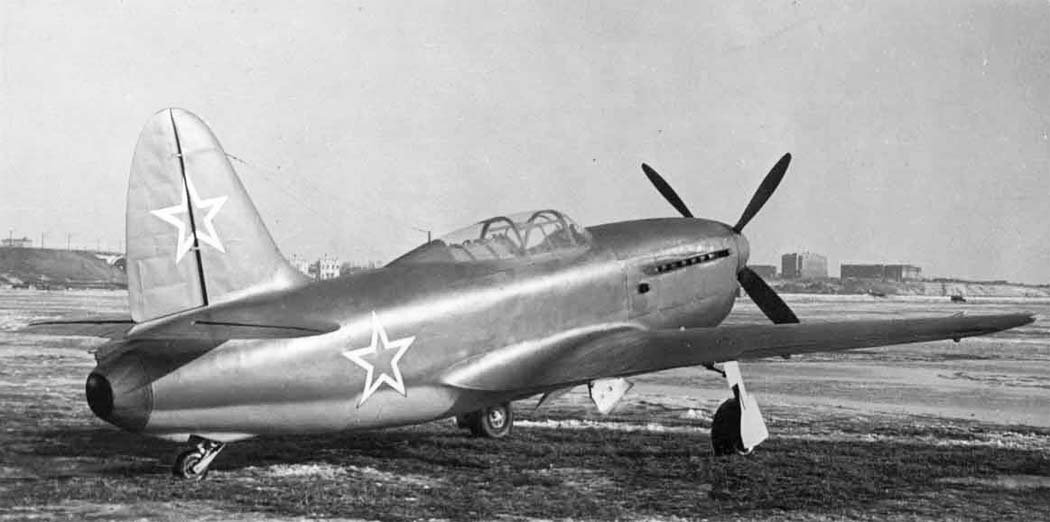
Sukhoi Su-5
The Sukhoi Su-5 originated in Jan 1944 when Sukhoi’s OKB began the design of a mixed-power interceptor. Driven by the appearance of the German Me 262, Soviet planners sought interim high-speed fighters. Sukhoi designed the I-107 using a proven Klimov M-107A V‑12 (1650 hp) piston engine plus a VRDK compressor by K. Kholshchevnikov as a booster. In June 1944 the prototype was officially designated I-107, later renamed Su-5. On 22 May 1944 the State Defence Committee ordered Sukhoi to “design and build” this single-seat interceptor.
- 1944 – Jan–Aug: Preliminary and detailed design of I-107/Su-5 (OKB Sukhoi, Moscow). Official approval was granted in May 1944.
- Nov 1944: Design reviews approved the laminar-wing refinement. Late delivery of the VK-107A engine delayed airframe completion.
- 6 Apr 1945: First flight of Su-5 prototype (test pilot G.I. Komarov). Initial tests to 15 June 1945, when the VK-107A failed. During this pause, the aircraft received a new laminar wing.
- July–Oct 1945: After installing another VK-107A, trials resumed. Top speed of ~793 km/h (with VRDK engaged) was logged at 4,350 m. By 18 Oct 1945 tests halted due to engine life expiring. Planned speeds (~810 km/h at high altitude) were never demonstrated because of these failures.
- Nov 1946: Formal cancellation by Soviet government decree. At this point jet-powered fighters with RD-20/RD-21 engines were already in service, rendering the motorjet concept obsolete.
Airframe and Powerplant
The Su-5 was an all-metal, single-seat, mid-wing monoplane with conventional tail and retractable landing gear. Structurally, it featured a duralumin monocoque fuselage and two-spar wing. Important design details:
- Fuselage & wing: Monocoque duralumin skin (~1–2 mm thick) with one-piece wing of 17.0 m² area. A central duct ran along the fuselage, housing the VRDK compressor, coolant radiator, and combustion chamber in sequence.
- Powerplant: Nose: a Klimov VK-107A liquid-cooled V‑12 piston engine (1,650 hp) driving a 4-blade constant-speed propeller (Ø2.9 m). Rear: a VRDK motorjet compressor by Kholshchevnikov – an axial compressor driven by a long shaft from the VK-107A. The VRDK had no turbine; fuel was injected into compressed air in a combustion chamber just aft of the radiator. This generated extra jet thrust out the tail nozzle (≈2.9 kN for ~10 min of use). The system added ~650 lbf thrust, estimated to raise top speed by ~100 km/h when engaged.
- Cooling & fuel: The VK-107A was water-cooled, with its radiator in the fuselage duct. VRDK’s double-walled combustion chamber was air-cooled via surrounding airflow. Fuel came from two tanks: one in the fuselage behind the cockpit and one in the right wing tip, feeding both engines as needed.
- Avionics: Standard wartime radio and sight; no special systems are recorded. The cockpit had a 10 mm armoured seat back and a 65 mm armoured windshield.
Weights, Dimensions, Armament
- Dimensions: Length 8.51 m; wingspan 10.56 m; height 3.53 m. Wing area ~17 m².
- Weights: Empty ~2,954 kg; loaded ~3,804 kg.
- Armament: One 23 mm NS-23 autocannon (100 rounds) mounted in the engine Vee, firing through the propeller hub, plus two 12.7 mm Berezin UBS machine guns (200 rpg) above the engine.
Performance Estimates
Flight testing provided the only performance data for Su-5, which must be treated cautiously (initial subscale wind-tunnel vs. limited flight results). Summary figures:
- Max speed: ~793 km/h (493 mph) at 4,350 m with VRDK running. (Projected ~810 km/h at 7,800 m with laminar win.) Without the VRDK, speed was ~90–110 km/h lowe.
- Range: ~600 km (370 mi) ferry range. (Limited by fuel capacity and high consumption; actual combat radius likely much smaller.)
- Ceiling: ~12,000 m (39,000 ft).
- Climb: ~5,000 m in 5 min 42 s. High-altitude climb was aided by the VRDK, but only for its short burn period.
Motorjet Concept – Analysis
The Su-5’s VRDK motorjet (Воздушно-Реактивный Двигатель Компрессорный) was essentially a piston-driven turbo-compressor – a rudimentary “jet” without a turbine. When engaged, the VK-107A engine drove an axial compressor (via a long shaft) that fed air into a combustion chamber. Fuel injectors ignited the mix, and the hot gas expanded rearward to produce ~2.9 kN thrust.
Advantages: At the time, the USSR had no production turbojets. The motorjet used existing piston-engine technology to gain a burst of extra power. It effectively acted like a 10-minute afterburner, pushing top speed ~100 km/h higher for short sprints. It was simpler to implement than a true jet engine (no turbine to manufacture).
Limitations: In practice, the VRDK was heavy, complex and inefficient. It burned fuel very fast (approved only ~10 min of use) and added weight/drag (compressor, ducting) that reduced range. Cooling was problematic – engineers had only the thick stainless-steel chamber mass and ram-air for heat dissipation. The result was marginal performance gains: in tests the Su-5 never achieved its design figures, and flight data remained below target. By late 1945, better Soviet turbojets (e.g. Lyulka RD-20) were flying. The Council of Ministers thus judged “combined installations with power take-off to the compressor” as not promising. In short, the motorjet was a stop-gap solution that was quickly superseded once genuine jets appeared.
Photographs of the Sukhoi Su-5


References and Further Reading
- Shavrov, V.B. Istoriya konstruktsiy samoletov v SSSR 1938–1950 (History of Aircraft Designs in the USSR). Mashinostroenie, Moscow, 1994.
- Antonov, V., Gordon, Y., et al. OKB Sukhoi: A History of the Design Bureau and Its Aircraft. Midland, 1996.
- Gordon, Yefim. Early Soviet Jet Fighters: 1944–1950, Red Star Vol.4. Midland, 2001.
- Green, W. & Swanborough, G. The Great Book of Fighters. MBI, 200.
- Gunston, Bill. The Osprey Encyclopedia of Russian Aircraft. Osprey, 1995.
- Sukhoi OKB Museum (archived): “Sukhoi Su-5” page. Sukhoi Company (JSC) – Airplanes – Museum (archived 2006).
- AirWar.ru (Уголок неба) – Su-5 technical page (Russian). Available at airwar.ru.
- Aviastar.org – Su-5 experimental interceptor overview (English).
- Harkins, Hugh. Soviet Mixed Power Experimental Fighter Aircraft. Centurion Publishing, 2018.
- Articles on mixed-power fighters and VRDK engines in Aviation Week and Air Enthusiast.
- Further reading: Gordon & Komissarov, OKB MiG, Vol.1 (MiG-13/I-250 context); Yefim Gordon, Sukhoi Jet Fighters (1985, San Diego Air & Space Museum); and Monino Museum materials on late-war Soviet jets.
Sukhoi Su-5 – Wikipedia
https://en.wikipedia.org/wiki/Sukhoi_Su-5
Су-5 — Википедия
https://ru.wikipedia.org/wiki/%D0%A1%D1%83-5
Sukhoi Su-5 (I-107) – experimental interceptor
http://www.aviastar.org/air/russia/su-5.php
Mikoyan-Gurevich MiG-9 – Wikipedia
https://en.wikipedia.org/wiki/Mikoyan-Gurevich_MiG-9
Yak-15. Turbojet Fighter.
https://airpages.ru/eng/ru/yak15.shtml
Heinkel He 162 Volksjaeger
https://www.airvectors.net/avhe162.html
Messerschmitt Me 262 – Wikipedia