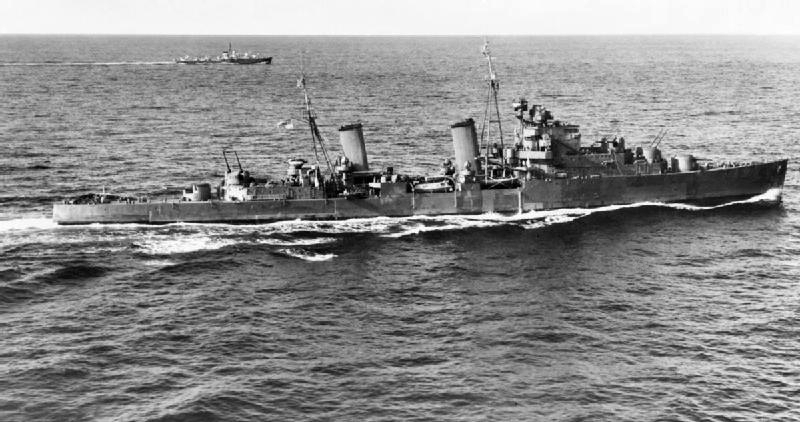
HMS Hermione was a Royal Navy light cruiser of the Dido class, designed to provide fleet air defence and escort protection during the Second World War. Built by Alexander Stephen and Sons at Linthouse on the River Clyde, she was launched on 30 September 1939 and commissioned on 5 March 1941. Although her active career lasted just over fifteen months, Hermione became one of the Royal Navy’s busiest cruisers, serving primarily in the Mediterranean where she escorted convoys, screened capital ships, and supported Allied operations against Axis forces.
The Dido-class cruisers were intended as versatile escorts capable of defending fleets against both aircraft and surface threats. HMS Hermione displaced approximately 5,600 tons standard and was armed with ten 5.25-inch dual-purpose guns mounted in five twin turrets. She also carried light anti-aircraft weapons, six 21-inch torpedo tubes, radar, and a limited anti-submarine capability, making her well suited to the demanding escort role.
Soon after entering service, Hermione joined the Mediterranean Fleet. In May 1941 she temporarily served with the Home Fleet during the hunt for the German battleship Bismarck, escorting major Royal Navy units involved in the operation before returning to the Mediterranean.
Throughout her career, Hermione escorted numerous convoys carrying vital troops, fuel, ammunition, and supplies through some of the most dangerous waters of the war. She participated in several major convoy operations, including Operation Substance in July 1941 and Operation Halberd in September 1941. During Operation Halberd, she formed part of the powerful escort protecting nine merchant ships bound for the besieged island of Malta. Despite repeated attacks by Axis aircraft and submarines, the convoy successfully delivered most of its cargo, providing Malta with supplies essential for its continued resistance.
One of Hermione‘s most notable actions occurred on 2 August 1941 while escorting a convoy to Malta. An aircraft from the aircraft carrier Ark Royal spotted the Italian submarine Tembien on the surface and reported its position. Directed towards the target, Captain Geoffrey Oliver ordered Hermione to attack before the submarine could dive. Travelling at high speed, the cruiser rammed Tembien amidships, cutting the submarine in two and sinking her with all hands. Hermione sustained only minor damage to her bow and was able to continue her mission.
During late 1941 and early 1942, Hermione remained continuously employed escorting Malta convoys, screening aircraft carriers during aircraft ferry operations, and protecting fleet units in the Eastern Mediterranean. Her powerful anti-aircraft armament and modern radar made her one of the Royal Navy’s most valuable escort cruisers, although the increasing effectiveness of German and Italian submarines made every operation increasingly hazardous.
Her final mission came during Operation Vigorous in June 1942, another major attempt to reinforce Malta. On 16 June, while escorting the convoy south of Crete, Hermione was intercepted by the German submarine U-205. A spread of torpedoes struck the cruiser on her starboard side, causing catastrophic damage. She capsized and sank within minutes. Eighty-eight members of her crew lost their lives, while the majority of the ship’s company were rescued by accompanying destroyers.
Photographs of HMS Hermione
Operation Halberd
HMS Hermione with her 10 x 5.25-inch guns elevated, in the Mediterranean in September 1941HMS Edinburgh with HMS Hermione and HMS Euryalus on convoy duty during Operation Halberd in September 1941Views of the convoy for Operation Halberd seen from HMS Hermione. September 1941HMS Euryalus astern of HMS Hermione during Operation HalberdHMS Euryalus astern of HMS Hermione during Operation HalberdViews of the convoy of Operation Halberd from HMS Hermione. Sep 1941HMS Hermione on her way through the Mediterranean to Malta during Operation HalberdA view of HMS Ark Royal and HMS Nelson from HMS Hermione. Sep 1941 during Operation HalberdHMS Hermione escorts HMS Ark Royal and HMS Nelson, Sept 1941Another view of the convoy during Operation Halberd proceeding through the Mediterranean Sep 1941HMS Ark Royal and HMS Rodney seen over the torpedo tubes of HMS Hermione. Sep 1941HMS Ark Royal and HMS Rodney seen over the torpedo tubes of HMS Hermione. Sep 1941HMS Ark Royal and HMS Rodney seen over the torpedo tubes of HMS Hermione. Sep 1941HMS Ark Royal and HMS Rodney seen from HMS Hermione. Sep 1941A close-up of remains of a shot down Italian torpedo bomber seen from HMS Hermione during Operation Halberd. Sep 1941
HMS Hermione refuelling from RFA Dingledale
HMS Hermione refuelling from RFA Dingledale. 30 January 1942The tanker RFA Dingledale passing the ship’s hose by means of a grass line with tow hawsers attached to HMS Hermione. 30 January 1942HMS Hermione refuelling from RFA Dingledale. 30 January 1942Fuel pipes from RFA Dingledale to HMS Hermione. 30 January 1942HMS Hermione refuelling from RFA Dingledale. 30 JANUARY 1942. Ahead of the tanker HM Submarine Clyde acting as an escortHMS Hermione refuelling from RFA Dingledale. 30 January 1942
Operation Slipper
Left to right HMS Argus, Eagle and Malaya seen under the guns of HMS Hermione. Spitfire are being flown off Eagle for Malta 7 March 1942Supermarine Spitfire (right) after taking off from HMS Eagle 7 March 1942
Armament of HMS Hermione
HMS Hermione’s 5.25 gunsHMS Ramillies and destroyers entering French Bay Harbour Madagascar after the surrender. 7 May 1942HMS Ark Royal and HMS Rodney seen from HMS Hermione. Sep 194120 mm Oerlikon gun on board HMS Hermione, showing a naval gunner utilising the rubber shoulder rests for high-angle firingA naval gunner on HMS Hermione utilising the rubber shoulder rests for high-angle firing of a 20mm OerlikonHMS Ark Royal and HMS Rodney seen over the torpedo tubes of HMS Hermione. Sep 1941HMS Ark Royal and HMS Rodney seen over the torpedo tubes of HMS Hermione. Sep 1941HMS Ark Royal and HMS Rodney seen over the torpedo tubes of HMS Hermione. Sep 1941
The Sinking of Tembien
Vice Admiral Sir James Somerville (centre) on HMS Hermione congratulates Captain Oliver (left) and Lieut Wainright (navigator ) on their DSO. Both officers were decorated for sinking an Italian submarine, by ramming. 6 January 1942Admiral Sir James Somerville, KCB, DSO, leaving HMS Hermione. Sep 1941Vice Admiral Sir James Somerville, KCB, DSO, acknowledging cheers after leaving HMS Hermione. 6 January 1942
Escorting the Damaged Submarine to the Azores
A view of Ponta Delgado, the central port in the Azores, belonging to Portugal. HMS Hermione was escorting the storm damaged submarine HMS Regent for 24 hours of repairs. 24 January 1942Captain M M Sarmento Rodriguiz of the Portuguese destroyer Lima shaking hands with Captain G N Oliver, of HMS Hermione when the Portuguese Captain made a courtesy call.
Miscellaneous Photos of HMS Hermione
A whaler transferring a sailor with a medical emergency from the destroyer HMS Zulu to HMS Hermione, 17 November 1941Crashed Bristol Beaufort aircraft photographed from the HMS Hermione off GibraltarHMS Hermione in 1942