
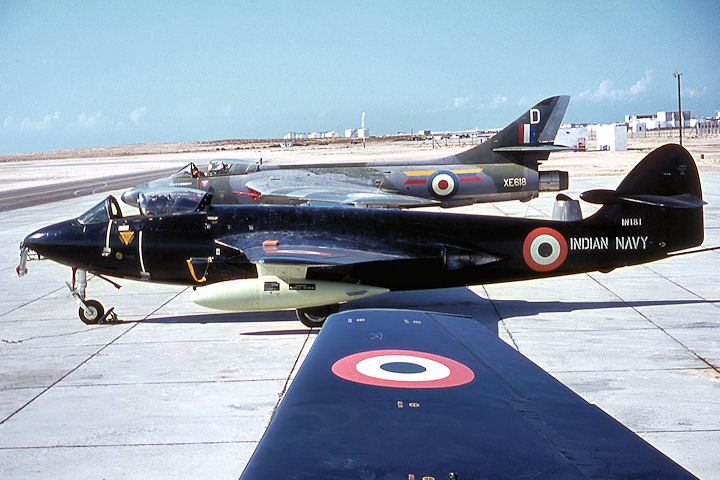
Hawker Sea Hawk in Indian Service
The Hawker Sea Hawk was one of the most important naval combat aircraft to serve with the Indian Navy during the formative years of India’s carrier aviation capability. Acquired in the late 1950s, the Sea Hawk provided the Indian Navy with a modern jet-powered fighter-bomber and became the principal combat aircraft of the fleet air arm for more than two decades.
India purchased Sea Hawk FGA.6 fighter-ground attack aircraft and a small number of trainer variants from the United Kingdom. Deliveries began in 1959, and the aircraft entered service with the newly formed Indian Naval Air Squadron 300 (INAS 300), known as the “White Tigers.” The Sea Hawk was selected to operate from India’s first aircraft carrier, INS Vikrant, which had been acquired from Britain and commissioned into Indian service in 1961. The aircraft represented a major advance over piston-engined naval aircraft, giving the Indian Navy an effective platform for fleet defence, maritime strike, and ground attack missions.
The Sea Hawk was a conventional but highly reliable naval jet. Powered by a Rolls-Royce Nene turbojet engine, it possessed good handling characteristics and was well suited to carrier operations. Although not supersonic, it could carry a useful weapons load that included bombs, rockets, and cannon armament. Indian Sea Hawks were primarily employed in the strike role, supporting naval operations and providing offensive capability against enemy surface and shore targets.
The aircraft’s most significant combat service occurred during the Indo-Pakistani War of 1971. During this conflict, INS Vikrant operated in the Bay of Bengal, enforcing a naval blockade of East Pakistan (now Bangladesh). Sea Hawks from INAS 300 flew numerous sorties against Pakistani military installations, ports, shipping, and coastal infrastructure. Operating from the carrier’s deck, they attacked targets at Chittagong, Cox’s Bazar, Khulna, and Mongla. These strikes contributed significantly to the isolation of Pakistani forces in the east by disrupting supply lines and limiting maritime movement.
Throughout the campaign, the Sea Hawks demonstrated their effectiveness as naval strike aircraft. They successfully attacked merchant vessels, gunboats, fuel storage facilities, and harbour installations. Despite operating from a relatively small carrier and in challenging tropical conditions, the aircraft maintained a high operational tempo. The absence of significant aerial opposition in the eastern theatre allowed them to focus on strike missions, where their four 20 mm cannon and rocket armament proved particularly valuable.
Following the 1971 war, the Sea Hawk continued in Indian service throughout the 1970s. However, by this period the design was becoming increasingly obsolete compared with newer generations of jet aircraft. Maintenance requirements grew, and the aircraft’s performance no longer matched contemporary naval aviation standards. Nevertheless, the Sea Hawk remained dependable and continued to provide valuable operational experience for Indian naval aviators.
The type was gradually replaced by the British-built Sea Harrier beginning in the early 1980s. The last Indian Sea Hawks were retired from frontline service in 1983, ending nearly twenty-five years of operation. Their retirement marked the conclusion of the Indian Navy’s first era of carrier-borne jet aviation.


