
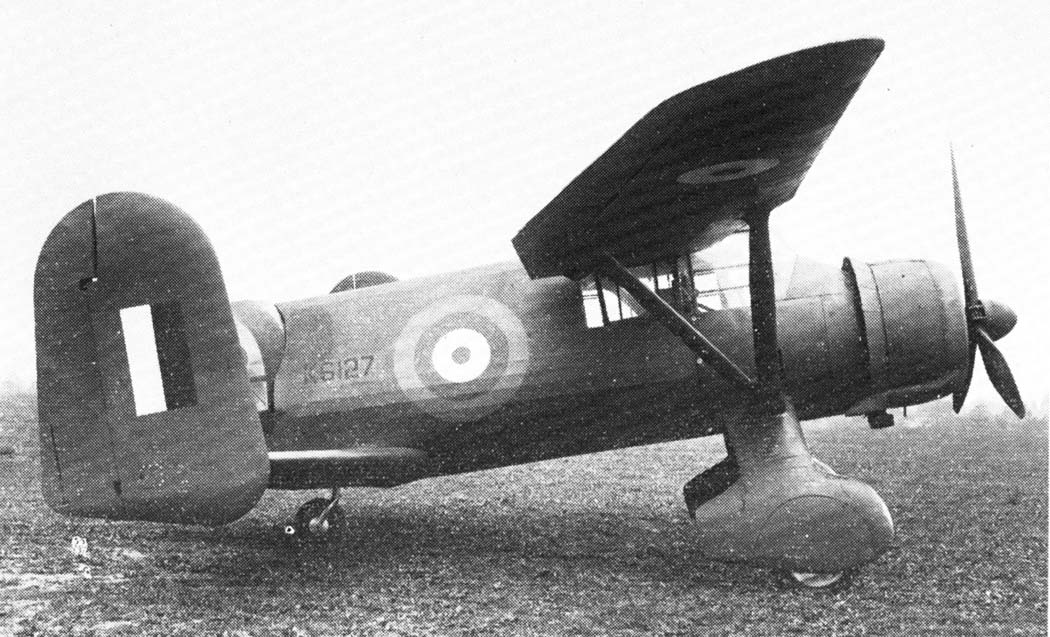
Westland P.12 Delanne Lysander (Wendover)
The Westland P.12 Delanne Lysander (sometimes referred to as the Wendover) was one of the most unusual experimental aircraft developed in Britain during the Second World War. Created by modifying the prototype of the Westland Lysander, the P.12 was an attempt to solve a major weakness of the Lysander: its poor defensive armament and vulnerability to enemy fighters. The aircraft emerged during the invasion scare of 1940, when Britain feared a German landing on its southern coast and sought new methods of attacking invasion barges and troop concentrations.
The design was based on ideas developed by French engineer Maurice Delanne, who advocated a tandem-wing configuration. Instead of using a conventional tailplane, Delanne aircraft employed a second lifting wing at the rear. Westland engineers believed this arrangement could support the weight of a powered gun turret mounted at the back of the aircraft without causing dangerous centre-of-gravity problems. To explore the concept, the prototype Lysander K6127 was extensively rebuilt into what became known as the P.12 Delanne.
The aircraft retained the standard Lysander’s forward fuselage, engine and main wing, but the rear fuselage was completely redesigned. A broad, constant-section rear fuselage supported a low-mounted secondary wing with twin vertical fins. This arrangement left space for a four-gun power-operated turret at the extreme rear of the aircraft. Both Frazer Nash and Boulton Paul turret designs were considered, although most flight testing was conducted with a weighted mock-up rather than an operational turret.
The intended role of the P.12 was low-level ground attack and “beach strafing.” In the event of a German invasion, the aircraft would have used its heavy rear armament to attack barges and troops while maintaining strong defensive fire against pursuing fighters. Some proposals also included fitting 20 mm cannon for additional offensive capability. The unusual tandem-wing layout offered a wide centre-of-gravity range and maintained acceptable handling despite the heavy armament carried far aft.
Flight trials began in July 1941. By then, however, the immediate threat of invasion had largely disappeared following Germany’s shift of attention to the Soviet Union. Although reports indicated that the aircraft flew surprisingly well, the requirement that had inspired its creation no longer existed. As a result, the P.12 remained an experimental one-off and never entered production.


