
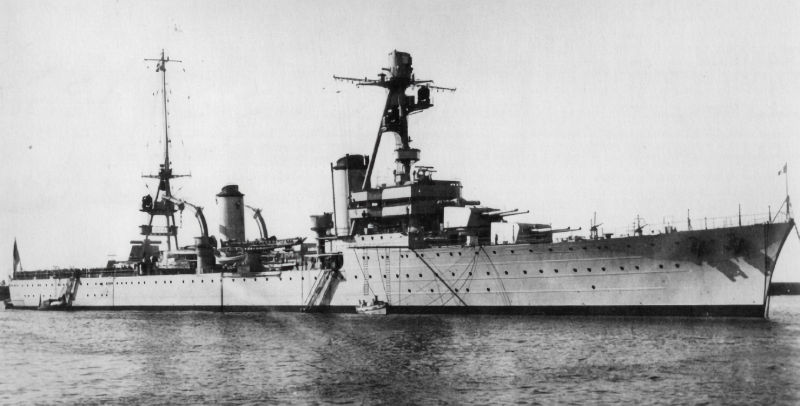
Dupleix (1930) French Heavy Cruiser
The French heavy cruiser Dupleix was the fourth and final member of the Suffren class of treaty cruisers built for the French Navy during the interwar period. Named after the eighteenth-century French colonial administrator Joseph François Dupleix, she represented the culmination of French efforts to improve cruiser protection while remaining within the restrictions imposed by the Washington Naval Treaty. Ordered in 1929, she was laid down at Brest on 14 November 1929, launched on 9 October 1930, and completed in July 1932 before entering full service in 1933.
Like her sister ships, Dupleix carried a powerful main armament of eight 203 mm guns mounted in four twin turrets, giving her considerable firepower against enemy cruisers. She was also armed with eight 90 mm dual-purpose guns, light anti-aircraft weapons, six 550 mm torpedo tubes, and carried reconnaissance floatplanes launched from two catapults. The cruiser displaced approximately 10,000 tons standard, measured 194 metres in length, and was capable of speeds of around 32 knots.
Dupleix differed significantly from the earlier members of the Suffren class. French naval architects had become increasingly concerned about the vulnerability of treaty cruisers and sought to improve protection without greatly increasing displacement. As a result, Dupleix featured a strengthened internal armoured caisson protecting her machinery and magazines, with armour thickness increased to 60 mm. This gave her substantially better protection than earlier French heavy cruisers and made her arguably the best-protected ship of the Suffren class. The design lessons learned from Dupleix would later contribute to the development of the highly regarded heavy cruiser Algérie.
During the 1930s, Dupleix served primarily with the French Mediterranean Fleet based at Toulon. Like many French cruisers of the period, she participated in training exercises, diplomatic visits, and patrol duties. She also took part in the international naval patrols established during the Spanish Civil War to enforce non-intervention agreements and protect maritime traffic in the western Mediterranean.
At the outbreak of the Second World War in September 1939, Dupleix was assigned to operations against German commerce raiders. She participated in the search for the German pocket battleship Admiral Graf Spee in the Atlantic and Indian Oceans as part of French hunting groups. Although these operations failed to bring her into combat with the German raider, they demonstrated the strategic value of France’s heavy cruisers in long-range patrol and interception roles.
Dupleix saw her only significant combat action in June 1940. Alongside the heavy cruisers Foch, Colbert, and Algérie, she participated in Operation Vado, a bombardment of Italian coastal targets near Genoa and Vado Ligure following Italy’s entry into the war. The attack caused limited damage but marked one of the few offensive naval operations conducted by the French fleet during the brief Franco-Italian campaign.
Following the French armistice with Germany in June 1940, Dupleix remained at Toulon under the control of Vichy France. She stayed largely inactive until November 1942, when German forces moved to occupy the unoccupied zone of France. To prevent capture of the fleet, French sailors scuttled their ships at Toulon on 27 November 1942. Dupleix was among the vessels deliberately sunk. She was later raised by the Italians but never returned to service. After the war, her wreck was scrapped in 1951.


