
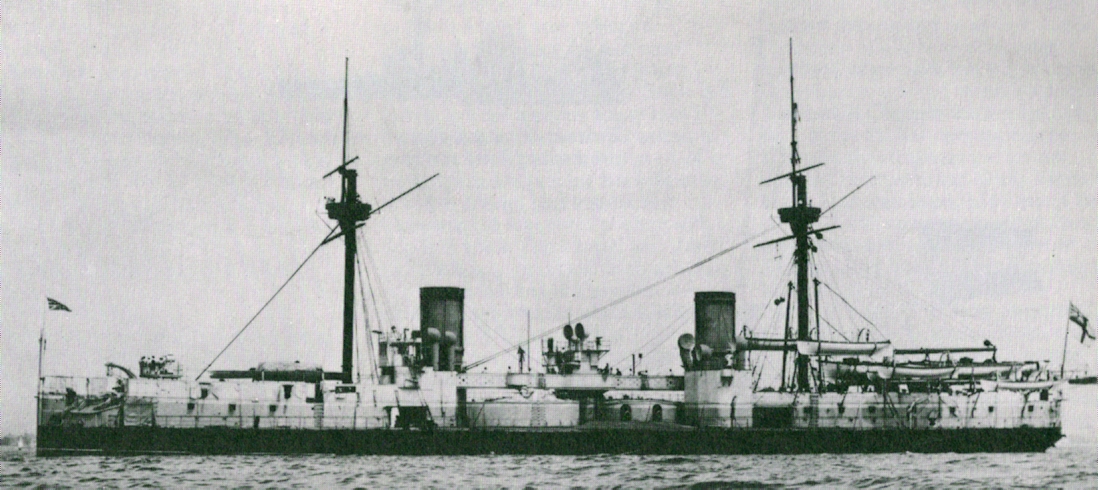
HMS Inflexible (1876) Ironclad Battleship
Laid down at Portsmouth in 1874 and launched two years later, HMS Inflexible (1876) was designed by the Chief Constructor of the Navy, Nathaniel Barnaby. Her design was in response to the perceived threat posed by powerful Italian ironclads then under construction, particularly the Duilio and Dandolo. Barnaby’s response was a vessel that pushed the boundaries of contemporary shipbuilding in almost every respect, though the compromises required to achieve her formidable protection and armament would generate controversy for years to come.
At 11,880 tons displacement and 344 feet in length, Inflexible was the heaviest warship in the world at the time of her completion in 1881. Her most striking feature was her armour. The central citadel, a box-like armoured redoubt amidships, was protected by iron plating 24 inches thick, the heaviest ever fitted to a Royal Navy vessel. This belt of armour was intended to keep the ship afloat and her guns in action even if the unprotected sections of the hull were riddled with shellfire. Beyond the citadel, the bow and stern were left comparatively exposed, relying instead on a watertight cellular structure packed with cork and coal to maintain buoyancy should those sections be flooded. It was an ingenious if deeply debated solution, and the naval architect Edward Reed publicly condemned the design as dangerously unstable.
Her armament was equally formidable. Four 81-ton muzzle-loading guns were mounted in two turrets arranged en echelon on the centreline, a configuration that allowed a degree of fore-and-aft fire on both sides of the ship. These were the heaviest guns yet carried by a Royal Navy vessel, each capable of firing a projectile weighing over 1,600 pounds. Loading such weapons was a slow and laborious process, and the rate of fire was necessarily low, but the destructive potential of a single round was considered sufficient justification.
Inflexible also pioneered several technological innovations that would become standard across the fleet in subsequent years. She was among the first warships in the Royal Navy to be fitted with electric lighting, powered by generators driven off the main engines. She also carried torpedo tubes, reflecting the growing naval interest in this new class of weapon during the 1870s and 1880s. Her compound steam engines gave her a top speed of around 14 knots, respectable for a vessel of her size and armoured weight.
She saw active service during the bombardment of Alexandria in July 1882, firing her guns against Egyptian shore batteries during the British intervention that followed Urabi Pasha’s nationalist uprising.
Criticised throughout her service life for her unconventional design philosophy, Inflexible was placed on the reserve list and eventually sold for breaking in 1903.


