
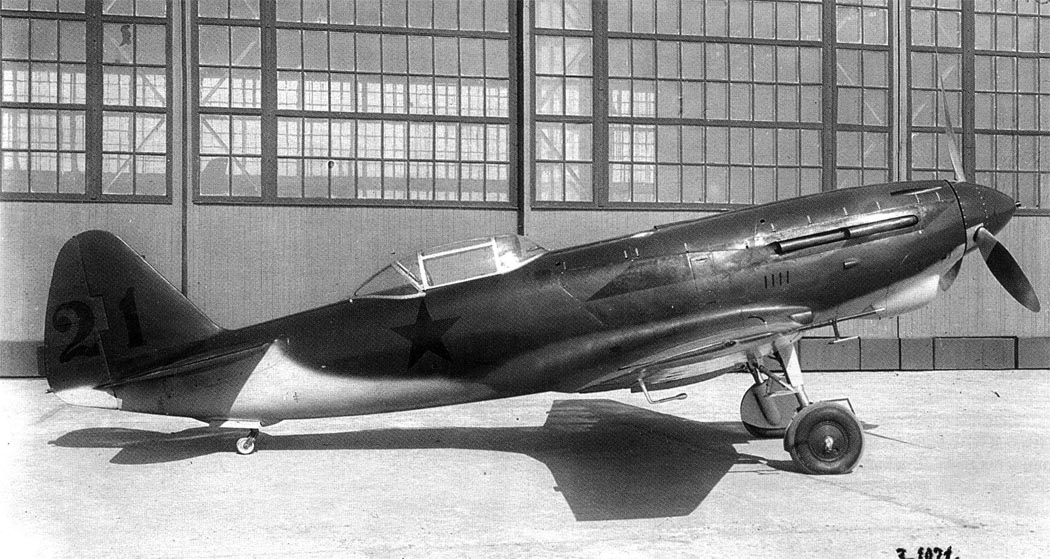
Pashinin I-21 Fighter Prototype
The Pashinin I-21 was an experimental Soviet fighter developed in 1939–1941 as a potential successor to the aging Polikarpov I-16. Designed by Mikhail M. Pashinin, formerly a deputy to Nikolai Polikarpov, the aircraft reflected lessons learned from Soviet air combat during the Spanish Civil War and the Nomonhan clashes against Japan. The Soviet Air Force sought a modern monoplane fighter capable of higher speed, heavier armament, and improved pilot visibility while retaining good manoeuvrability.
The I-21 was a low-wing, single-seat monoplane of mixed construction. Its forward fuselage consisted of welded steel tubing covered with duralumin panels, while the rear fuselage was a wooden monocoque. The aircraft featured retractable landing gear, an enclosed cockpit with an unusually streamlined canopy providing excellent all-round visibility, and a laminar-flow wing designed to reduce drag. The original design called for the powerful 1,300 hp Klimov M-107 engine, but delays in that engine’s development forced the prototypes to use the less powerful 1,050 hp Klimov M-105P. Armament comprised a 20 mm ShVAK cannon firing through the propeller hub and two 7.62 mm ShKAS machine guns, although later prototypes experimented with a more powerful 23 mm BT-23 cannon.
The first prototype flew on 18 May 1940 and demonstrated promising speed, achieving over 480 km/h at sea level and approximately 570 km/h at altitude. However, flight testing revealed significant longitudinal instability and poor landing characteristics. Engineers responded by redesigning the wings and tail on the second and third prototypes, incorporating revised wing shapes, clipped wingtips, and improved tail surfaces. Although these changes improved handling, the aircraft still required unusually long take-off and landing distances and remained demanding to fly.
Ultimately, the Soviet authorities concluded that the I-21 offered insufficient advantages over fighters already entering production, notably the Yakovlev Yak-1 and Mikoyan-Gurevich MiG-3. Only three prototypes were completed before the programme was cancelled in 1941.


