
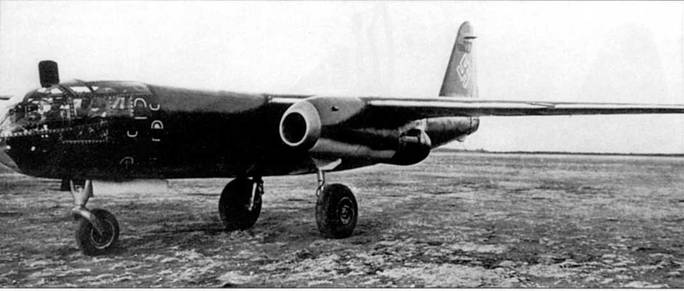
Arado Ar 234
The Arado Ar 234 “Blitz” was the world’s first operational jet-powered bomber and reconnaissance aircraft. Designed by Arado Flugzeugwerke under Walter Blume, it was conceived initially as a long-range reconnaissance machine that could not be intercepted by conventional fighters. Its speed, advanced aerodynamics, and jet propulsion put it years ahead of its contemporaries, though it entered service too late to alter the course of the war.
Development and Prototypes
The initial prototypes faced one major design challenge: no suitable lightweight, retractable undercarriage was available when the first airframes were completed. To save weight and maximise internal fuel capacity, Arado engineers used a takeoff trolley and landing skid system.
- The aircraft would launch from a jettisonable wheeled trolley.
- For landing, it deployed retractable skids from the fuselage and wings.
This worked in testing but proved impractical for operational service—recovering the aircraft was difficult, the skids often damaged airframes, and the aircraft could not rapidly redeploy from forward bases. From the V6 prototype onward, the Ar 234 was fitted with a tricycle landing gear, which became standard for all production aircraft.
Production Versions
Ar 234B – Reconnaissance and Bomber
- The first production model, introduced late 1944.
- Equipped with a proper tricycle undercarriage.
- Powered by 2 × Junkers Jumo 004B turbojets.
- Sub-variants:
- B-1: Long-range reconnaissance, fitted with Rb 50/30 cameras.
- B-2: Light bomber, carrying up to 1,500 kg of bombs.
- Armament: None in most B-1s; bomber versions sometimes carried 2 × MG 151/20 cannon in the rear fuselage for defence.
- Operational Use: Proved highly effective as a reconnaissance platform—fast enough to evade Allied interceptors over Normandy, the Ardennes, and the Ruhr.
Ar 234C – Four-Engine Versions
- Developed due to the limited thrust and reliability of the Jumo 004.
- Fitted with 4 × BMW 003 turbojets in paired nacelles.
- Much improved performance: speeds up to 870 km/h and better climb rates.
- Planned subtypes:
- C-1: Reconnaissance.
- C-2: Bomber.
- C-3: Fighter-bomber.
- Only a few completed before war’s end.
Ar 234D (Projected)
- Proposed advanced version with HeS 011 turbojets.
- Never built.
Ar 234P – Night Fighter Proposals
- A series of paper projects to adapt the Ar 234 as a jet night fighter.
- Planned to carry radar (FuG 218 Neptun or FuG 220 Lichtenstein) and heavy forward-firing cannon.
- None progressed past the planning stage.
Operational Use
- Reconnaissance: Ar 234B-1s provided invaluable high-speed reconnaissance over Allied positions, especially during the Ardennes Offensive and in the defence of the Reich.
- Bomber: Used in small numbers against targets such as the Remagen bridgehead in March 1945, though accuracy was limited by primitive sighting methods.
- Night Fighter Trials: Short-lived, as described above.
Fuel shortages, pilot inexperience, and the small number of aircraft delivered (about 210 in total) limited the Ar 234’s impact.
Trial Use as a Night Fighter
In late 1944 and early 1945, the Luftwaffe carried out experimental trials with the Ar 234B in a night fighter role. A small number of aircraft were fitted with radar equipment and flown by experienced night fighter units (notably Kommando Bonow and later Kommando Sperling).
The aircraft’s speed made it an intriguing prospect, but its unsuitability soon became clear:
- No onboard radar operator: The single-seat cockpit left the pilot overburdened.
- Limited radar installation space: Fitting bulky early radar antennae reduced speed and worsened handling.
- High speed vs. interception: While fast, the Ar 234 was too quick to loiter effectively in bomber streams, making controlled interceptions difficult.
Only a handful of sorties were flown, and no confirmed victories were achieved. The trials were soon abandoned, with focus shifting to the Me 262B-1a/U1, which was a more practical two-seat jet night fighter.
Photograph Menu
- Arado Ar 234 V1
- Arado Ar 234 V2
- Arado Ar 234 V3
- Arado Ar 234 V4
- Arado Ar 234 V5
- Arado Ar 234 V6
- Arado Ar 234 V7
- Arado Ar 234 V8
- Arado Ar 234 V9
- Arado Ar 234 V13
- Arado Ar 234 V17
- Arado Ar 234 V19
- Arado Ar 234 V20
- Arado Ar 234 V21
- Arado Ar 234 B0
- Arado Ar 234 B1
- Arado Ar 234 B2
- Arado Ar 234 C1
- Arado Ar 234 C2
- Arado Ar 234 Captured by the British
- Arado Ar 234 Captured by the US
- Miscellaneous Arado Ar 234 Photos
Arado Ar 234 V1
The first prototype of the Ar 234; powered by two Junkers Jumo 004 jet engines, it used a droppable take-off trolley and landing skids. First flight took place on 30 July 1943. This marked the beginning of jet bomber flight tests.


Arado Ar 234 V2
The second prototype, similar in configuration to V1, suffered engine and instrumentation failures and crashed on 2 October 1943, killing the pilot.


Arado Ar 234 V3
The third prototype retained the skid/trolley gear but incorporated a brake-parachute system for landing tests.


Arado Ar 234 V4
Similar to V2, part of the early A-series (Ar 234A) with trolley and skids.


Arado Ar 234 V5
Incorporated updated Jumo 004B engines and tweaks to the take-off trolley; flew in 1943–44 as part of early prototype evaluations.


Arado Ar 234 V6
A four-engine prototype using four BMW 003 turbojets in separate nacelles under the wings — an early step toward the Ar 234C series.


Arado Ar 234 V7
This prototype closely resembled later B-series aircraft but still used the A-series skid undercarriage; it was used in reconnaissance development and saw active service tests.
Arado Ar 234 V8
Another quad-engine prototype, but with engines paired in twin nacelles under each wing. This configuration influenced the C-series designs.


Arado Ar 234 V9
The first Ar 234B prototype with fully retractable tricycle landing gear; V9 also featured pylons for external stores and bomb tests. It first flew on 12 March 1944.


Arado Ar 234 V13
A B-series prototype fitted with four BMW 003 engines in twin nacelles (a precursor to C-series). It flew mid-war but suffered engine reliability issues.


Arado Ar 234 V17
Another prototype used to test two BMW 003 engines with RATO rocket assistance and other performance variables.

with ETC503A-1 Bomb Racks


Arado Ar 234 V19
Significant as the first prototype of the Ar 234C series, powered by four BMW 003A engines and introducing the improved airframe intended for production C variants. First flight October 1944.


Arado Ar 234 V20
A follow-up C-series prototype with a pressurized cockpit, enhancing high-altitude performance research. It was first flown in early November 1944.

Arado Ar 234 V21
Part of ongoing Ar 234C development; many in this V21–V30 subset explored refined airflow and wing modifications, though none entered mass production.


Arado Ar 234 B0
Pre-production aircraft (about 20 built), serving as transitional units between prototype and operational versions; most lacked full pressurization or standard equipment.


Arado Ar 234 B1
Intended primarily as a reconnaissance aircraft, configured to carry photographic cameras.

Arado Ar 234 B2
The main production bomber variant, nicknamed Blitz. It carried bombs externally on racks beneath engine nacelles due to the slender fuselage. About 186 examples were built and some flew combat missions into 1945.


Arado Ar 234 B-2N

Arado Ar 234 C1
A four-engine reconnaissance variant of the C-series, with cameras and pressurized cabin features.

Arado Ar 234 C3
The four-engine bomber variant of the C series, combining BMW 003 turbojets with the B-2’s mission role.


Arado Ar 234 Captured by the British


Arado Ar 234 Captured by the US


Fiesler Fi103 Deichselschlepp
Fiesler Fi 103 Deichselschlepp “Air Trailer” was a highly modified Fiesler Fi 103 (V1 flying bomb). It was a 2800 litre towed fuel tank intended to increase the range of the Arado Ar 234..


Arado Ar 234 Captured by the Soviet Union

Miscellaneous Arado Ar 234 Photos


