
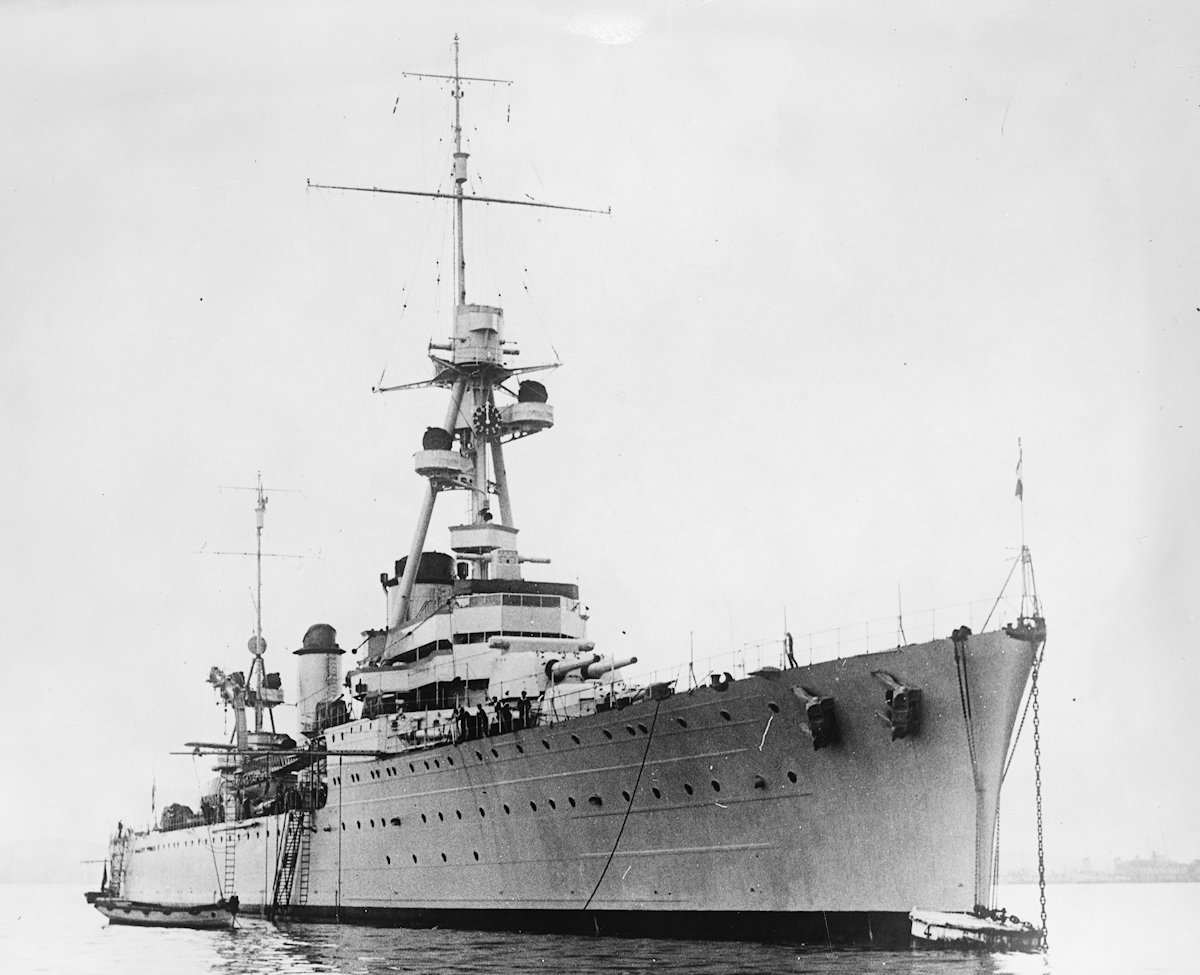
Colbert (1928) French Heavy Cruiser
The French heavy cruiser Colbert (1928) was the second ship of the four-vessel Suffren class and represented the continued evolution of France’s Washington Treaty cruiser designs. Named after the seventeenth-century French statesman Jean-Baptiste Colbert, the cruiser combined powerful offensive armament with high speed, although like many treaty cruisers of the period, her armour protection was compromised to remain within the 10,000-ton displacement limit.
Ordered under the 1926 naval programme, Colbert was laid down at the Brest Naval Arsenal on 12 June 1927, launched on 20 April 1928, and entered service in 1931. Although based on the earlier Suffren, she featured numerous improvements. Her bridge structure was redesigned, her aircraft facilities were relocated between the funnels, and her anti-aircraft battery was upgraded with eight 90 mm guns replacing the earlier 75 mm weapons carried by her predecessor. She displaced approximately 10,000 tons standard, measured 194 metres in length, and was powered by three Rateau-Bretagne geared steam turbines producing nearly 89,000 shaft horsepower, giving a designed top speed of 32 knots.
Her main armament consisted of eight 203 mm (8-inch) guns mounted in four twin turrets, supported by six 550 mm torpedo tubes. For aerial reconnaissance she carried up to three floatplanes, initially Gourdou-Leseurre GL-810s and later Loire 130 aircraft, launched by two catapults. Armour protection remained relatively light, with a belt of only 50 mm and a 25 mm armoured deck, reflecting the design compromises imposed by the naval treaties.
During the interwar years Colbert served primarily with the Mediterranean Fleet based at Toulon. In 1935 she underwent a major refit at Lorient before participating in the international neutrality patrols off the Spanish coast during the Spanish Civil War. These patrols were intended to prevent foreign intervention, although they often proved politically complicated and only partially effective.
At the outbreak of the Second World War, Colbert formed part of the French Navy’s 1st Cruiser Squadron. After Italy entered the war in June 1940, she participated in the French naval bombardment of Genoa during Operation Vado on 14 June 1940. Alongside other heavy cruisers, she shelled military and industrial targets along the Ligurian coast, although poor visibility and the short duration of the operation limited its overall effectiveness.
Following the French Armistice in June 1940, Colbert remained at Toulon under the control of the Vichy French Navy. During 1941 her anti-aircraft armament was substantially strengthened in recognition of the growing air threat, but she otherwise saw little operational activity. Like many Vichy warships, she remained largely inactive while political negotiations between Germany and Vichy France continued.
Her career ended dramatically on 27 November 1942 during the Scuttling of the French fleet at Toulon. As German forces moved to seize the French fleet during Operation Anton, Colbert’s crew carried out pre-arranged demolition plans, scuttling the cruiser and detonating her magazines to prevent capture. The wreck remained in Toulon harbour throughout the remainder of the war before being broken up for scrap in 1948.


