
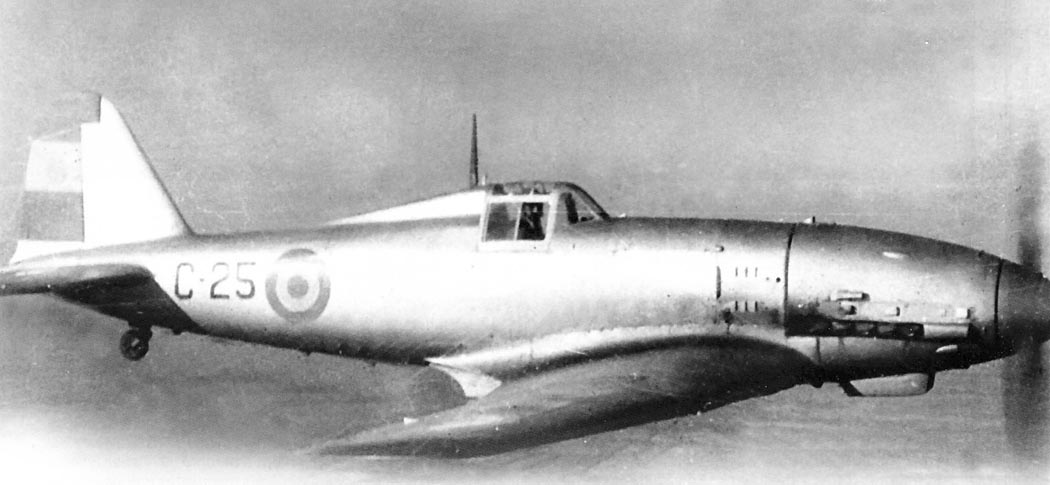
Fiat G.55 Centauro in Argentine Service
The Fiat G.55 Centauro entered Argentine service in the immediate post-war period as part of a broader effort by the Fuerza Aérea Argentina to modernise its fighter arm with high-performance European designs. Originally designed by Giuseppe Gabrielli for Fiat during the Second World War, the G.55 had earned a strong reputation for its aerodynamic refinement, heavy armament, and effective use of the Daimler-Benz DB 605 inline engine. After 1945, Fiat resumed limited production in improved export forms, notably the G.55A single-seat fighter and the G.55B two-seat conversion trainer.
Argentina purchased 30 Fiat G.55A fighters and 15 G.55B trainers in 1947. The aircraft were shipped from Italy in crates and assembled locally, entering service later that year. They were assigned primarily to fighter units based at El Plumerillo in Mendoza, where they were used both as operational interceptors and as advanced trainers for pilots transitioning to modern, high-performance monoplanes. In the late 1940s the G.55 represented a significant qualitative improvement over many aircraft previously operated by Argentina, offering a top speed in excess of 600 km/h, good high-altitude performance, and harmonised cannon and machine gun armament suited to contemporary fighter doctrine.
In practice, however, the Centauro’s Argentine career was constrained by logistics. The DB 605 engine, though powerful, required careful maintenance and a steady supply of spare parts. Italy’s post-war industrial limitations and the relatively small production run of the G.55 complicated the supply chain. As a result, serviceability rates declined steadily. A number of aircraft were lost in flying accidents between 1948 and 1954, further reducing the effective strength of the fleet. Although pilots generally regarded the type favourably for its stability and manoeuvrability, the maintenance burden limited sustained operational readiness.
By 1954 the combination of attrition, spare-parts shortages, and the availability of more modern aircraft led to the withdrawal of the Centauro from Argentine service. The type’s tenure was therefore relatively brief, spanning roughly seven years. While it did not serve in combat under Argentine colours, the G.55 played a transitional role in elevating pilot training standards and exposing the Fuerza Aérea Argentina to late-war European fighter technology during a formative period in its post-war development.
Accidents and Incidents
A high number of Centauro airframes were lost in accidents during service (likely exacerbated by maintenance challenges and frequent flight operations). Notable examples include:
- C-05: Crashed trying to land near Balcarce (22 Feb 1948), pilot killed.
- C-34: Destroyed on landing at El Plumerillo (19 Jul 1949).
- C-13 / C-20 collision: Ground incident at Morón Air Base (3 Jul 1951) with damage but no fatalities.
- C-28: Fatal crash during aerobatics near El Borbollón (15 Oct 1953).
- March 1954 Incidents: Several G.55 and G.55B aircraft damaged at El Plumerillo (22 Mar 1954).


References
Angelucci, E., & Matricardi, P. (1978). World Aircraft: World War II, Volume I. London: Sampson Low.
Green, W. (1961). War Planes of the Second World War, Volume Two: Fighters. London: Macdonald.
Sgarlato, N. (2005). Fiat G.55 Centauro. Parma: Delta Editrice.
Taylor, J. W. R. (ed.). (1969). Jane’s All the World’s Aircraft 1969–70. London: Jane’s Publishing Company.
Interliggi, O. El Fiat G.55 Centauro en la Fuerza Aérea Argentina – AeroAr (2025).
Aviation Safety Network ASN