
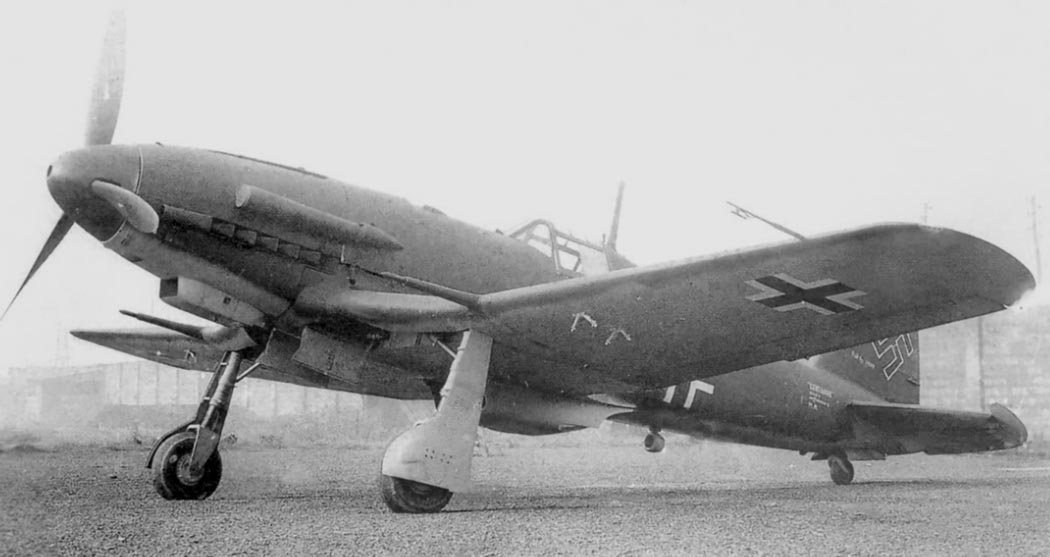
Fiat G.55 Centauro in German Service
The Fiat G.55 Centauro was among the most capable Italian fighters of the Second World War and attracted serious attention from the German Luftwaffe during 1943 and 1944. Designed by Giuseppe Gabrielli and built by Fiat Aviazione, the G.55 was powered by the licence built Daimler Benz DB 605A engine, known in Italy as the RA.1050 R.C.58 Tifone. Its combination of high altitude performance, heavy armament, and structural strength made it one of the most effective Axis fighters to emerge from the Italian aircraft industry.
In February 1943, the Luftwaffe conducted comparative trials at Guidonia between the G.55 and contemporary German fighters including the Messerschmitt Bf 109G and the Focke-Wulf Fw 190A. German evaluation pilots reported favourably on the Centauro’s handling, particularly at high altitude. The aircraft’s standard armament of three 20 mm MG 151 cannon and two 12.7 mm Breda SAFAT machine guns provided substantial firepower for bomber interception. Luftwaffe technical officers also noted the aircraft’s rugged construction and good diving characteristics. Some German reports suggested that, in overall balance, the G.55 compared favourably with the Bf 109G, though it was more complex to manufacture.
Following the Italian armistice of September 1943, northern Italian factories came under German control within the Italian Social Republic. Production of the G.55 continued in limited numbers. A small number of aircraft were taken on charge by the Luftwaffe and used primarily in northern Italy for air defence against Allied bomber formations operating over the Po Valley and industrial targets.
German units known to have operated the G.55 included elements of JG 77 and JG 53 during the transitional period after the armistice, particularly while re equipping and reorganising in northern Italy. In practice, Luftwaffe use remained limited and short lived, as priority was given to standard German types for logistical reasons. The G.55 required significantly more man hours to produce than the Bf 109G, which was a critical disadvantage in 1944 when fighter output was paramount.
Although never adopted in large numbers by Germany, the Fiat G.55 Centauro earned genuine respect among German test pilots and technical authorities. Industrial constraints rather than operational shortcomings prevented its broader service in the Luftwaffe.


References
Dunning, C. (2000). Courage Alone: The Italian Air Force 1940–1943. Hikoki Publications.
Green, W. (1961). Warplanes of the Second World War: Fighters, Volume Two. Macdonald.
Mondey, D. (2006). The Hamlyn Concise Guide to Axis Aircraft of World War II. Hamlyn.