
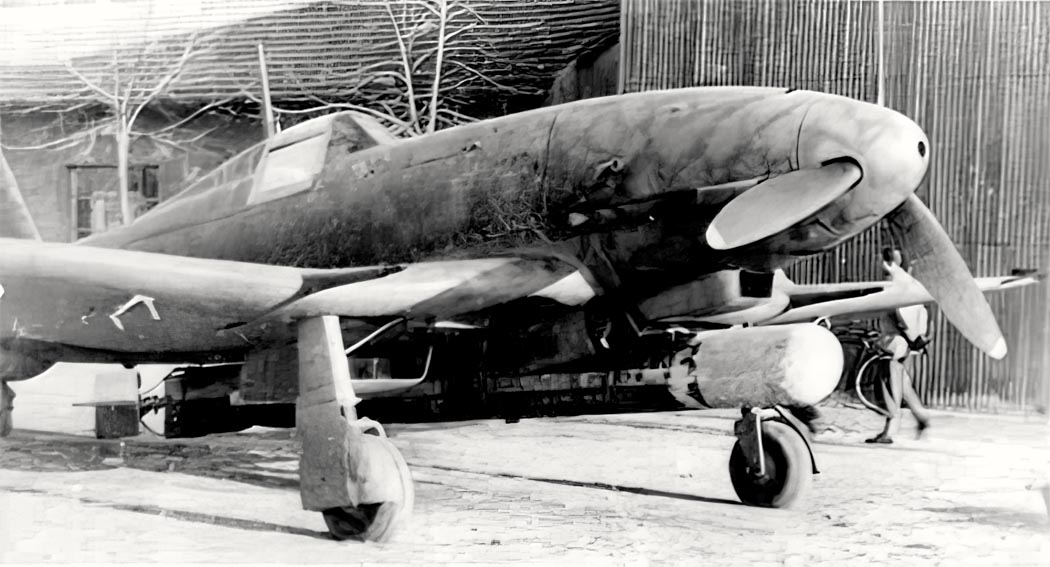
Fiat G.55S Torpedo Fighter
The Fiat G.55S (silurante, meaning torpedo-carrier) was an experimental torpedo-fighter derivative of the Italian Fiat G.55 Centauro developed during the final phase of the Second World War. Conceived as a fast, single-engine alternative to traditional torpedo bombers, the G.55S reflected Italian attempts to modernise anti-shipping aviation in response to changing combat conditions in the Mediterranean.
Development Background
By 1942–43, Italian torpedo-bombing operations relied primarily on aircraft such as the SIAI‑Marchetti SM.79 Sparviero. Although effective earlier in the war, these medium bombers became increasingly vulnerable to improved Allied fighters and shipboard anti-aircraft defences. Italian planners therefore considered the “torpedo-fighter” concept: a high-performance single-seat aircraft capable of delivering a torpedo at speed and then defending itself or escaping using fighter-like manoeuvrability.
Initial work focused on a dedicated torpedo-fighter design, the G.57, but when that project was abandoned, engineers of the Aeronautica Nazionale Repubblicana (ANR) turned to adapting the G.55 instead.
Design Modifications
A standard production G.55 Serie I (serial MM.91086) was converted into the torpedo-fighter prototype, designated G.55/S. The principal modification involved enabling the aircraft to carry a large Whitehead torpedo weighing roughly 920–987 kg and measuring about 5.46 m in length.
To accommodate the torpedo, engineers significantly altered the aircraft’s underside configuration. The original ventral radiator was divided into two smaller radiators mounted under the wing roots, creating space beneath the fuselage for torpedo attachment racks. The tailwheel strut was lengthened and reinforced to prevent the torpedo’s fins from striking the ground during take-off or landing, and a streamlined fairing was added to reduce aerodynamic drag.
Armament remained broadly similar to the fighter configuration, typically consisting of three 20 mm MG 151/20 cannon and two Breda-SAFAT machine guns, allowing the aircraft to retain a fighter-like offensive capability in addition to its anti-shipping role.
Testing and Performance
The modified aircraft first flew in August 1944 and underwent torpedo-carrying trials in early 1945, with test pilot Adriano Mantelli conducting evaluations. Reports indicated that, despite the heavy external load, performance remained satisfactory and handling acceptable for operational use.
Successful trials led the ANR to order a small pre-series batch of ten aircraft and to propose production of up to one hundred examples. However, Italy’s military collapse in 1945 ended further development before series production could begin.
Post-war Fate
Unlike many late-war experimental aircraft, the G.55S prototype survived the conflict. After the war it was converted back to standard fighter configuration and became the first G.55 delivered to the newly formed Italian Air Force (Aeronautica Militare Italiana). The airframe later served in testing roles and was eventually converted into a G.59-series aircraft using a Rolls-Royce Merlin engine.


References
Airpages. (n.d.). G.55S specification and history.
Encyclopedia MDPI. Fiat G.55 entry.
Wardrawings. G.55 Centauro data pages.
Wikipedia contributors. Fiat G.55 Centauro.
WW2 in Color. Centauro torpedo aircraft article.
Stormo Magazine. FIAT G.55 variants overview.