
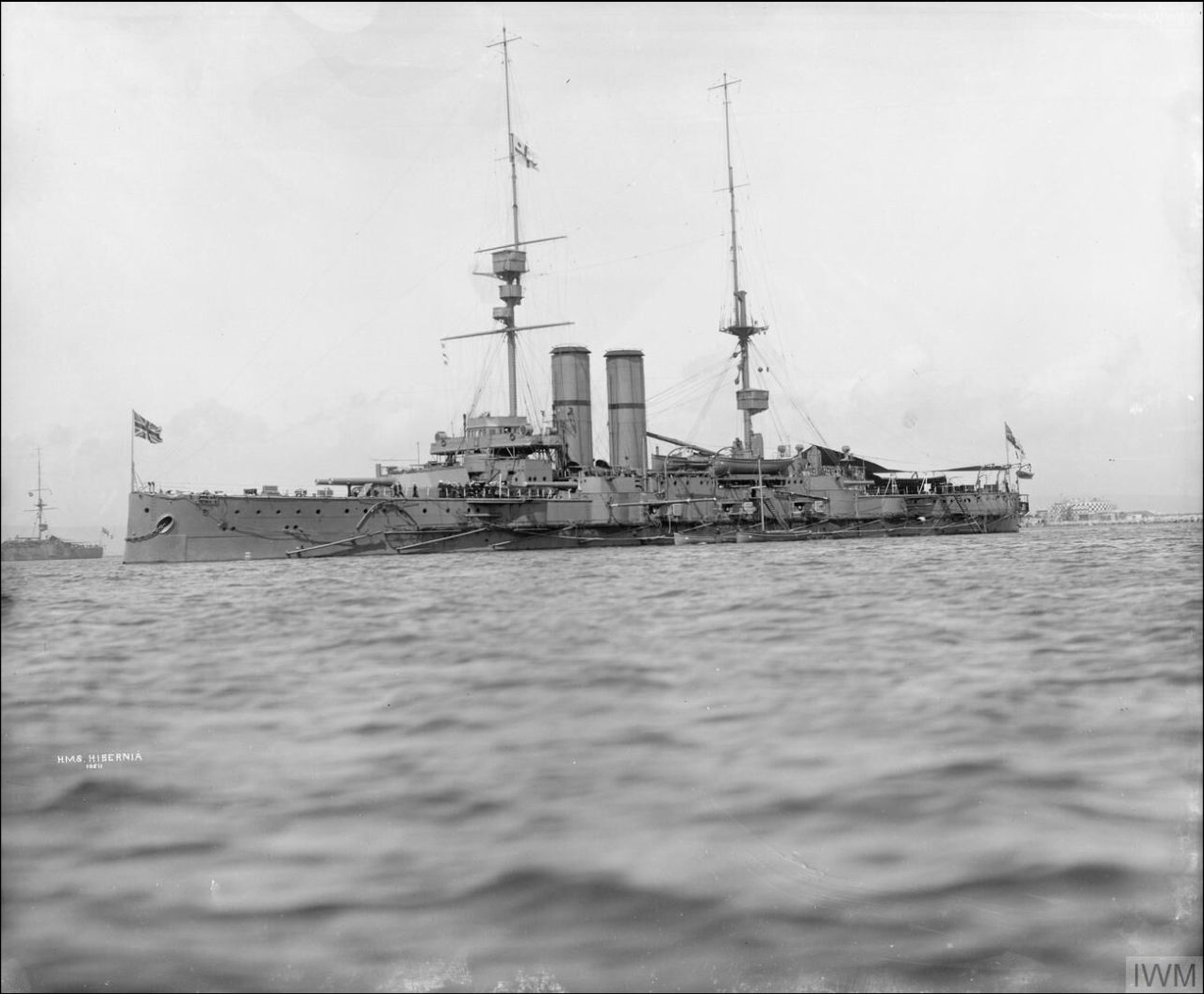
HMS Hibernia
HMS Hibernia was a King Edward VII-class pre-dreadnought battleship of the Royal Navy, built at Devonport Dockyard in Plymouth, England. Her keel was laid on 6 January 1904, and she was launched on 17 June 1905. Commissioned on 2 January 1907 the arrival of HMS Dreadnought in 1906 made her immediately obsolete.
Displacing 17,500 tons at full load, Hibernia measured 454 feet in length and could reach a speed of 18.5 knots. Her armament was comprised four 12-inch guns in twin turrets, four 9.2-inch guns, ten 6-inch guns and smaller weapons for defence against torpedo boats. She was protected by a 9 inch armour belt.
Hibernia achieved a significant place in aviation history on 4 May 1912, when Commander Charles Samson took off in a Short S.27 seaplane from a temporary flying-off platform fitted above the forward gun turret. This was the first launch of an aeroplane from a warship underway.
During the First World War, Hibernia initially served with the Grand Fleet before transferring to the Mediterranean in November 1915. There, she supported operations associated with the Dardanelles campaign, serving as a reserve battleship and flagship for Admiral Sir Thomas Fremantle. She saw no major fleet engagement during the war.
After the war, Hibernia served as an accommodation ship before being sold for scrapping in November 1921.


First Launch of an Aeroplane From a Warship Underway 4 May 1912


