
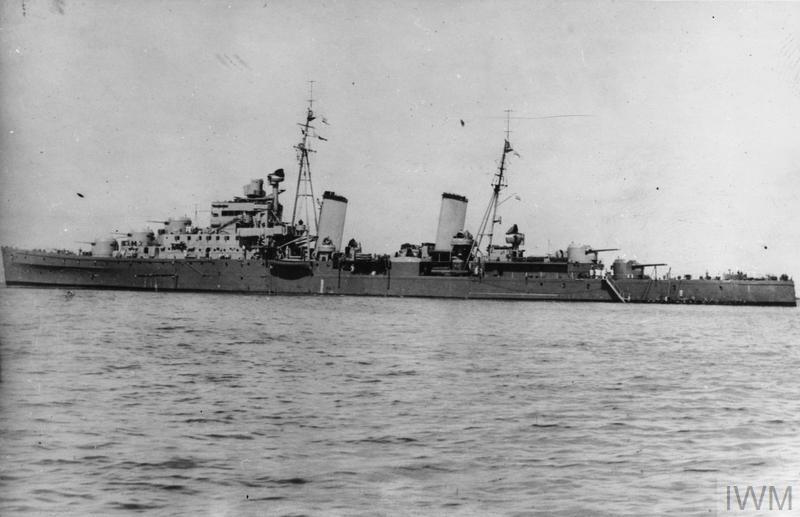
HMS Naiad British Light Cruiser
HMS Naiad was a Dido-class light cruiser of the Royal Navy that served during the Second World War. Designed primarily as an anti-aircraft cruiser, she was intended to provide protection for fleet units against air attack while retaining the speed and firepower necessary for traditional cruiser operations. Although her career lasted less than two years, Naiad became one of the most active ships of her class, serving in both northern waters and the Mediterranean before being lost to enemy action in 1942.
The ship was built by R. & W. Hawthorn, Leslie & Company Ltd. at Hebburn-on-Tyne. Her keel was laid down on 26 August 1937, and she was launched on 3 February 1939. Construction was delayed by wartime circumstances, including damage sustained during German air raids on the shipyard. Naiad was finally commissioned on 24 July 1940.
As completed, Naiad displaced approximately 5,600 tons standard and was armed with eight 5.25-inch dual-purpose guns mounted in four twin turrets. These weapons could engage both aircraft and surface targets, making them suitable for the cruiser’s intended escort role. She also carried light anti-aircraft weapons and was capable of speeds exceeding 32 knots.
In May 1941, Naiad was transferred to the Mediterranean, where she would spend the remainder of her career. The Mediterranean theatre demanded constant naval activity as Allied and Axis forces fought to maintain supply lines across the sea. Malta, under siege from Axis air and naval forces, depended heavily on convoys for survival, and Naiad frequently operated as part of the escort forces protecting these vital shipments.
Throughout late 1941 and early 1942, the cruiser participated in numerous fleet operations, convoy escorts, and sweeps against Axis shipping. She worked closely with the Mediterranean Fleet under Admiral Sir Andrew Cunningham and often served alongside battleships, aircraft carriers, and destroyers. Her anti-aircraft armament was in constant demand as British warships faced repeated attacks from German and Italian aircraft.
One of her most notable operations was participation in the First Battle of Sirte on 17 December 1941. During this action, British naval forces successfully prevented a stronger Italian fleet from reaching a convoy bound for Malta. Although the battle was largely inconclusive, it demonstrated the determination of the Royal Navy to keep Malta supplied despite overwhelming opposition.
Naiad’s service came to an abrupt end on 11 March 1942. While operating north of Sollum on the Egyptian coast, she was struck by a torpedo fired by the German submarine U-565. The hit caused catastrophic damage, and the cruiser quickly developed a severe list. Despite efforts to save the ship, she capsized and sank. Eighty-two members of her crew lost their lives, while the majority were rescued by accompanying vessels.


