
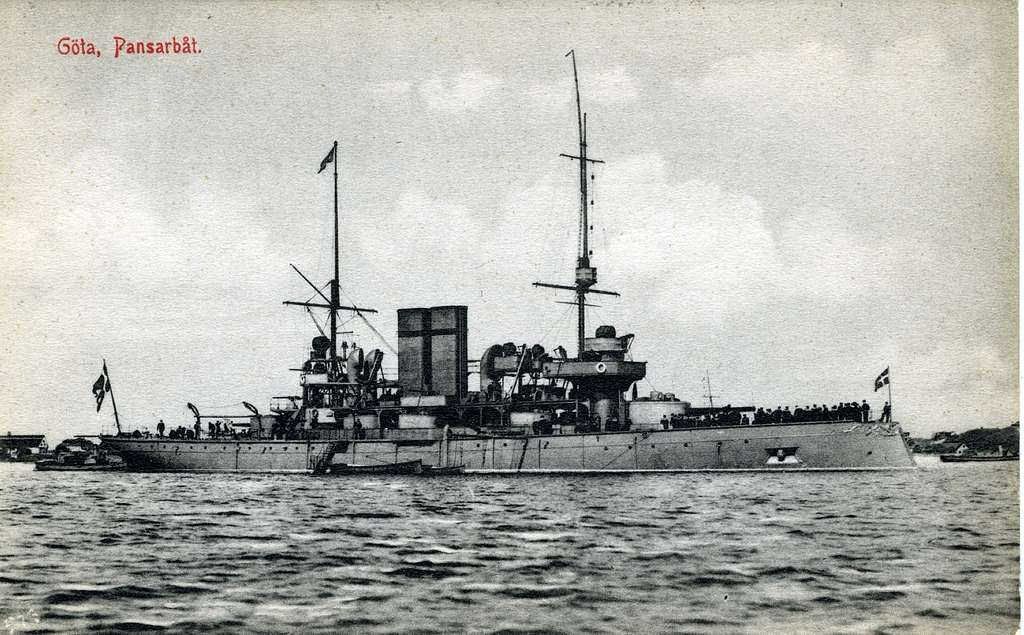
Swedish Navy Coastal Defence Ship HSwMS Göta
HSwMS Göta was one of three Svea class coastal defence ships built for the Swedish Navy during the late nineteenth century. Constructed at Lindholmens Mekaniska Verkstad in Gothenburg, she was launched in 1891 and completed the following year. Göta formed part of Sweden’s response to the rapidly changing naval balance in the Baltic. Rather than construct large ocean going battleships, Sweden invested in heavily armoured but comparatively small coastal defence ships capable of operating in confined waters and supporting fixed coastal fortifications.
Göta displaced just over 3,000 tons and measured approximately 75 metres in length. She was powered by horizontal compound steam engines developing around 4,500 to 4,700 indicated horsepower, giving a maximum speed of about 16 knots. Her original armament consisted of two 25.4 cm guns mounted in a forward turret, supplemented by a secondary battery of 15.2 cm guns and lighter quick firing weapons for defence against torpedo craft. A substantial belt and turret armour scheme, reaching nearly 30 cm in places, provided protection appropriate to her intended role as a floating coastal battery.
By the end of the nineteenth century rapid advances in naval architecture and ordnance had begun to render early coastal defence ships obsolescent. In the early 1900s Göta underwent a comprehensive modernisation that effectively rebuilt significant portions of the ship. The heavy military mast was removed and replaced with lighter pole masts, improving stability and reducing topweight. The original wooden deck was replaced with an insulated iron deck to reduce fire risk and improve durability. Much of the interior wooden furnishing was removed for similar reasons. Ventilation was improved and electric lighting installed, enhancing both habitability and operational efficiency. Wireless telegraphy equipment was also fitted, reflecting the growing importance of modern communications. Although her propulsion machinery was not fundamentally altered, the refit extended her effective service life by roughly two decades and allowed her to remain in active service through the First World War period, during which Sweden maintained neutrality but sustained a credible defensive posture in the Baltic.
By the 1920s, however, the emergence of more modern cruisers, destroyers and submarines had relegated ships of Göta’s type to secondary roles. Rather than immediately scrap her, the navy chose to adapt the still sound hull to new requirements. In 1927 she was converted into an accommodation and support ship for the naval air arm. During this conversion her heavy main guns were removed and replaced with lighter defensive weapons including 40 mm anti aircraft guns. Internal spaces were reconfigured to provide living quarters and support facilities for personnel of the naval air service, and she served as a stationary base at Hägernäs with the Roslagen naval air flotilla. In this capacity Göta contributed indirectly to Sweden’s interwar maritime defence by supporting the development of naval aviation.
Göta was finally decommissioned in 1938 as personnel and resources were redirected to more modern units. She was scrapped during the early 1940s, although parts of her hull reportedly found secondary use as a pontoon.
| Displacement | 3,200 tons |
|---|---|
| Length | 75.7 m (248 ft 4 in) |
| Draught | 5.18 m (17 ft 0 in) |
| Propulsion | 4,700 hp (3,500 kW) |
| Speed | 16 knots (30 km/h; 18 mph) |
| Complement | 252 |
| Armament | 2 × 10 in (25 cm) 4 × 6 in (15 cm) (4 × 1) 6 × 5.7 cm (2.2 in) (6 × 1) 3 × 15 in (38 cm) torpedo tubes |
| Armour | 11.5 in (29 cm) belt11.5 in (29 cm) turret |


References
Conway’s All the World’s Fighting Ships 1860 to 1905. London: Conway Maritime Press.
Conway’s All the World’s Fighting Ships 1906 to 1921. London: Conway Maritime Press.
Gardiner, Robert, ed. The Eclipse of the Big Gun: The Warship 1906 to 1945. London: Conway Maritime Press.
Högman, Hans. Swedish Coastal Defence Ships.
Naval Encyclopedia. Svea class coast defence ships.