
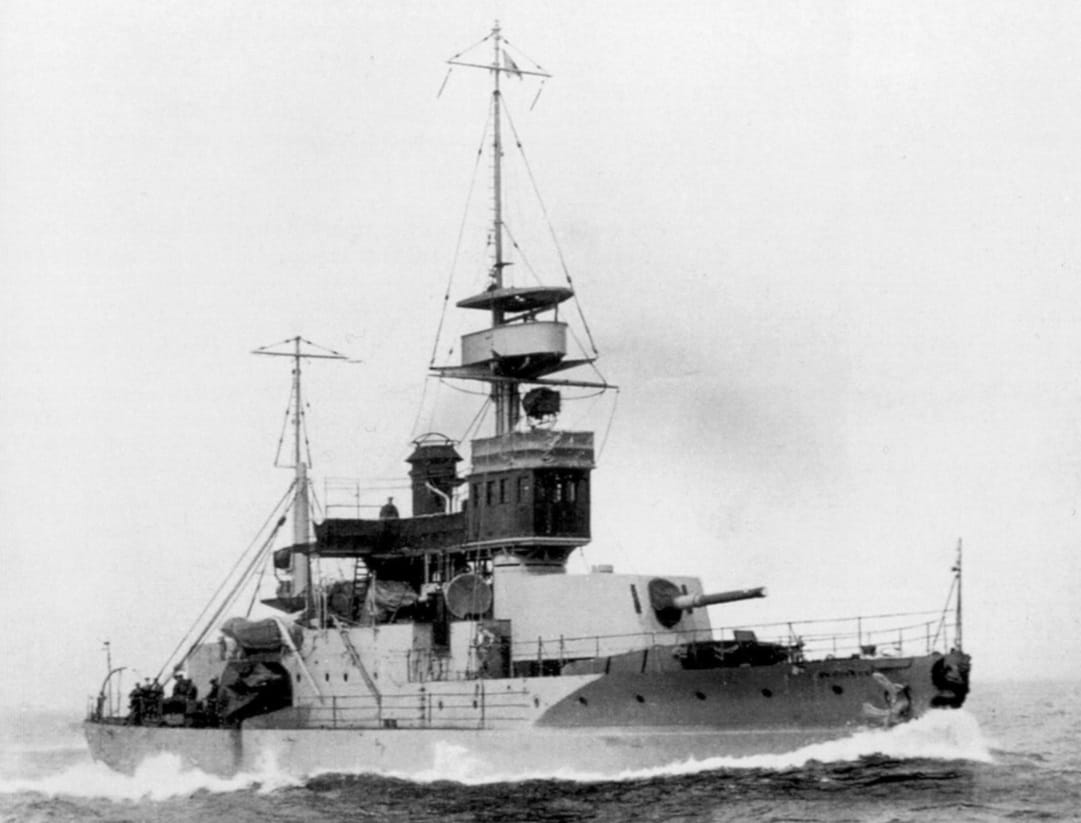
HTMS Rattanakosindra
HTMS Rattanakosindra was an armoured gunboat of the Royal Thai Navy and the lead ship of the Rattanakosindra class (with her sister ship HTMS Sukhothai). Built in the United Kingdom by Armstrong Whitworth at High Walker, Newcastle upon Tyne, she was laid down on 29 September 1924, launched on 21 April 1925, and completed in August 1925. The vessel represented an important step in the modernization of the Siamese (later Thai) Navy during the interwar period.
The ship’s origins stretched back to an earlier 1914 order for a pair of armoured gunboats. Construction was interrupted by the outbreak of the First World War, and the partially completed vessel was dismantled to free shipyard capacity for British wartime requirements. Following the war, Siam revived the project and reordered the ship to a revised design that emphasized improved seaworthiness and reduced armament.
Displacing approximately 1,000 tons, Rattanakosindra was unusual in appearance, combining characteristics of a gunboat and a monitor. She featured a low freeboard hull, a raised forecastle, armoured turrets fore and aft, and a prominent superstructure. Her main armament consisted of two 152 mm (6-inch) guns mounted in single enclosed turrets, supplemented by four 76 mm anti-aircraft guns. Power was provided by oil-fired Yarrow boilers and triple-expansion steam engines, giving a speed of about 12 knots. The ship was also heavily armoured for her size, reflecting her intended coastal defence role.
Throughout her long career, Rattanakosindra served as one of the principal units of the Royal Thai Navy. She remained in commission during the Franco-Thai War and the Second World War, although she saw little direct combat. Additional anti-aircraft weapons were added during her service life as naval aviation became a greater threat. After more than four decades of service, she was retired in 1967 and struck from the naval register soon afterwards.

