
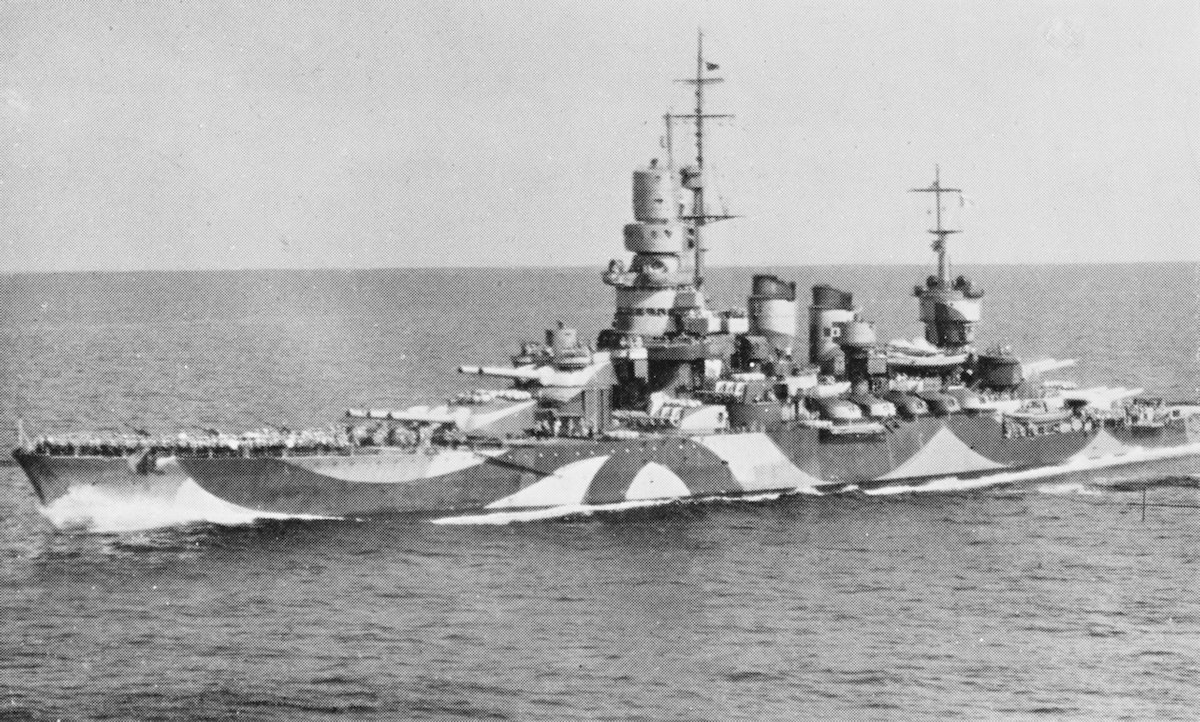
Italian Battleship Andrea Doria
The Italian battleship Andrea Doria was a dreadnought-era capital ship of the Regia Marina (Royal Italian Navy), lead ship of her class alongside her sister Duilio. She was laid down at La Spezia on 24 March 1912, launched 30 March 1913, and completed 13 March 1916 amid the First World War. The vessel was named for the 16th-century Genoese admiral Andrea Doria.
As built, Andrea Doria displaced roughly 24,700 tonnes, measured about 176 m (577 ft) overall, and was powered by Parsons steam turbines driving four shafts for a top speed of 21 knots. Her main battery comprised thirteen 305 mm (12 in) guns mounted in five turrets.
Service History
During World War I, Andrea Doria and her sister saw no major action; Italian naval strategy focused on containing the Austro-Hungarian fleet in the Adriatic rather than seeking decisive engagements.
In the interwar period, the ship remained active. She took part in the Corfu incident of 1923 and operations along the Mediterranean coast, including intervention near Syria. Andrea Doria underwent an extensive reconstruction from 1937 to 1940, which modernized her propulsion, armour and armament. Her main guns were re-bored to 320 mm calibre and anti-aircraft batteries were added.
World War II
In World War II Andrea Doria again saw limited front-line action. She escorted convoys to North Africa and participated in the First Battle of Sirte in December 1941. Fuel shortages and strategic constraints kept her largely inactive by 1942–43. After Italy’s armistice in September 1943, she was sailed to Malta before returning to Sicily and eventually Taranto.
Post-war
After the war Andrea Doria served as the Italian fleet’s flagship and later as a gunnery training ship. She was paid off on 16 September 1956, stricken on 1 November 1956 and subsequently scrapped at La Spezia.
Photos of Andrea Doria
Pre-Reconstruction


Undergoing Reconstruction


World War Two


Post-World War Two


Scrapping


