
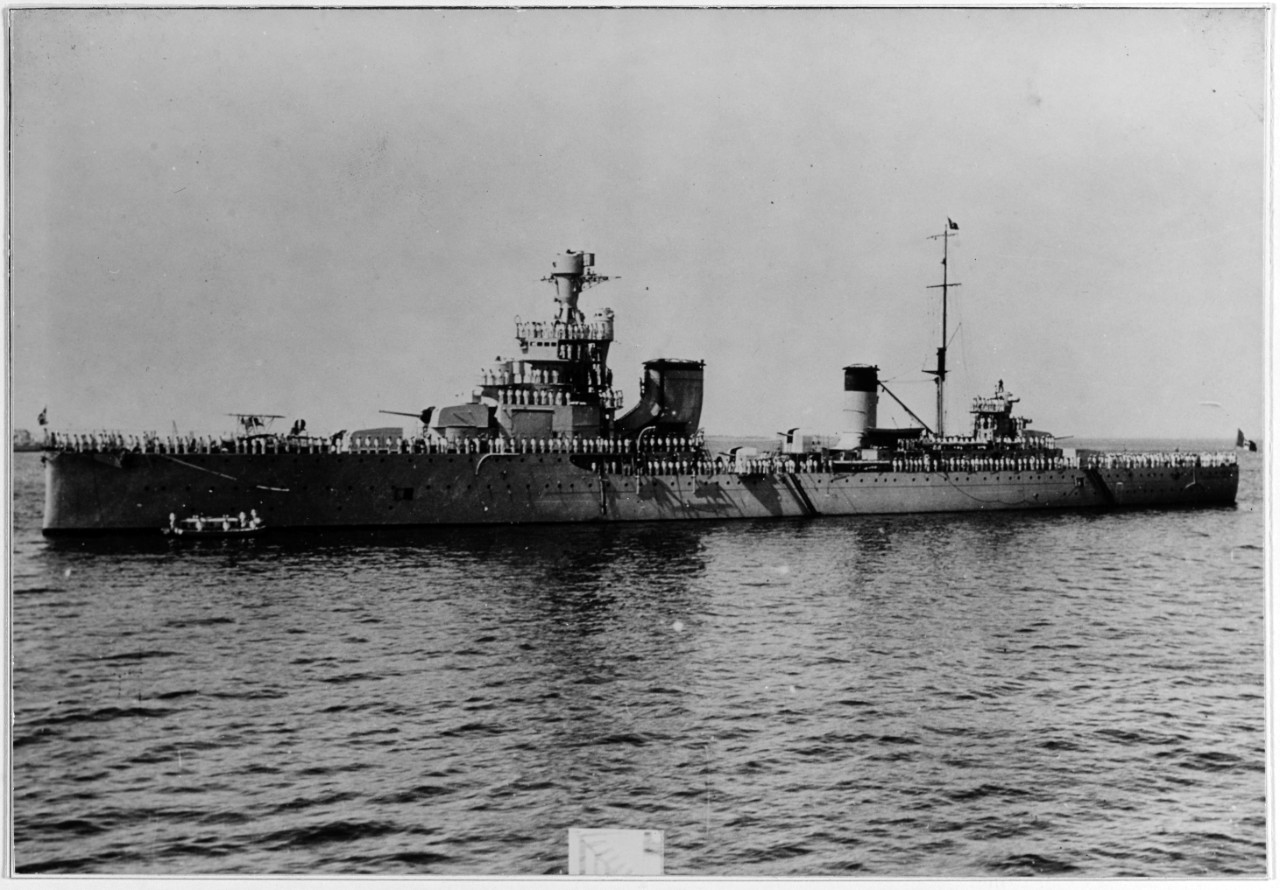
Italian Light Cruiser Alberico da Barbiano
Alberico da Barbiano was a Giussano-class light cruiser of the Regia Marina (Royal Italian Navy), commissioned in the early 1930s and lost in combat during World War II. Designed to match fast destroyers, her conception reflected Italian naval doctrine that emphasised speed and offensive firepower over armour protection.
Design and Construction
Built by Ansaldo at Genoa, Italy, Alberico da Barbiano was laid down on 16 April 1928, launched on 23 August 1930, and commissioned on 9 June 1931. Her overall dimensions were 169.3 m in length, 15.5 m beam, and 5.3 m draught. Standard displacement was approximately 6,571 tonnes, rising to 6,954 tonnes at full load. She was powered by six boilers feeding two shafts producing about 95,000 shp, intended to yield a design speed of 37 knots; during trials she briefly exceeded this, reaching over 42 knots under forced power.
Armament and Protection
As built, Alberico da Barbiano carried eight 152 mm/53 calibre main guns in four twin turrets, providing significant punch against surface opponents. Secondary armament comprised six 100 mm guns, while anti-aircraft defence included eight 37 mm guns and eight 13.2 mm machine guns. The cruiser also had four 533 mm torpedo tubes. She carried two seaplanes (initially CANT 25AR, later Ro.43) with a single catapult for reconnaissance.
Armour was deliberately light, with a 20 mm deck, 24 mm belt, 23 mm turret plating, and a 40 mm conning tower, characteristic of Italian light cruisers prioritising agility over protection.
Operational Service
In the late 1930s, Da Barbiano served in the Spanish Civil War, escorting Italian shipping supporting Nationalist forces. With Italy’s entry into World War II in June 1940, she joined the 4th Cruiser Division. On 9 July 1940, she participated in the Battle of Calabria (Punta Stilo) against the British Mediterranean Fleet. Through summer operations she performed convoy escort and minelaying missions, but her class’s light protection spurred her brief reassignment as a training ship on 1 September 1940, returning to active service on 1 March 1941.
Battle of Cape Bon and Loss
By late 1941 Axis supply lines to North Africa were strained. The Italian High Command ordered Alberico da Barbiano and her sister Alberto di Giussano to deliver desperately needed aviation fuel and supplies to Tripoli. Owing to urgency, fuel barrels were stowed on deck which drastically increased vulnerability. On 13 December 1941, while transiting near Cape Bon, Tunisia, they were intercepted by a force of British and Dutch destroyers using radar to locate their position. In a night engagement, torpedoes and gunfire struck both cruisers; Alberico da Barbiano was engulfed in fire and sank rapidly, with heavy loss of life including Rear Admiral Antonino Toscano and her captain.
References
Primary sources (online):
Italian cruiser Alberico da Barbiano — Wikipedia article. Italian cruiser Alberico da Barbiano — Wikipedia
Giussano-class cruiser — class overview. Giussano‑class cruiser — Wikipedia
Alberico da Barbiano — official Italian Navy historical entry (Marina Militare).


