
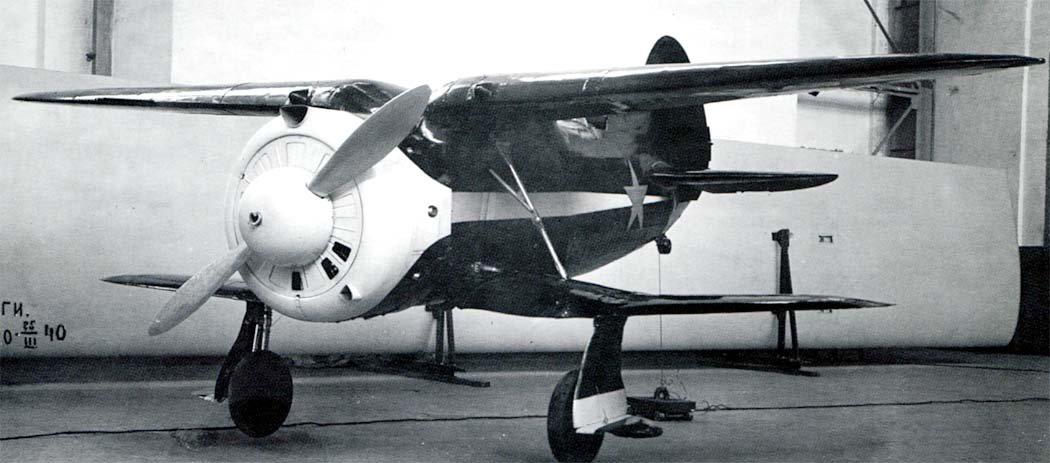
Nikitin-Shevchenko IS Polymorphic Fighter
The Nikitin-Shevchenko IS (Istrebitel Skladnoi – “Folding Fighter”) was one of the most unconventional Soviet fighter aircraft projects of the Second World War era. Designed by Vasily Nikitin and test pilot Vladimir Shevchenko, the aircraft was conceived in the late 1930s as a “polymorphic fighter” capable of transforming between a biplane and a monoplane during flight. The concept aimed to combine the excellent take-off, climb, and manoeuvrability of a biplane with the superior speed and lower drag of a monoplane.
The aircraft featured a unique retractable lower wing. During take-off and landing, the IS operated as a conventional sesquiplane, with the lower wing providing additional lift. Once airborne, the landing gear retracted into the lower wing, after which the entire wing folded upward into recesses beneath the fuselage and upper wing. The complete transformation took only a few seconds and was controlled by a simple three-position lever in the cockpit. This ingenious mechanism allowed the pilot to choose the most suitable configuration for different phases of flight.
The first prototype, designated IS-1, was powered by a Shvetsov M-63 radial engine and armed with four 7.62 mm ShKAS machine guns mounted in the upper wing. Flight testing demonstrated that the folding-wing mechanism worked reliably, validating the engineering concept. A second prototype, the IS-2, incorporated a more powerful M-88 radial engine, a slimmer fuselage, and heavier armament consisting of two 12.7 mm Berezin BS machine guns and two ShKAS guns. Plans also existed for more advanced IS-3 and IS-4 variants fitted with even more powerful engines and improved aerodynamics.
Despite its technical success, the polymorphic fighter failed to outperform contemporary Soviet monoplanes such as the MiG-3 and Yak-1, whose simpler designs offered superior speed and were easier to manufacture. The German invasion of the Soviet Union in 1941 ended further development, as Soviet industry concentrated on proven combat aircraft. Only two prototypes were completed.


