
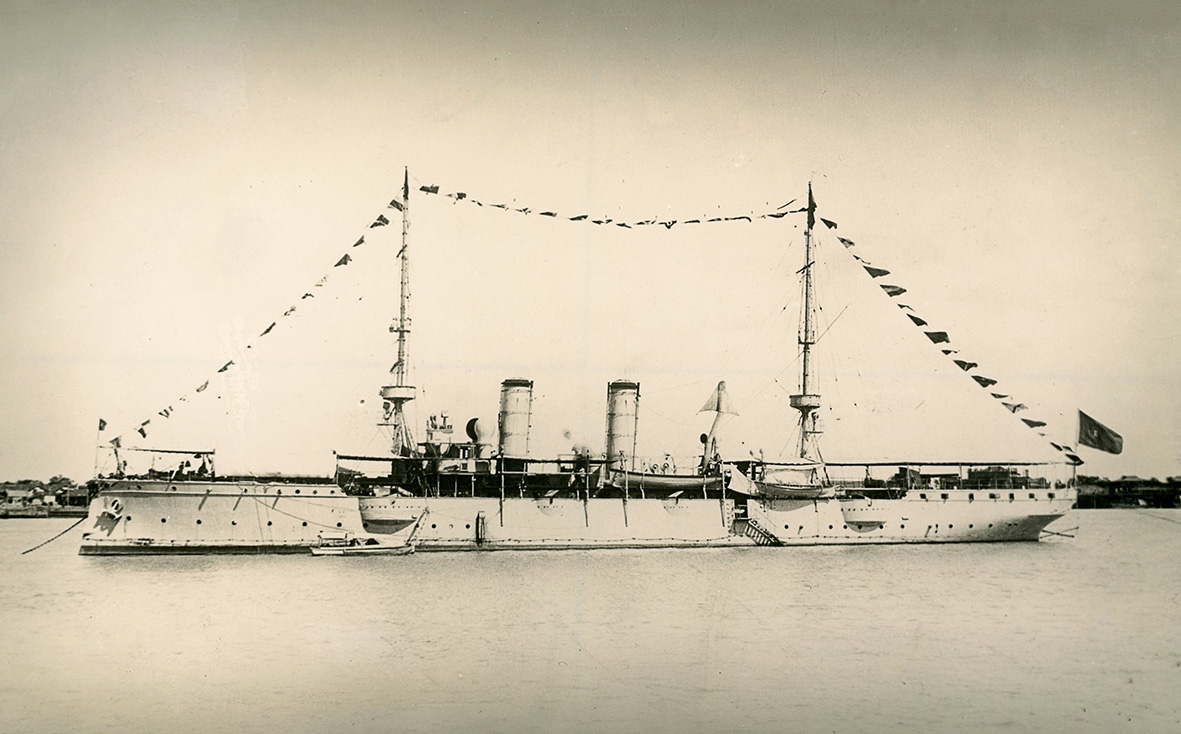
Portuguese Unprotected Cruiser Adamastor
The NRP Adamastor was an unprotected cruiser of the Portuguese Navy, built during a period of naval rearmament that followed the 1890 British Ultimatum. Funded in part by public subscription, she symbolised a national effort to restore maritime prestige and strengthen Portugal’s ability to police its overseas empire.
Design and Characteristics
Constructed by the Orlando shipyard at Livorno, Italy, Adamastor was laid down in 1895, launched in 1896, and commissioned in 1897. She displaced approximately 1,729 tons and measured about 74 metres in length, with a beam of roughly 10.7 metres. Propulsion was provided by two vertical triple expansion steam engines powered by cylindrical boilers, producing around 4,000 indicated horsepower for a maximum speed of about 18 knots.
Although officially classified as an unprotected cruiser, she incorporated limited protective features. A protective deck of about 30 mm shielded vital machinery spaces, and the conning tower had thicker armour. Her armament reflected late nineteenth century cruiser doctrine. The main battery comprised two 150 mm Krupp guns, supplemented by four 105 mm guns, smaller quick firing weapons, and three torpedo tubes. This configuration made her suitable for colonial patrol, commerce protection, and limited fleet duties.
Service Career
Adamastor undertook numerous overseas deployments to Portuguese colonies in Africa and Asia. She made goodwill and training cruises, including visits to Brazil and the Far East, reflecting Portugal’s global maritime connections.
Her most politically significant moment occurred during the Republican revolution of 5 October 1910. The ship’s crew sided with the revolutionaries and Adamastor participated in the bombardment of the royal palace at Necessidades, an action that symbolised naval support for the overthrow of the monarchy and the establishment of the Portuguese Republic.
During the First World War she served primarily in Portuguese East Africa. In operations along the Rovuma River and the Mozambican coast, she supported Portuguese forces confronting German colonial troops operating from neighbouring German East Africa. Her presence helped secure coastal positions and deter further incursions.
In her later career Adamastor served in Asian waters. In 1929 she ran aground in Hong Kong. Although the incident caused damage, she was successfully refloated and returned to service after repairs. The grounding marked one of the more serious peacetime incidents of her long career.
After more than three decades in commission, Adamastor was decommissioned in 1933 and subsequently scrapped.


References
- Gardiner, R., & Gray, R. (Eds.). (1985). Conway’s All the World’s Fighting Ships 1860–1905. Conway Maritime Press.
- Direção Cultural da Marinha. “Cruzador Adamastor.” Museu de Marinha, Lisbon.
- Navypedia. “Adamastor (1897) Unprotected Cruiser.”
- Scientific American. (1898). “The Portuguese Cruiser Adamastor.”
- Wikipedia contributors. “NRP Adamastor.” Wikipedia.