
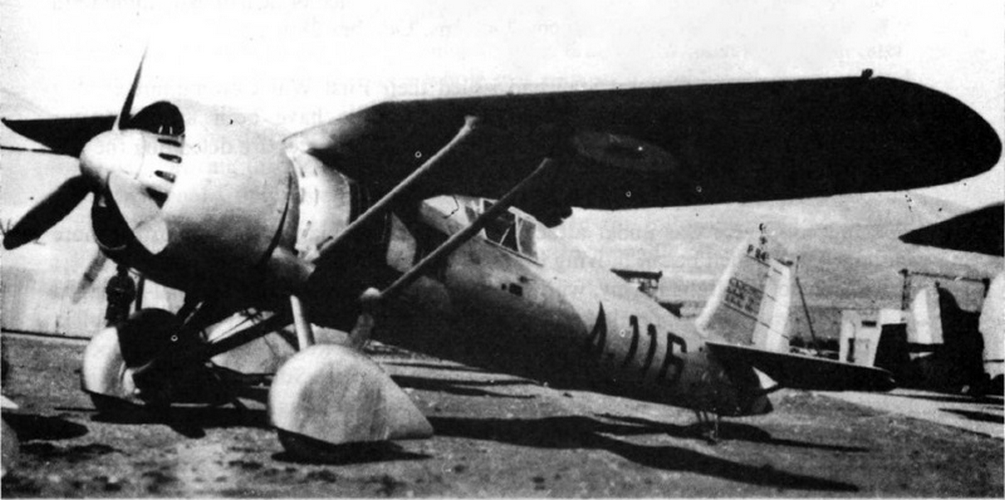
PZL P.24 in Greek Service
PZL P.24 Overview
The PZL P.24 was a Polish-designed monoplane fighter developed in the mid-1930s by Państwowe Zakłady Lotnicze (PZL). It was a further development of the successful PZL P.11, fitted with the more powerful Gnome-Rhône radial engine. Unlike the P.11, which was primarily for Polish service, the P.24 was specifically intended for export, as licensing restrictions on the British Bristol Pegasus engine (used in the P.11) prevented its sale abroad.
The P.24 featured a gull-wing configuration, open cockpit, fixed undercarriage, and was heavily armed for its time, with versions carrying 2–4 machine guns or 2 machine guns plus 2 × 20 mm cannon. It proved attractive to countries seeking to modernise their fighter fleets in the late 1930s. Although never operated by Poland itself, it became one of the most widely exported Polish aircraft prior to the Second World War.
Use by Greece
On 16 November 1936, Greece contracted PZL to supply 36 P.24 fighters: 30 P.24As and six P.24Bs. After the first five P.24As had been completed, Greece revised the order to specify the more powerful Gnôme-Rhône 14N-07 engine, rated at 699 kW nominally and 713 kW maximum. The change produced two variants. The P.24F carried two 20 mm cannon and two 50 kg bombs, while the P.24G mounted four machine guns and four 12.5 kg bombs. Both received a propeller spinner, an additional 24 litres of fuel, 35 mm armoured windscreen glass and 7 mm armour protecting the pilot’s head and back.
Initially, Greece expected 30 P.24Fs and six P.24Gs, but the final allocation became 12 Fs and 24 Gs. Five existing P.24As were converted to the F standard, although they retained P.24A armament, while seven new P.24Fs were constructed.
Production ran from autumn 1937 to spring 1938. The fighters equipped Greece’s 21st, 22nd and 23rd Fighter Squadrons and formed the core of its fighter force. In 1940, the P.24Fs were rearmed with four machine guns.
When Italy invaded on 28 October 1940, only 24 P.24s remained serviceable. They entered combat over Thessaloniki on 1 November. The following day brought their greatest success, with claims for eight Cant Z.1007bis bombers, one Savoia-Marchetti S.81 bomber and one Fiat CR.42 fighter in combat. Despite declining strength, Greek pilots resisted the Italians until Germany invaded on 6 April 1941. On 14 April, with 13 aircraft remaining, they downed a Ju 87 and an Hs 126 without loss. German attacks between 19 and 23 April destroyed the survivors. During the campaign, Greek P.24 pilots claimed 40 victories consisting of 37 Italian and three German aircraft, while losing 35 of their own fighters.


