
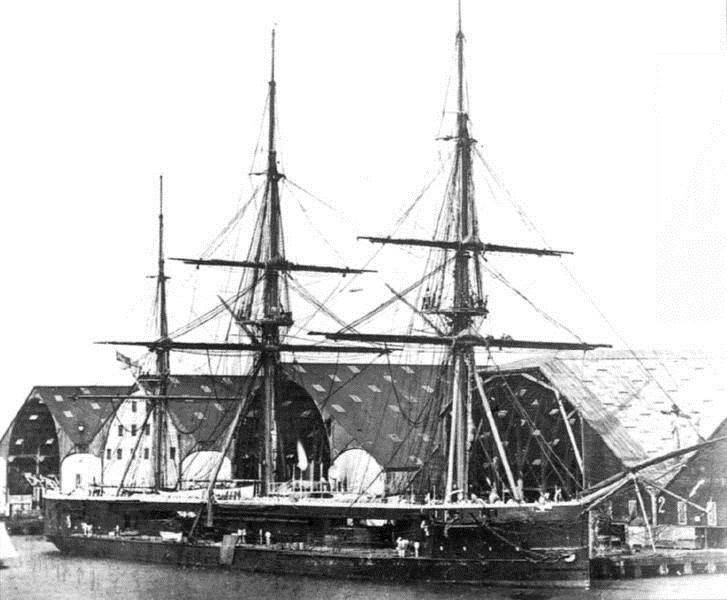
Royal Navy Ironclad HMS Captain
HMS Captain was an innovative but ultimately ill-fated ironclad turret ship of the Royal Navy, launched in 1869. She was designed during a period of rapid technological change in naval architecture, when the transition from wooden sailing warships to armoured, steam-powered vessels was still underway. Although conceived as a powerful ocean-going turret ship, Captain became a cautionary example of the risks associated with experimental warship design and political pressure in naval procurement.
The ship was built at the Laird shipyard in Birkenhead and designed largely under the influence of Captain Cowper Phipps Coles, a naval officer and strong advocate of rotating gun turrets. Coles had previously developed turret systems used successfully in coastal defence vessels. He believed that a fully rigged sailing ship equipped with turrets and a low freeboard would combine fighting efficiency with ocean-going capability. Despite reservations from the Admiralty’s Director of Naval Construction, Sir Edward Reed, public and parliamentary support for Coles’ ideas led to approval of the project.
HMS Captain displaced approximately 6,950 tons and measured about 320 feet in length. She carried two revolving turrets, each mounting two 12-inch muzzle-loading rifled guns. Her armour belt reached a thickness of around 8 inches amidships. In addition to steam propulsion from a trunk engine driving a single screw, the ship carried a full sailing rig with three masts, intended to improve range and reduce coal consumption on long voyages.
The vessel’s most controversial feature was her low freeboard, only about 8 feet when fully loaded. While this reduced the target area presented to enemy fire, it significantly affected seaworthiness. The heavy turrets, armour, and rigging raised the ship’s centre of gravity, compromising stability. Although stability concerns were raised during construction and after launch, modifications were limited, and the ship entered service in April 1870.
HMS Captain joined the Channel Squadron soon after commissioning. During summer manoeuvres that year, she initially performed satisfactorily in moderate conditions. However, concerns persisted among naval architects and some officers regarding her tendency to roll heavily and take on water in rough seas.
The crisis came on the night of 6–7 September 1870 off Cape Finisterre, Spain. The squadron encountered a severe gale. With sails set and heavy seas striking the low deck, Captain heeled over repeatedly. Shortly after midnight, she rolled beyond the point of recovery and capsized. The ship sank rapidly, taking nearly all aboard with her. Of roughly 500 officers and crew, only 18 survived. Captain Cowper Coles was among those lost.
The loss of HMS Captain shocked the Royal Navy and the British public. A Court-martial and subsequent investigation concluded that the ship had been dangerously unstable due to excessive topweight and insufficient freeboard. The disaster highlighted the importance of professional naval architectural oversight and careful stability calculations in warship design.
In the longer term, the sinking influenced Admiralty policy by reinforcing the authority of trained naval constructors and reducing external political interference in technical ship design. It also contributed to improved standards for stability testing and seaworthiness in armoured warships.


