
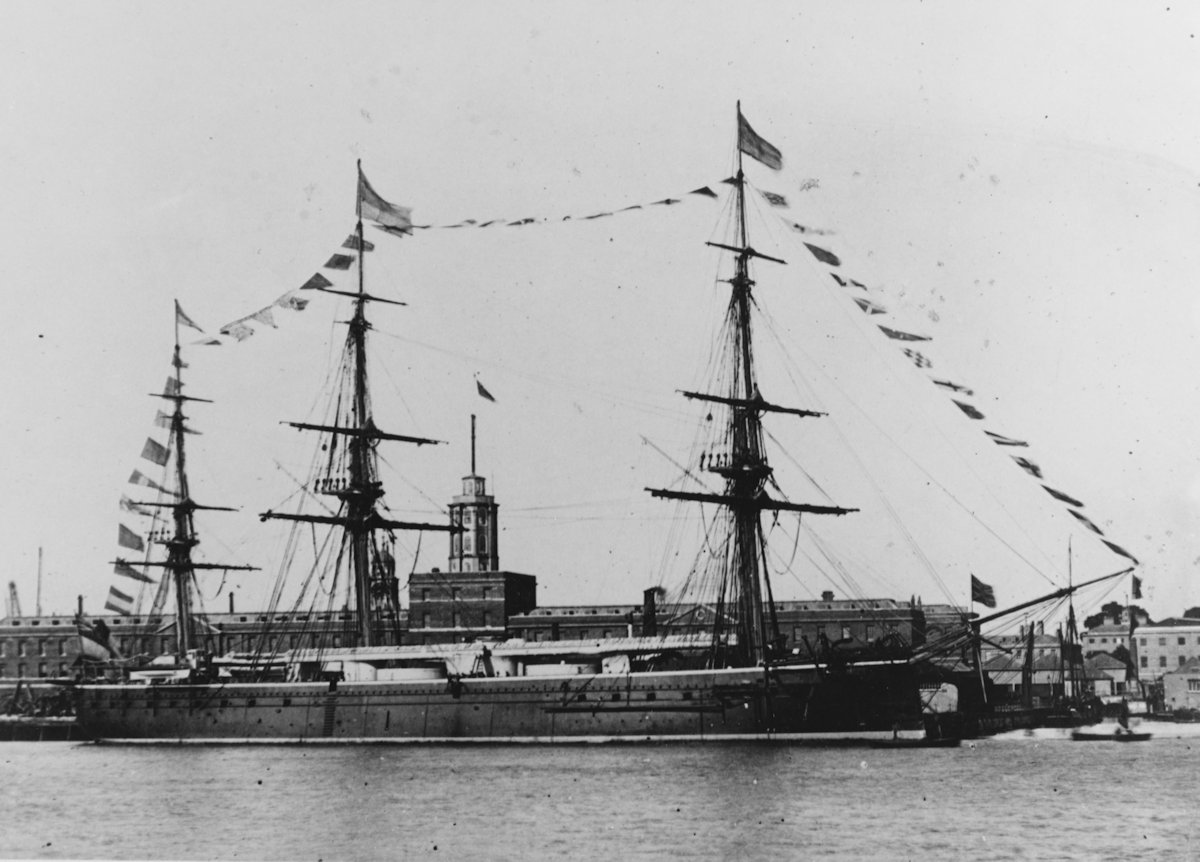
Royal Navy Ironclad HMS Monarch (1868)
HMS Monarch, launched in 1868, was one of the Royal Navy’s early seagoing turret ships and represented an important stage in the transition from broadside ironclads to modern battleships. Built at Chatham Dockyard, she was designed under the direction of Sir Edward Reed, the Chief Constructor of the Navy. Monarch was conceived as a compromise between traditional sailing warships and the emerging turret-armed steam battleship, combining rotating gun turrets with full sailing rig.
The ship displaced about 8,300 tons and measured roughly 330 feet in length. Her hull was constructed of iron and protected by a belt of wrought-iron armour up to 7 inches thick along the waterline. The main armament consisted of four 12-inch muzzle-loading rifled guns mounted in two turrets positioned on the centreline. These turrets were placed so they could fire on either beam, though the ship’s rigging restricted some firing arcs. Secondary weapons, including smaller guns added later in her career, provided defence against lighter vessels. Propulsion came from a single screw driven by a steam engine, supplemented by a full ship rig that allowed long-distance cruising without reliance on coal supplies.
Monarch served primarily with the Channel Squadron and the Mediterranean Fleet during the 1870s and early 1880s. She took part in routine patrols, training exercises, and diplomatic naval visits that demonstrated British naval power during a period of rapid technological change. Although considered successful as an ocean-going turret ship, her mixed sail-and-steam configuration soon became obsolete as mastless turret ships and barbette designs proved more effective.
By the late 1880s, Monarch was relegated to reserve and auxiliary duties. She was eventually sold for scrap in 1905.


