
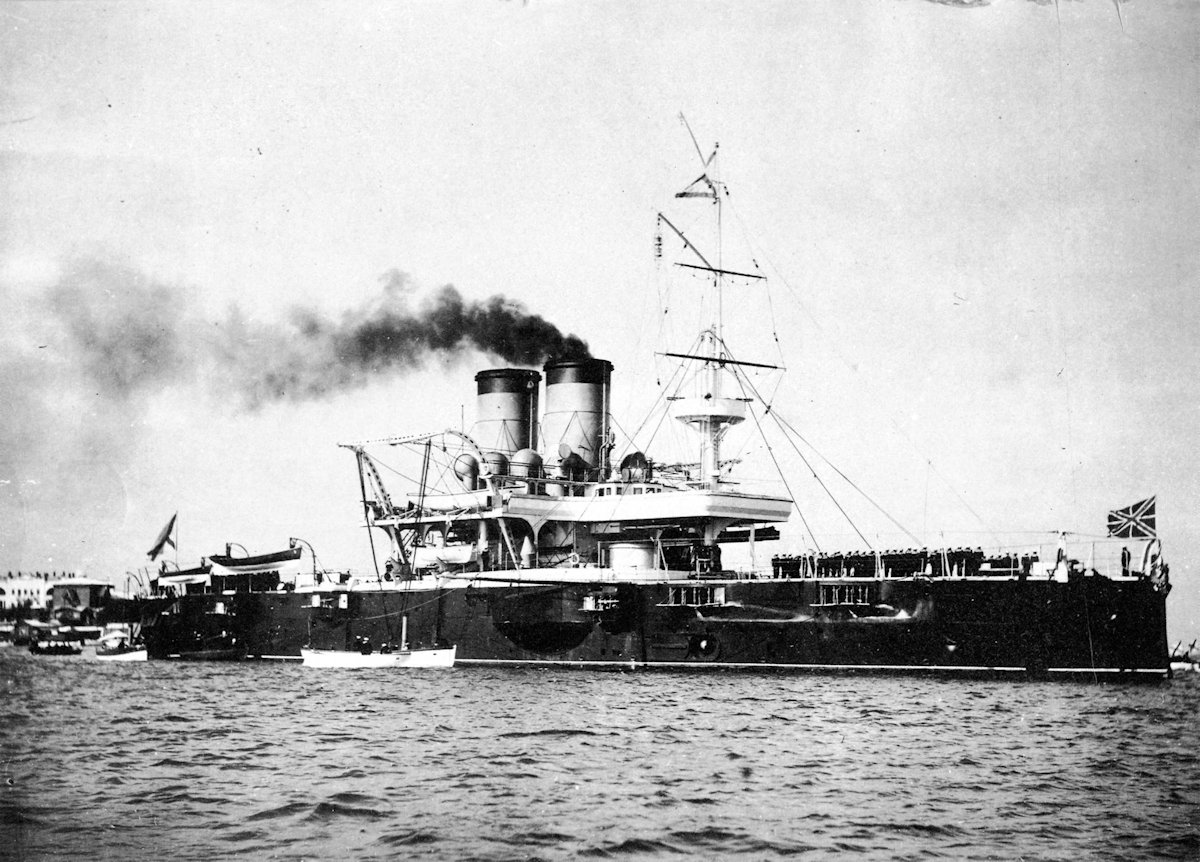
Russian Ironclad Battleship Ekaterina II
The Russian ironclad battleship Ekaterina II was the lead ship of a class of Black Sea fleet ironclads (which included Chesma, Sinop, and Georgii Pobedonosets) constructed during the 1880s to counter the naval strength of the Ottoman Empire. Laid down at Nikolaev in 1883 and commissioned in 1889, she embodied the transitional character of late nineteenth century capital ship design, combining heavy armour protection with large calibre breech loading artillery in a compact, low freeboard hull optimised for operations in confined waters.
Ekaterina II displaced roughly 10,000 tons and measured about 103 metres in length. Her propulsion plant consisted of compound steam engines driving two shafts, supplied by coal fired boilers that enabled a maximum speed of approximately 15 knots. Although not exceptional by contemporary European standards, this performance was adequate for Black Sea service, where endurance and seakeeping requirements differed from those of ocean going fleets.
The ship’s principal armament was distinctive. She mounted six 305 mm guns arranged in three twin barbette mountings positioned in a triangular layout, two forward and one aft. This configuration permitted heavy end on fire, reflecting Russian tactical doctrine that emphasised closing the range against an adversary. Secondary armament included medium calibre guns and a number of smaller quick firing weapons added in later refits to counter the emerging torpedo boat threat.
Armour protection followed contemporary practice, with a thick belt of compound armour along the waterline and heavily protected barbettes. Throughout the 1890s Ekaterina II served as a core unit of the Black Sea Fleet, participating in exercises and representing Russian naval power in regional waters. By the early twentieth century she was obsolescent. Stricken from the naval register on 14 August 1907. On 22 April 1912, the former battleship was formally reclassified as Stricken Vessel No. 3. Soon afterward, the hulk was expended as a torpedo target during training exercises conducted by the Black Sea Fleet


