
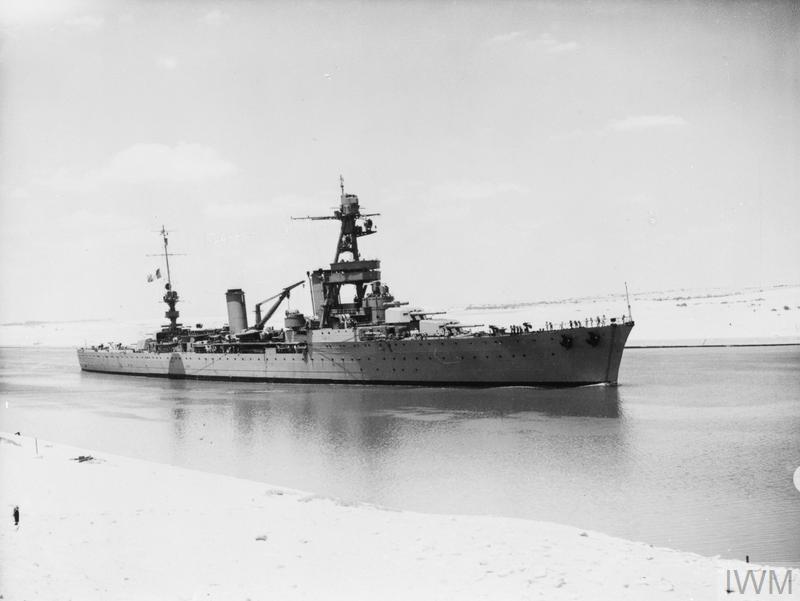
Suffren (1927) French Heavy Cruiser
Laid down at the Arsenal de Brest in 1926 and launched on 3 May 1927, the Suffren was the lead ship of her class and one of the most significant French warships of the interwar period. She represented France’s earnest attempt to build a modern heavy cruiser within the constraints of the Washington Naval Treaty, which had capped cruiser displacement at 10,000 tons and main armament at eight-inch guns. The result was a vessel that embodied both the ambitions and the compromises of a nation striving to project naval power in an era of careful international limitation.
Displacing approximately 10,000 tonnes as designed, the Suffren measured 194 metres in length and carried a main battery of eight 203mm guns arranged in four twin turrets, two forward and two aft. Her secondary armament included eight 75mm anti-aircraft guns, supplemented by torpedo tubes. She was driven by a turbine propulsion plant capable of pushing her to speeds approaching 31 knots, making her a genuinely fast vessel for her class. Her profile was distinctive and unmistakably French: tall and lean, with a raked bow and prominent funnels that gave her a rakish, aggressive character on the water.
The French Navy classified the Suffren as a croiseur lourd, a heavy cruiser, and she occupied an important role in the Marine Nationale’s strategic thinking throughout the 1930s. She was employed extensively in the Mediterranean, a theatre that preoccupied French naval planners given the competing interests of Italy. The ship served with the Force de Raid, the French fleet’s principal striking formation, and participated in numerous exercises and patrols designed to demonstrate French readiness and maintain regional influence.
The fall of France in June 1940 placed the Suffren, along with the other ships of Force X under Admiral René-Émile Godfroy, in an extraordinarily difficult position. Rather than fight or scuttle, Godfroy reached an agreement with British Admiral Andrew Cunningham, and the squadron was interned at Alexandria. The arrangement was an uneasy one. The ships lay immobilised in harbour, their fuel drained and their crews in a kind of suspended limbo, neither at war nor truly at peace, watched over by the Royal Navy while the wider conflict raged around them.
This long internment ended in 1943, when the liberation of North Africa persuaded Godfroy to bring Force X back into the Allied cause. She operated off Dakar and then in Indochina, before returning to France. She was sold for scrap in 1963.


