
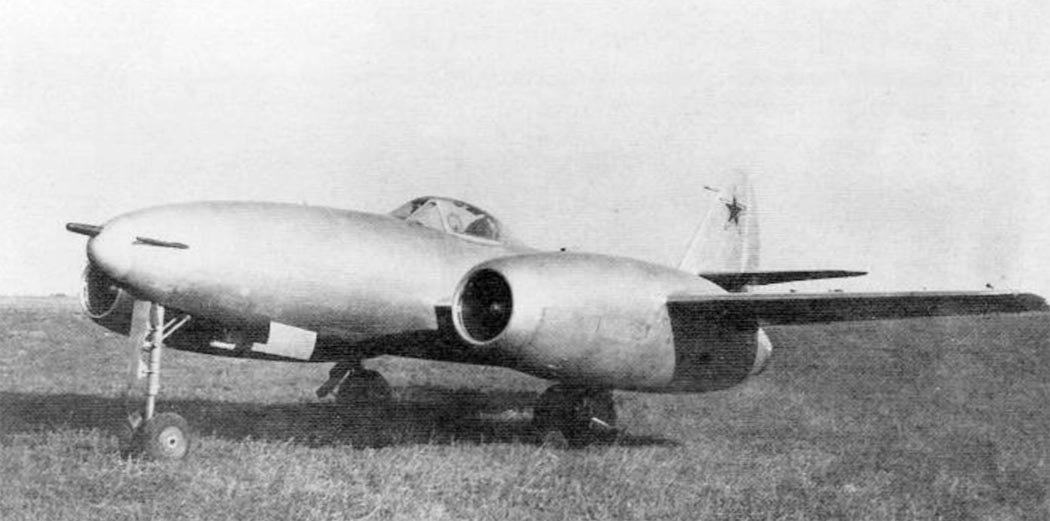
Sukhoi Su-11 (1947)
The 1946 Sukhoi Su-11 was an advanced iteration of early Soviet jet fighter design, developed by the bureau of Pavel Sukhoi as a follow-on to the Su-9. Conceived during a period of rapid technological transition, the aircraft embodied both incremental refinement and significant redesign as Soviet engineers grappled with the aerodynamic and propulsion challenges of early turbojet flight.
Initially, the Su-11 was intended to be powered by the Yakovlev-designed afterburning RD-10F engine, an improved derivative of the German Jumo 004 that promised enhanced thrust and performance. However, aerodynamic testing quickly drove major changes to the design. Wind tunnel experiments conducted in September on the earlier Sukhoi Su-9 revealed that overall drag could be reduced by relocating the engines within the wing, rather than in nacelles under it. This change significantly altered the aircraft’s structural and aerodynamic layout.
Further refinements were introduced to address stability and compressibility effects at higher speeds. The wing tips were redesigned with a different airfoil profile that reduced the onset of Mach tuck, a critical issue as aircraft approached transonic velocities. These modifications necessitated a complete redesign of the wing. Structurally, the main spar was reshaped into an inverted U configuration to accommodate the engines within the wing, an unusual but effective solution for integrating propulsion with the airframe. In addition, the simple flaps of the earlier design were replaced with more advanced slotted flaps, improving lift characteristics during takeoff and landing.
Attention was also given to the tail arrangement. The horizontal tailplane was given a dihedral angle of five degrees, raising it clear of the jet exhaust flow and thereby preserving control effectiveness. This modification reflected the growing understanding of jet efflux interference, a problem not encountered in piston-engined aircraft to the same degree.
Before the prototype could be completed in its intended form, a directive required Sukhoi to adopt the new Lyulka TR-1 turbojet engines, originally planned for the Su-9. This revised aircraft received the designation Su-11 and was referred to internally as Samolyet KL within the OKB. The TR-1 engines, however, proved underpowered, each producing only 12.7 kN of thrust compared to the 15 kN that had been anticipated. This shortfall had a direct impact on overall performance.
The Su-11 made its maiden flight on 28 May 1947 and was publicly displayed during the aviation parade at Tushino in August of that year, demonstrating a maximum speed of approximately 940 kilometres per hour at sea level. Despite these promising figures, flight testing revealed serious deficiencies. Most notably, the aircraft suffered from poor longitudinal stability at high speeds, an issue that could not be resolved through iterative modifications. Adjustments to the wing-to-nacelle fillets and the extension of the engine nacelles were attempted, but these measures failed to correct the instability.
Combined with the persistent immaturity and unreliability of the TR-1 engines, these aerodynamic shortcomings ultimately led to the cancellation of the program. Although the Su-11 did not progress beyond the prototype stage, it remains a technically significant design. The lessons learned from its development contributed to the broader Soviet effort to master jet propulsion and high-speed aerodynamics in the late 1940s.


