
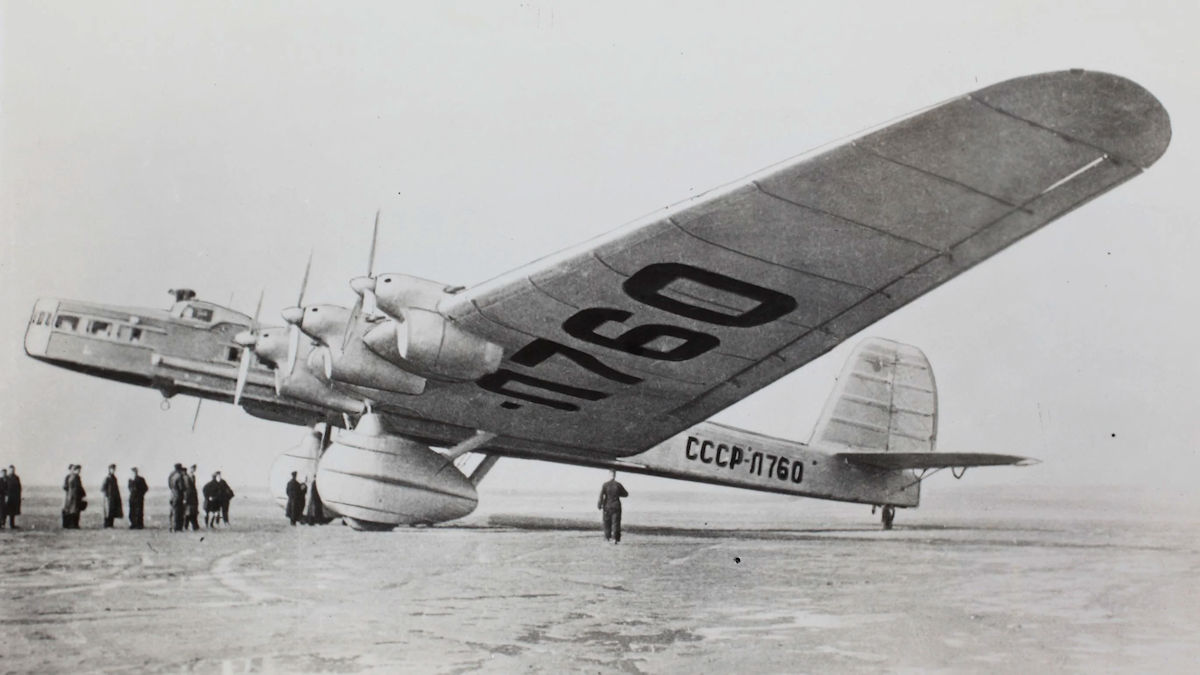
Tupolev ANT-20
The original ANT-20 was powered by eight Mikulin AM-34FRN V-12 engines. Six engines were mounted conventionally in the wing leading edges, while two additional engines were mounted in tandem above the fuselage in a push-pull arrangement. This unusual installation provided sufficient power without requiring larger individual engines, which were not yet available in the Soviet Union.
The interior resembled a flying community centre. Besides seating for passengers, the aircraft carried a printing press capable of producing thousands of leaflets, a powerful radio transmitter known as the “Voice from the Sky,” loudspeakers, a photographic laboratory, a film projector, a library, and meeting facilities. It was among the first aircraft equipped with both alternating and direct current electrical systems and could even be dismantled for transport by railway. During its brief career it established several payload records, demonstrating the capabilities of Soviet aviation technology.
Its career ended tragically on 18 May 1935 during a demonstration flight over Moscow. An accompanying Polikarpov I-5 fighter attempted aerobatic manoeuvres around the giant aircraft and collided with its wing. The ANT-20 crashed into a residential district, killing everyone aboard along with the fighter pilot and several people on the ground.
Tupolev ANT-20 Maxim Gorky
The original ANT-20 was powered by eight Mikulin AM-34FRN V-12 engines. Six engines were mounted conventionally in the wing leading edges, while two additional engines were mounted in tandem above the fuselage in a push-pull arrangement. This unusual installation provided sufficient power without requiring larger individual engines, which were not yet available in the Soviet Union.
The interior resembled a flying community centre. Besides seating for passengers, the aircraft carried a printing press capable of producing thousands of leaflets, a powerful radio transmitter known as the “Voice from the Sky,” loudspeakers, a photographic laboratory, a film projector, a library, and meeting facilities. It was among the first aircraft equipped with both alternating and direct current electrical systems and could even be dismantled for transport by railway. During its brief career it established several payload records, demonstrating the capabilities of Soviet aviation technology.
Its career ended tragically on 18 May 1935 during a demonstration flight over Moscow. An accompanying Polikarpov I-5 fighter attempted aerobatic manoeuvres around the giant aircraft and collided with its wing. The ANT-20 crashed into a residential district, killing everyone aboard along with the fighter pilot and several people on the ground.
Tupolev ANT-20bis
The loss of the Maxim Gorky prompted construction of a replacement, officially designated ANT-20bis and later operated as PS-124. Although often described simply as an improved ANT-20, it differed in several significant ways. Most noticeably, the aircraft abandoned the original eight-engine arrangement in favour of six more powerful Mikulin AM-34FRNV engines, eliminating the distinctive pair of engines mounted above the fuselage. This simplified maintenance, reduced drag, and improved reliability while providing comparable overall performance. Later, the two inner engines were upgraded to Mikulin AM-35 units.
The ANT-20bis also featured structural refinements, including revised wing, fuselage and tailplane details, and was completed as a practical passenger transport rather than a propaganda platform. Operated by Aeroflot from 1939, it accommodated approximately 64 passengers and served routes linking Russia and Uzbekistan. Unlike the original aircraft, it spent its career in regular airline service rather than public demonstrations.
Its operational career likewise ended in tragedy. On 14 December 1942, while flying near Tashkent, the aircraft entered a steep dive after the pilot temporarily vacated his seat and a passenger inadvertently activated the stabilizer controls. All 36 people aboard were killed.
Photographs
Tupolev ANT-20 Maxim Gorky


Tupolev ANT-20bis


Interior

