
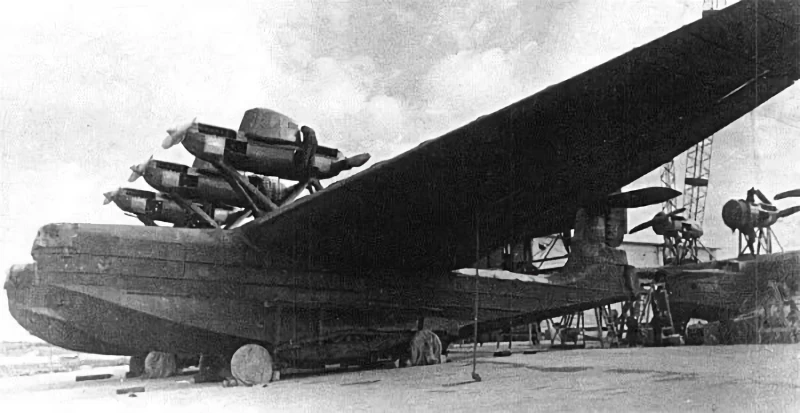
Tupolev ANT-22 Flying Boat
The Tupolev ANT-22 (also designated MK-1, or Morskoi Kreiser – “Sea Cruiser”) was the largest flying boat built in the Soviet Union during the 1930s and one of the most ambitious seaplane projects of its era. Designed by the Tupolev Design Bureau under the leadership of Andrei Tupolev, the prototype first flew in 1934. It was intended as a long-range maritime reconnaissance aircraft capable of carrying heavy bomb loads while also performing naval patrol, transport, and anti-shipping missions.
The ANT-22 featured an unusual twin-hull configuration joined by a broad centre wing, providing excellent stability on water and ample internal space for fuel, crew, and military equipment. Constructed largely from corrugated duralumin, a trademark of Tupolev aircraft of the period, it had an impressive wingspan of over 50 metres. Power was supplied by six Mikulin M-34R liquid-cooled V-12 engines arranged in tandem push-pull pairs mounted above the wing. This configuration was intended to maximise thrust while reducing asymmetric handling should an engine fail.
The aircraft’s large size allowed it to carry a substantial payload, including bombs, defensive armament, and a crew of up to a dozen personnel. Multiple gun positions gave it reasonable defensive capability for the time, while its endurance made it suitable for long-range patrols over the Baltic and Black Seas. During testing, the ANT-22 demonstrated respectable handling characteristics despite its immense dimensions, but its overall performance fell short of expectations. The aircraft proved underpowered, and maintenance of its six-engine arrangement was complex and labour-intensive.
Only a single prototype was completed. By the mid-1930s, advances in aircraft design were favouring faster, more efficient land-based bombers and more conventional flying boats, reducing the military value of such an enormous seaplane. Consequently, the ANT-22 never entered serial production.


