
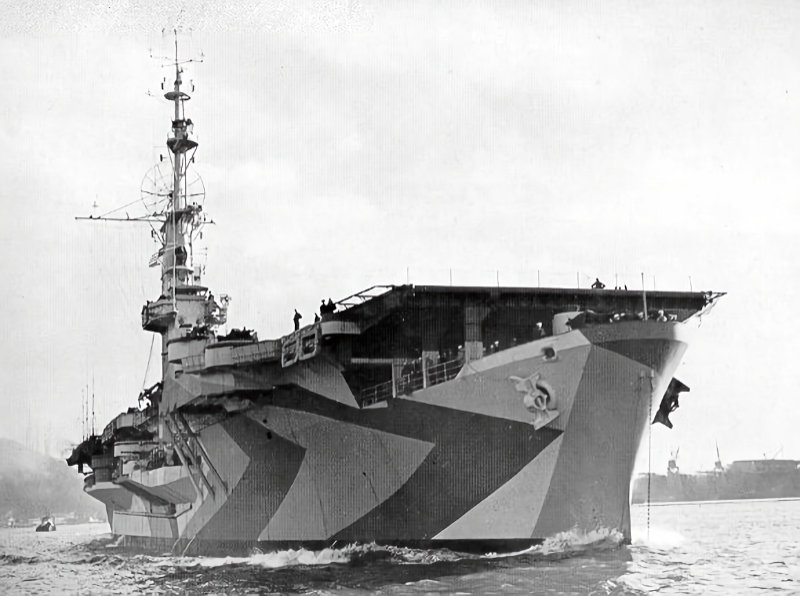
US Navy Escort Carrier USS Block Island CVE-106
USS Block Island (CVE-106) emerged from the United States Navy’s wartime effort to expand intermediate aviation capacity for escort, anti submarine, and amphibious support operations. She was a Commencement Bay-class escort carrier constructed on a merchant style hull utilising shipyard production efficiencies that enabled rapid output under the Emergency Shipbuilding Program. The vessel was laid down by the Todd-Pacific Shipyards, Inc Tacoma, Washington on 15 October 1943, launched on 10 June 1944, and commissioned into service on 30 December of the same year under the command of Captain Francis M Hughes.
Escort carriers such as Block Island were pragmatically engineered platforms. They offered a limited but reliable flight deck, modest aviation complement, economical propulsion, and acceptable self defence armament. The class was not designed for high speed manoeuvre warfare alongside fleet carriers but rather for sustained station keeping and sortie generation in support of convoys and amphibious landings. The naming of CVE-106 honoured the first USS Block Island (CVE-21), which had been sunk in 1944 by U-boat action in the Atlantic.
Design Characteristics and Capabilities
Block Island displaced approximately 10,400 tonnes at full load. Her length overall measured roughly 156 metres with a beam suitable for a compact flight deck equipped with a single aircraft lift and associated hangar. Aviation capacity fluctuated depending on operational tasking but generally consisted of twenty four to thirty aircraft combining fighters for combat air patrol and Avengers for strike, anti shipping, and anti submarine warfare. The propulsion plant was a single shaft turbo electric drive rated at approximately 9,000 horsepower that provided a maximum speed of about nineteen knots. This performance was sufficient to escort convoys and support amphibious operations, though inadequate for participation in fast carrier task groups.
Defensive armament typically included two 5 in (127 mm) dual-purpose guns and a mixture of 40 mm Bofors and 20 mm Oerlikon mounts that offered local air defence against low altitude dive bombers, torpedo aircraft and later kamikaze attackers. Armour protection was minimal. The class relied on dispersal, manoeuvre, and layered screening by destroyers and destroyer escorts for survivability. While operational limitations were well understood by naval planners, escort carriers were nonetheless valued for their ability to provide persistent reconnaissance and strike options in areas where land based aviation could not be rapidly positioned.
Operational Service in the Pacific
Block Island entered the Pacific theater during the final phases of the Second World War when United States carrier aviation dominated maritime operations. She was assigned to task groups supporting the Okinawa campaign in 1945 where escort carriers were tasked with combat air support, maritime interdiction, and anti submarine patrols. For several months the ship launched Avengers and Wildcats against Japanese coastal traffic, small craft, and ground targets while also maintaining combat air patrol in coordination with other CVE units.
The Okinawa operation exposed escort carriers to intense Japanese air action, particularly suicide attacks that sought to overwhelm defensive screens and strike vulnerable ships. Block Island avoided catastrophic hits during this period, yet the tempo of flight operations and the hazard environment underscored the vulnerabilities of the type. Despite such limitations, escort carriers were indispensable for close support missions around Okinawa since their sortie density and station endurance made them logistically efficient tools for ground support and maritime interdiction.
Postwar Roles and Demobilisation
Post-war, Block Island was used as a training carrier until 1954 when she was placed in reserve. Consideration was given to modifying her into an amphibious assault ship, however this proved too expensive and the availability of Essex-class ships provided a better option. Block Island was struck from the Naval Vessel Register on 1 June 1959 and sold for scrap in December 1960.
Photographs of USS Block Island (CVE-106)
- World War Two
- Post World War Two
- Repatriation of Former Prisoners of War.
- Fire Fighting Facilities
- Aircraft Operations
World War Two


Post World War Two


Repatriation of Former Prisoners of War


Liberated British and Australian prisoners from a Formosan prison camp get their first real meal aboard USS Block Island (CVE-106) after a three-year confinement.

Bombardier Walter G. McFarlane, liberated after 3.5 years captive at Singapore, enjoys the comforts provided on the hangar deck of USS Block Island (CVE-106)

Fire Fighting Facilities
The photos below were taken aboard USS Block Island (CVE-106) in 1952.


Aircraft Operations
Grumman AF-2S Guardian

Grumman F6F Hellcat


Grumman TBM Avenger


Vought F4U Corsair


References
Blair, C. 1996. Hitler’s U Boat War: The Hunted 1942 to 1945. Random House, New York.
Chesneau, R. (ed.) 1980. Conway’s All the World’s Fighting Ships 1922 to 1946. Conway Maritime Press, London.
Friedman, N. 1983. U.S. Aircraft Carriers: An Illustrated Design History. Naval Institute Press, Annapolis.
Hone, T. and Hone, T. 1993. Innovation and the U.S. Navy: The Development of Carrier Aviation 1917 to 1941. Naval Institute Press, Annapolis.
Morison, S. E. 1960. History of United States Naval Operations in World War II, Volume XIV. Little, Brown and Company, Boston.
Naval History and Heritage Command. 2023. “USS Block Island (CVE-106).” United States Navy Historical Reference Portal.
Sears, D. 2007. Pacific Air: How Fearless Flyboys, Peerless Aircraft, and Fast Flattops Conquered the Pacific War. Da Capo Press, Cambridge.