
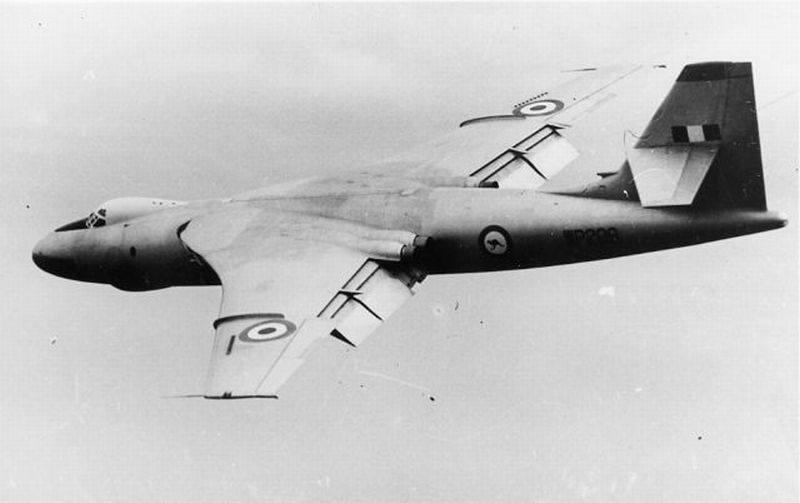
Vickers Valiant in Australia
Australia played a significant role in the operational history of the Vickers Valiant, the first of Britain’s V-bombers. Between 1955 and 1963, numerous Valiants operated from Australian bases in support of weapons trials, nuclear testing, photographic reconnaissance, missile development, and long-range survey missions. Australia’s vast test ranges at Woomera and Maralinga made the country an important partner in Britain’s Cold War weapons programmes.
The first Valiant closely associated with Australia was WP209, which arrived at the Long Range Weapons Establishment at Woomera in August 1955. Attached to the Air Trials Unit, the aircraft assumed bomb ballistic and weapons-development duties previously undertaken by Avro Lincolns and English Electric Canberras. Operated by RAF crews, often accompanied by RAAF personnel, WP209 remained in Australia until October 1960. During its delivery flight from Britain it established impressive speed records between London and Baghdad and between Singapore and Darwin.
In September 1955, WP206 and WP207 visited Australia as part of Operation Too Right, a demonstration and tropical trials tour intended to showcase Britain’s newest strategic bomber. WP207, flown by Flight Lieutenant Roy Mather, arrived at Sydney’s Mascot Airport after a record-breaking flight from Perth. The aircraft subsequently toured Melbourne, Adelaide, and New Zealand. While landing at Melbourne, WP207 suffered a locked brake and burst tyre, an incident that generated considerable newspaper coverage. Both aircraft attracted large public crowds wherever they appeared. WP206 later returned to Australia and was employed in weapons-trial activities, remaining associated with Australian operations until 1963.
Australia also played a central role in Britain’s nuclear weapons programme. During Operation Buffalo at Maralinga in 1956, Valiants participated in trials involving the Blue Danube nuclear weapon. On 11 October 1956, WZ366 became the first RAF aircraft to drop a British operational atomic bomb when it released a Blue Danube device over the Maralinga test range. The event marked a major milestone in British nuclear capability.
Additional Valiants were deployed during Operation Antler in 1957. Photo-reconnaissance aircraft WZ391 and WZ392 operated from RAAF Edinburgh as part of Air Task Group Antler, conducting photographic and scientific missions before and after the detonations. On 11 October 1957, WZ366 again played a direct role in weapons testing, while WZ378 and WZ381 photographed the nuclear trials and recorded valuable scientific data.
Australia was also used for reconnaissance and survey work. The prototype photographic reconnaissance Valiant, WP205, conducted photo-reconnaissance trials in Australia between October 1956 and March 1957. Later, during Operation Bafford in 1962, reconnaissance Valiants WZ391, WZ392, WZ304, and WZ307 operated from RAAF Townsville. Flying 47 sorties, they surveyed large areas of the South Pacific, including New Guinea, the Solomon Islands, the Santa Cruz Islands and the New Hebrides.
Another major Australian contribution involved development of the Blue Steel stand-off nuclear missile. Between 1959 and 1963, several Valiants operated from RAAF Edinburgh under the control of A.V. Roe & Company. These included WP204, WZ203, WZ370, WZ373, and WZ375. The aircraft were used in missile development, carriage trials, systems testing and evaluation work that supported Britain’s airborne nuclear deterrent.
Although not based in Australia, XD822 represented the culmination of the weapons-development work in which Australia had played a major role. During Operation Grapple in 1958, XD822 dropped the Orange Herald and Flagpole nuclear devices from Christmas Island (Kiritimati) in the central Pacific. The operational experience gained through years of trials at Woomera and Maralinga helped establish many of the procedures later used during Britain’s thermonuclear testing programme.


