
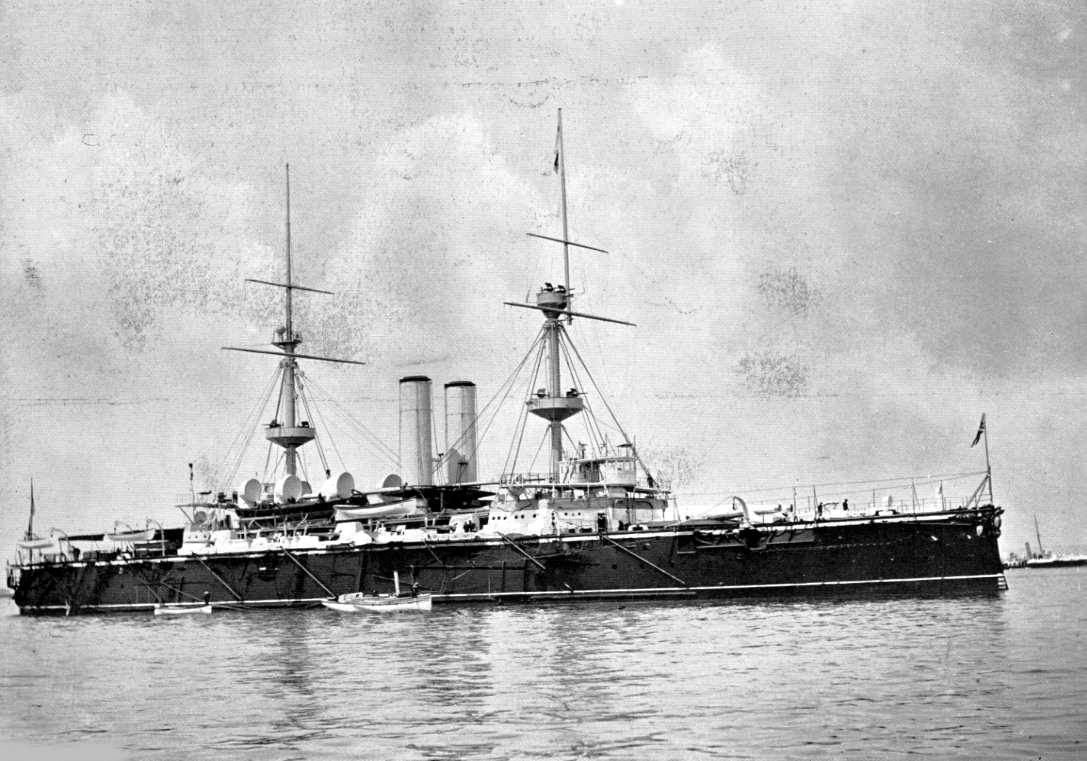
British Pre-Dreadnought Battleship HMS Empress of India (1891)
HMS Empress of India was one of eight Royal Sovereign class pre dreadnought battleships authorised under the Naval Defence Act of 1889. Built at Pembroke Dockyard, she was laid down in 1889, launched in 1891, and completed in 1893. The class represented a decisive move away from the low freeboard turret ships of the 1880s toward a higher freeboard design that offered improved seakeeping, better fighting efficiency in heavy weather, and a more balanced combination of armour and armament.
Displacing about 14,150 tons at normal load, Empress of India measured roughly 380 feet in length with a beam of 75 feet. Her machinery consisted of two sets of triple expansion engines supplied by cylindrical boilers, producing approximately 13,000 indicated horsepower for a designed speed of about 17.5 knots. Coal bunkerage gave her the endurance required for sustained fleet operations and imperial deployments.
Her main armament comprised four 13.5 inch breech loading guns mounted in two twin barbettes, fore and aft. The secondary battery included ten 6 inch quick firing guns in broadside casemates, supplemented by lighter quick firing weapons and torpedo tubes. Armour protection followed contemporary practice, with a thick compound belt over the vital areas, heavily protected barbettes, and an armoured deck.
On commissioning, Empress of India joined the Channel Fleet, then one of the Royal Navy’s principal battle formations in home waters. She subsequently served in the Mediterranean Fleet, where British capital ships maintained a strong presence amid great power rivalry and regional instability. Like her sisters, she participated in regular fleet manoeuvres that tested evolving tactical doctrines as gunnery, fire control, and propulsion technology advanced rapidly in the pre dreadnought era.
By the first decade of the twentieth century, successive improvements in battleship design had rendered the Royal Sovereign class obsolescent. The advent of the all big gun battleship, inaugurated by HMS Dreadnought in 1906, decisively eclipsed earlier types. Empress of India was reduced to subsidiary duties before being selected for use as a target ship. In 1913 she was expended as a live firing target during exercises.
| Displacement | 14,150 long tons (14,380 t) |
|---|---|
| Length | 380 ft (115.8 m) (pp) |
| Beam | 75 ft (22.9 m) |
| Draught | 27 ft 6 in (8.4 m) |
| Installed power | 11,000 ihp (8,200 kW) 8 cylindrical boilers |
| Propulsion | 2 shafts; 2 Triple-expansion steam engines |
| Speed | 17.5 knots (32.4 km/h; 20.1 mph) |
| Range | 4,720 nmi (8,740 km; 5,430 mi) @ 10 knots (19 km/h; 12 mph) |
| Complement | 670 |
| Armament | 2 × twin 13.5 in (343 mm) guns 10 × single 6 in (152 mm) guns 10 × single 6-pdr (57 mm (2.2 in)) guns 12 × single 3-pdr (47 mm (1.9 in)) guns 7 × 18-inch (450 mm) torpedo tubes |
| Armour | Main belt: 14–18 in (356–457 mm) Bulkheads: 14–16 in (356–406 mm) Barbettes: 11–17 in (279–432 mm) Casemates: 6 in (152 mm) Conning tower: 14 in (356 mm) Deck: 2.5–3 in (64–76 mm) |


References
Burt, R. A. British Battleships 1889–1904. London: Arms and Armour Press, 1988.
Chesneau, Roger, and Eugene M. Kolesnik, eds. Conway’s All the World’s Fighting Ships 1860–1905. London: Conway Maritime Press, 1979.
Gardiner, Robert, ed. Conway’s All the World’s Fighting Ships 1906–1921. London: Conway Maritime Press, 1985.
Brown, David K. Warrior to Dreadnought: Warship Development 1860–1905. London: Chatham Publishing, 1997.
Parkes, Oscar. British Battleships. London: Seeley Service, 1957.
Roberts, John. The Battleship Dreadnought. London: Conway Maritime Press, 1992.