
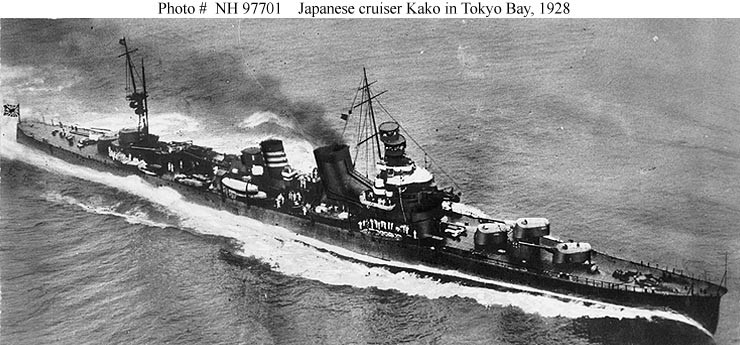
Japanese Heavy Cruiser Kako
The Japanese heavy cruiser Kako was one of the earliest heavy cruisers built for the Imperial Japanese Navy under the limitations of the Washington Naval Treaty. She was the second vessel of the Furutaka class, which represented Japan’s first generation of treaty-compliant heavy cruisers designed to combine strong armament with high speed and long operational range.
Kako was laid down at Kawasaki Shipyard in Kobe in 1922, launched in 1925, and commissioned in 1926. Like her sister ship Furutaka, she was initially armed with six 200 mm guns in single turrets, arranged along the centreline. This configuration reflected pre-treaty cruiser design concepts but soon proved less efficient than newer turret arrangements. During a major modernisation in the mid-1930s, Kako was rebuilt with three twin 203 mm gun turrets, significantly improving her firepower and combat effectiveness. The refit also included upgraded torpedo armament, improved aircraft handling facilities, and enhanced machinery performance.
By the time the Pacific War began in December 1941, Kako served with Cruiser Division 6 alongside Furutaka, Aoba, and Kinugasa. The division supported Japanese amphibious operations across the western Pacific. In August 1942, Kako participated in the Battle of Savo Island, part of the Guadalcanal campaign. During this night engagement, Japanese cruiser forces surprised Allied naval units and sank several cruisers in one of the most decisive Japanese surface victories of the war.
Despite surviving the battle itself, Kako was lost shortly afterward. On 10 August 1942, while returning to base at Kavieng, she was attacked by the American submarine USS S-44. The submarine fired a spread of torpedoes that struck the cruiser, causing catastrophic damage. Kako sank rapidly, with the loss of 68 crew, although another 649 were rescued.


