
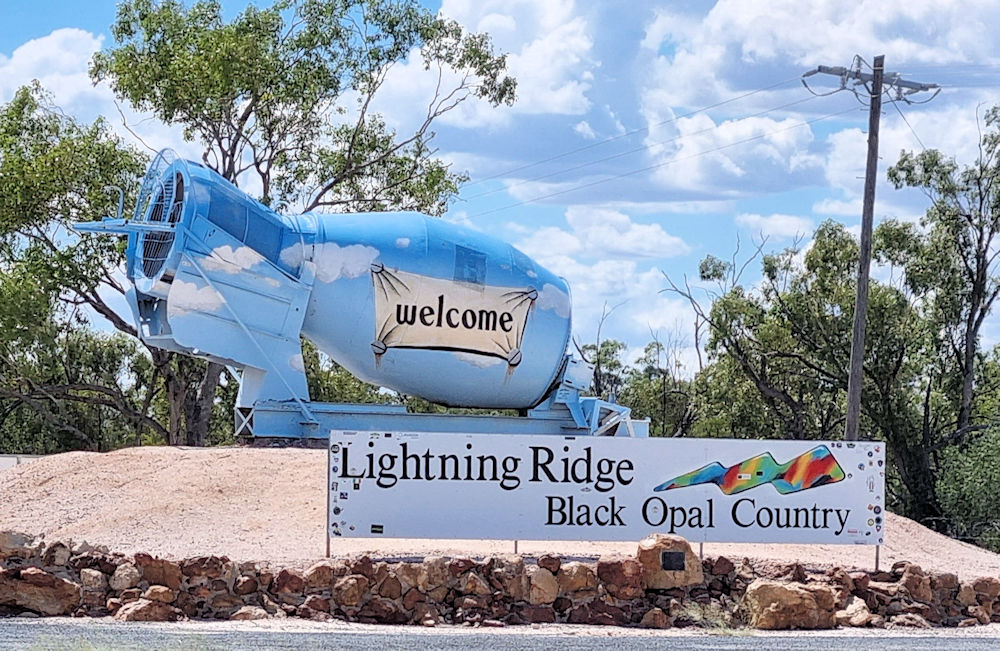
Lightning Ridge and Black Opals
Lightning Ridge is a remote outback town in north-western New South Wales, internationally renowned as the primary source of the rare and valuable black opal. Situated near the Queensland border, it lies within a semi-arid landscape characterised by low scrub, red soils, and wide horizons. The town’s origins date to the late nineteenth century, when opal were first discovered in the area, triggering intermittent rushes that shaped its development and identity.
Opal mining remains central to Lightning Ridge’s economy and culture. Unlike large-scale industrial operations, much of the mining here is conducted by individuals or small syndicates using relatively simple equipment. This has produced a distinctive landscape dotted with mullock heaps, shafts, and scattered claims. The rarity of black opal, noted for its dark body tone and vivid play of colour, has ensured the town’s global reputation among gem traders and collectors.
The population is small and highly diverse, with a strong presence of itinerant miners, artists, and retirees. This mix contributes to a unique social fabric marked by independence and creativity. The town has also developed a modest tourism industry centred on its opal heritage and unconventional attractions. In addition to opals and historic mining sites and underground tours, the town offers art galleries, quirky architecture and hot artesian baths.
Car Door Tours
The Car Door Tours in Lightning Ridge are a quirky set of self-guided driving routes that help visitors explore the town and surrounding opal fields. Instead of conventional road signs, the routes are marked by old car doors painted in bright colours and placed beside the road. Each door has a number that corresponds to a stop on a map, allowing travellers to follow the route from one attraction to the next.
The idea fits the eccentric character of Lightning Ridge, famous for its creativity and humour. Local residents came up with the system as a simple way to guide tourists around the district without formal signage. The result is both practical and distinctive, turning discarded car doors into landmarks that are instantly recognisable.
There are several different tours, each identified by a colour. The Green, Blue, Yellow, Red, and Orange car door routes take visitors to different parts of the town and the surrounding opal fields. Most of the routes take about thirty to forty minutes of driving time, although we spent longer as we stopped at the various attractions.
Each route highlights different aspects of the district. The Green Car Door Tour includes sites such as Nettleton’s First Shaft Lookout, associated with early opal mining history. The Blue Car Door Tour passes opal mines and attractions like underground mine tours and cactus gardens. The Yellow Car Door Tour leads to places such as the Chambers of the Black Hand sculpture galleries, while the Red Car Door Tour travels through several opal fields and past unusual local landmarks including handmade structures like Amigo’s Castle. The longer Orange Car Door Tour heads farther into the mining country and visits the famous “Three Pubs in the Scrub” and other remote communities.
Overall, the Car Door Tours combine history, landscape and local eccentricity. They guide visitors past opal mines, unusual buildings, artworks, lookouts and mining camps, giving a sense of the rugged lifestyle that developed around the black opal industry. The painted car doors themselves have become one of Lightning Ridge’s most recognisable symbols, reflecting the town’s inventive outback character. We really enjoyed following the tours, finding them the best way to see everything Lightning Ridge has to offer.
Red Door

Ridge Castle
Ridge Castle is not a historic European-style fortress despite its name. Instead, it is a hand-built, whimsical mining camp structure created by local miners using available materials such as stone, scrap metal, and even car parts. Its design includes features like a turret, courtyard, and rough-hewn “castle” walls, giving it a medieval appearance. There are several places to stop at nearby so that you can get out to take photos.

Lightning Ridge KFC
At some point, someone acquired a KFC sign and placed it here. No, there is not a KFC in Lightning Ridge, nor any other fast food outlet.

Amigo’s Castle
Amigo’s Castle is another quirky landmark in Lightning Ridge. Built by Italian-born opal miner Vittorio “Amigo” Stefanato, the castle is a remarkable handmade stone structure that began in the mid-1980s. Using ironstone boulders collected from the surrounding opal fields, Amigo constructed the entire building himself without formal plans or architectural training.
The result is a 15-metre-tall, unfinished castle inspired by the ruins of his homeland in Italy. Open to the public, there is an entrance fee. Unfortunately, it was closed during our visit.

Bottle House
The Bottle House promotes itself as an an interesting and educational. Unfortunately, we found it a bit rundown and in need of some love and attention. If you have kids they might find it fun. There is a fee for admission.


Blue Door

Bevan’s Cactus Nursery
Bevan’s Cactus Nursery in Lightning Ridge is one of the town’s most distinctive visitor attractions. Established in 1966 by local opal miner John Bevan and his wife Elizabeth, the garden grew from a private collection into one of the largest displays of cacti in Australia. The nursery contains more than 2,500 species of cactus and succulent plants collected from arid regions around the world, particularly the Americas. Many specimens are decades old and thrive in the hot, dry climate of the Lightning Ridge opal fields. Walking paths wind through dense plantings, allowing you to see the remarkable variety of shapes and sizes found among desert plants. There is an entry fee. If no-one is at the office a mobile phone number is provided. We used the phone number, and they we with us within a minute to let us in and give a quick introduction to the gardens.


Yellow Door

Chamber of the Black Hand
Chambers of the Black Hand is one of the best attractions in Lightning Ridge, combining opal mining history with underground sculpture. The chambers are located about eleven metres below the surface in a disused opal mine that was gradually transformed into a subterranean gallery. Work on the carvings began in 1986 when local miner and artist Ron Canlin started shaping figures and scenes directly into the soft sandstone walls left behind by earlier mining operations.
Over time the underground passages were expanded into a series of themed chambers. Walking through the tunnels you encounter hundreds of sculptures carved from the rock, including religious scenes, historical figures, animals and popular cultural characters. Among the subjects are depictions of well known leaders, mythological figures and moments from Australian history. The carvings are illuminated by soft lighting, which highlights the texture of the sandstone and adds to the atmosphere of the underground space.
Two tours are offered. The first is for the sculpture galleries. This starts with a short talk, after which you are free to wander around and view the art works. The second also includes a guided tour of the opal mine which is beneath the sculpture galleries.
Both tours start by descending 80 stairs to the first level. From here a tour guide led us down a sloping passage to the mine lower down. The guide was an opal miner, so he was full of information and real knowledge of mining in the area. We spent the next 45 minutes looking through old working and learning about the history of Lightning Ridge. Although some miners became very rich, most barely broke even and many lost money. Our guide said he makes more money as a guide than a miner.


Lunatic Hill


Four Mile Opal Fields
The Four Mile field lies a short distance from the main township and, like many Ridge fields, is named according to its approximate distance from the original settlement. The Four Mile field was actively worked during the early to mid-20th century, particularly from the 1930s onward. Today, the Four Mile area retains visible evidence of historic mining such as mullock heaps, shafts, and diggings scattered across the landscape. You can drive through the area, but beware of shafts and old workings.

Stanley the Emu
Stanley is a giant 18 metre tall emu built from recycled materials, including old Volkswagen Beetle parts, scrap steel, and satellite dishes, mounted on a steel framework. Located about 10 km outside Lightning Ridge on the Castlereagh Highway, access is easy as there is a rest area opposite. The sculpture was completed around 2013 by local artist John Murray.

Green Door
Nettleton’s First Shaft Lookout
Nettleton’s First Shaft Lookout is an important historic site connected with the early development of the Lightning Ridge black opal fields. The lookout marks the location where miner Jack Nettleton is believed to have sunk one of the first shafts in the district after the discovery of black opal in 1901. Nettleton had reportedly been shown pieces of the unusual dark opal by local station workers and Aboriginal people, prompting him to investigate the ridge and begin mining.
From this early shaft, Nettleton recovered parcels of black opal which helped demonstrate the value of the field and encouraged other prospectors to move into the area. In the following years Lightning Ridge developed into one of the world’s most important sources of black opal.
Today the site is a popular lookout that provides views across the surrounding opal fields and mullock heaps. It is included on the Green Car Door Tour and serves as a reminder of the beginnings of the Lightning Ridge mining industry.


Stone Labyrinth
Stone Labyrinth is a distinctive outdoor artwork located on the outskirts of Lightning Ridge near Nettleton’s First Shaft Lookout. The site consists of a winding labyrinth pattern created from local stones laid out across the ground, forming a circular pathway that visitors can walk through. The design follows the traditional style of a meditation labyrinth rather than a maze, meaning there is only a single path that leads gradually to the centre and then back out again.

Beer Can House
Located near Nettleton’s First Shaft Lookout, on the McDonalds Six Mile opal field, the Beer Can House, is, as the name suggests made mostly from beer cans. Although abandoned, it’s an interesting stop, especially if your on the Green Car Door Tour and looking at the adjacent lookout and labyrinth. Visitors can sign a guest book kept inside an old fridge at the house.


Other Attractions
John Murray Gallery
The John Murray Art Gallery is the official gallery for the work of John Murray, one of Lightning Ridge’s best‑known contemporary painters. Located at 8 Opal Street, the gallery serves as the exclusive outlet for his original artworks, prints, cards and souvenirs, and is a highlight for those interested in the artistic culture of the outback sandstone town.
Murray’s paintings are celebrated for their vivid depictions of the Australian Outback, capturing the unique light, colours and characters of life in remote New South Wales with striking detail and often a touch of humour. Works on display range from landscapes and town scenes to depictions of people and animals that reflect the culture and environment surrounding Lightning Ridge.
The gallery is open most days and welcomes visitors of all ages. In addition to original paintings, it offers a wide range of prints as well as posters and stationery, making it both a cultural experience and a place to take home a piece of Ridge art.
Murray’s art extends beyond the gallery walls; he has also painted significant public works in the region (Walgett and Gulargambone), and was recognised as a finalist in the 2021 Australian Street Art Awards, underlining his influence on the visual identity of the town and wider outback. Entry is free, but no photos allowed inside. However, if you want some photos there are some placed outside the gallery you can photograph.


Cottage Hospital Gallery
The gallery complex is centred on two historic buildings relocated to 7 Morilla Street, just past the Crocodile Caravan Park. The first is a 1930s opal miner’s hut furnished and preserved to illustrate the living conditions of early Ridge residents, with dirt floors, simple domestic fittings and memorabilia from the era. The second, the 1915 Bush Nurse Association cottage (Cottage Hospital), was originally built to provide basic health care in the isolated community and was part of one of the state’s earliest bush nursing initiatives. It now houses historical photographs, nurse memorabilia and interpretive displays highlighting the challenges of outback health services.
Unfortunately closed during our visit, we only had a look around the outside of the buildings.


Cooper’s Cottage
Built in 1916, it is one of the oldest surviving miner’s homes in the district and was constructed using whatever materials were available in the remote outback at that time. Located at 20 Morilla Street, it’s almost opposite the Lightning Ridge District Bowling Club.
The cottage reflects the rudimentary lifestyle and resourcefulness of early pioneers who sought their fortunes in the rugged opal fields. Walls of corrugated iron, a simple cypress pine frame and an earth floor demonstrate how miners made do with basic supplies, adapting to extreme conditions and limited resources. Over the decades the building remained in use; its last long‑term resident lived there until the 1990s before it became preserved as a historic site.


Artesian Baths
Artesian Bore Baths are one of the most iconic and enduring attractions in Lightning Ridge, offering both relaxation and a glimpse into the region’s unique outback environment. The baths are fed by natural artesian bore water, which emerges from deep underground aquifers at a constant temperature of around 42 degrees Celsius. This mineral-rich water has long been valued for its soothing and therapeutic properties, making the baths a popular destination for miners, locals, and visitors.
The site developed around the early 20th century when artesian bores were drilled to provide reliable water for mining and domestic use in the arid climate. Miners quickly discovered that soaking in the warm water provided relief after long hours underground, and over time the baths became a social hub for the community. Today, the baths consist of several large pools, surrounded by simple facilities that preserve the rustic charm of the original establishment.
Entry is free and you can enjoy the relaxing warmth of the mineral water while taking in views of the surrounding opal fields and low desert hills. The baths are accessible year-round and are particularly popular in winter when the contrast between the cool outback air and the hot water is most striking.
Located on Pandora Street, the baths are on the north east edge of town.

Peter Cookes’ Mini Golf & Sculpture Park
Peter Cooke’s Mini Golf & Sculpture Park is a unique combination of recreation and art located in Lightning Ridge. The attraction was created by local artist and entrepreneur Peter Cooke, who transformed his property into a family-friendly mini golf course adorned with an extensive collection of whimsical sculptures. The park reflects the creative spirit and eccentric charm that defines the Lightning Ridge community.
The mini golf course features multiple holes set among sculptural installations made from recycled materials, scrap metal, and found objects. Many of the sculptures depict Australian animals, mining scenes, and imaginative fantasy figures, blending playful humour with local cultural references. Each hole presents a different challenge, making the course entertaining for all ages while also encouraging visitors to appreciate the artistry of the surrounding works.
Visitors can wander beyond the golf course along pathways that wind through the sculpture displays, taking in larger pieces that highlight Cooke’s skill in combining everyday materials with creative vision. The park is open year-round and if you only want to walk around an view the sculptures, there is a smaller entry fee than if you also want a round of mini-golf.


Other Places to Visit in New South Wales
To see what else there is to do in New South Wales, click here.
Our photos are available for purchase on
Leave a Reply