
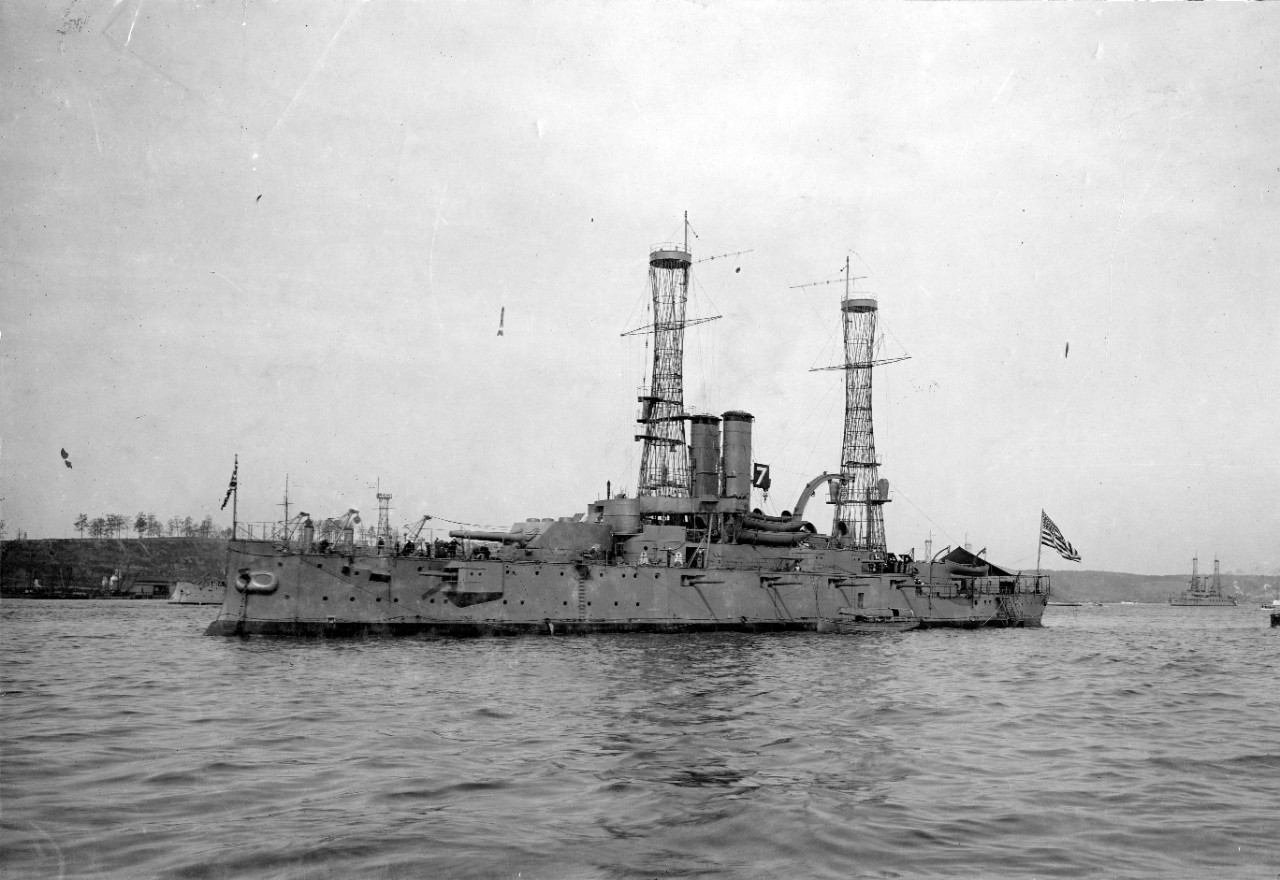
USS Illinois BB-7
USS Illinois (BB-7) was the lead ship of the Illinois-class pre-dreadnought battleships, authorized under the naval expansion program of the late 1890s. The class—Illinois, Alabama (BB-8), and Wisconsin (BB-9)—represented a transitional phase in U.S. capital ship architecture between the lighter Indiana-class and the more advanced pre-dreadnought types that directly preceded HMS Dreadnought (1906). The Illinois-class hull form emphasized improved seakeeping compared with the earlier American low-freeboard battleships. Moreover, the design reflected industrial maturation: American steel production, ordnance fabrication, and marine engineering were now able to support continuous construction of first-line capital ships.
Illinois displaced roughly 11,565 tons standard, with a length of 368 feet and beam of 72 feet. Her propulsion plant comprised two triple-expansion reciprocating engines driving twin screws, supplied by coal-fired boilers, yielding a maximum speed near 16 knots. Armament conformed to pre-dreadnought conventions: a main battery of four 13-inch/35-caliber guns in two twin turrets fore and aft, a secondary battery of fourteen 6-inch guns in casemates, and a tertiary suite of smaller quick-firing guns and machine weapons for defense against torpedo boats. Protection was balanced but weight-constrained. The main belt reached 16.5 inches across vital spaces, with turret, barbet, and conning tower armor scaled accordingly. In architecture and performance the Illinois class was competitive with contemporaries in European navies, yet within a few years the rapid acceleration of dreadnought technology rendered them obsolescent.
Construction and Commissioning
Illinois was built by Newport News Shipbuilding, laid down in early 1897 and launched in October 1898. Protracted fitting-out, gunnery calibration, and machinery trials preceded commissioning in September 1901. The timing is significant: although authorized in the immediate aftermath of the Spanish-American War, Illinois entered service in a fleet that was beginning to articulate a global mission. The U.S. Navy’s General Board sought standardization, larger operational ranges, and improved gunnery. Illinois thus formed part of a learning cycle in fleet tactics, logistics, and training that would culminate in Theodore Roosevelt’s Great White Fleet demonstration of 1907–09.
Early Service and Fleet Integration
Following shakedown, Illinois joined the North Atlantic Fleet, participating in fleet exercises, tactical experiments, and port calls that reflected the Navy’s transition from coastal defense paradigms toward blue-water capability. The ship’s operational tempo was heavy with peacetime training evolutions, including annual gunnery competitions under the influence of Captain William Sims, whose advocacy for continuous-aim firing and centralized fire control significantly advanced U.S. naval gunnery standards. Though Illinois predates full integration of director firing systems, she served as an experimental platform for incremental improvements, especially in range-finding, sighting equipment, and ammunition handling procedures.
In 1907, during preparations for the Great White Fleet, Illinois was assigned to modernization work and did not participate directly in the circumnavigation. However, the cruise indirectly shaped her subsequent employment: as the Navy recognized the operational gap between modern and obsolescent units, pre-dreadnoughts such as Illinois were increasingly relegated to second-line roles.
Pre-World War I Reclassification and Training Duties
By the 1910s Illinois was doctrinally obsolete as a frontline battleship due to the qualitative leap introduced by all-big-gun dreadnoughts and turbine propulsion. In 1910 she was reclassified as a Second Line Battleship, then in 1912 transferred to the Atlantic Reserve Fleet. Rather than decommission immediately, Illinois found extended utility as a training platform for naval recruits and midshipmen. This reflects the Navy’s chronic shortage of dedicated training vessels and the practical value of pre-dreadnought hulls for seamanship evolutions, machinery instruction, and gunnery familiarization.
During this period, modifications were modest: light anti-torpedo armament was reduced, casemate guns were partially deactivated, and berthing, classroom, and instructional spaces were added. The ship’s ability to operate under steam made her suitable for summer cruises designed to inculcate basic navigational and engineering skills among officer candidates.
World War I Employment
Upon U.S. entry into World War I (April 1917), Illinois was mobilized for war service, though her tactical value was limited. The U.S. Navy prioritized dreadnought battleships for convoy escort and Grand Fleet operations, while pre-dreadnoughts filled training and stateside auxiliary roles. Illinois was employed at Norfolk and Philadelphia for gunnery training, accelerating the throughput of naval gun crews for destroyers, cruisers, armed merchantmen, and merchant escorts. These wartime training functions were consequential, as the rapid expansion of the Navy necessitated standardized instruction across thousands of recruits.
Postwar Conversion: From Battleship to Barracks Ship
Technological obsolescence and treaty limitations shaped Illinois’ fate after the war. The Washington Naval Treaty (1922) imposed strict tonnage ceilings on capital ships, compelling the Navy to discard older units. Illinois was formally decommissioned in 1920, but was selected for conversion into a stationary barracks ship rather than scrapping outright. Converted at the Philadelphia Navy Yard, her propulsion machinery was removed or immobilized, armour and major armament stripped, and internal compartments reconfigured for berthing, messing, and administrative space.
Reclassified IX-15, 26 June 1922, the hulk served primarily at New York in support of the Naval Reserve and the U.S. Naval Academy’s summer training detachment. Although no longer seaworthy in strategic terms, IX-15 functioned as a quasi-campus: she provided accommodation for hundreds of reservists, midshipmen, and trainees, enabling structured instruction without requiring new shore facilities. This repurposing fit a broader naval pattern in the interwar period, wherein obsolete pre-dreadnoughts (e.g., USS Kearsarge as Crane Ship No. 1) and armoured cruisers were transformed into auxiliaries to extract continued value under treaty-imposed constraints.
During the 1930s Prairie State continued in this capacity, her external silhouette altered by the removal of funnels, masts, and superstructure elements. The hull was maintained to acceptable habitability standards but not for sea service. As geopolitical tensions rose late in the decade, her facilities supported naval reserve expansion and preliminary training for a generation of officers who would later serve in World War II. She was renamed Prairie State, 23 January 1941 so that her name could be used for the new battleship Illinois.
World War II and Final Disposition
During World War II, Prairie State remained at New York as a stationary housing and training hulk, complementing shore establishments during a period of explosive personnel growth. Her utility rested not in combat capability but in her ability to function as a floating dormitory, freeing scarce shore infrastructure for operational units and specialist schools. The ship’s endurance as an auxiliary speaks to the durability of the Illinois-class hull form and the Navy’s frugality in leveraging treaty-limited assets.
After the war’s conclusion the Navy no longer required the ship. Prairie State was stricken in 1956 and subsequently sold for scrapping, ending a service life spanning more than half a century. In net operational terms, Illinois had spent fewer than twenty years as an active battleship but more than three decades as a barracks and training platform.


![USS Prairie State (IX-15) being moved into position in New York [774 x 308] Originally USS Illinois (BB-7).](https://i0.wp.com/www.destinationsjourney.com/wp-content/uploads/2026/01/USS-Prairie-State-IX-15-being-moved-into-position-in-New-York-774-x-308-Originally-USS-Illinois-BB-7.webp?quality=80&ssl=1)


