
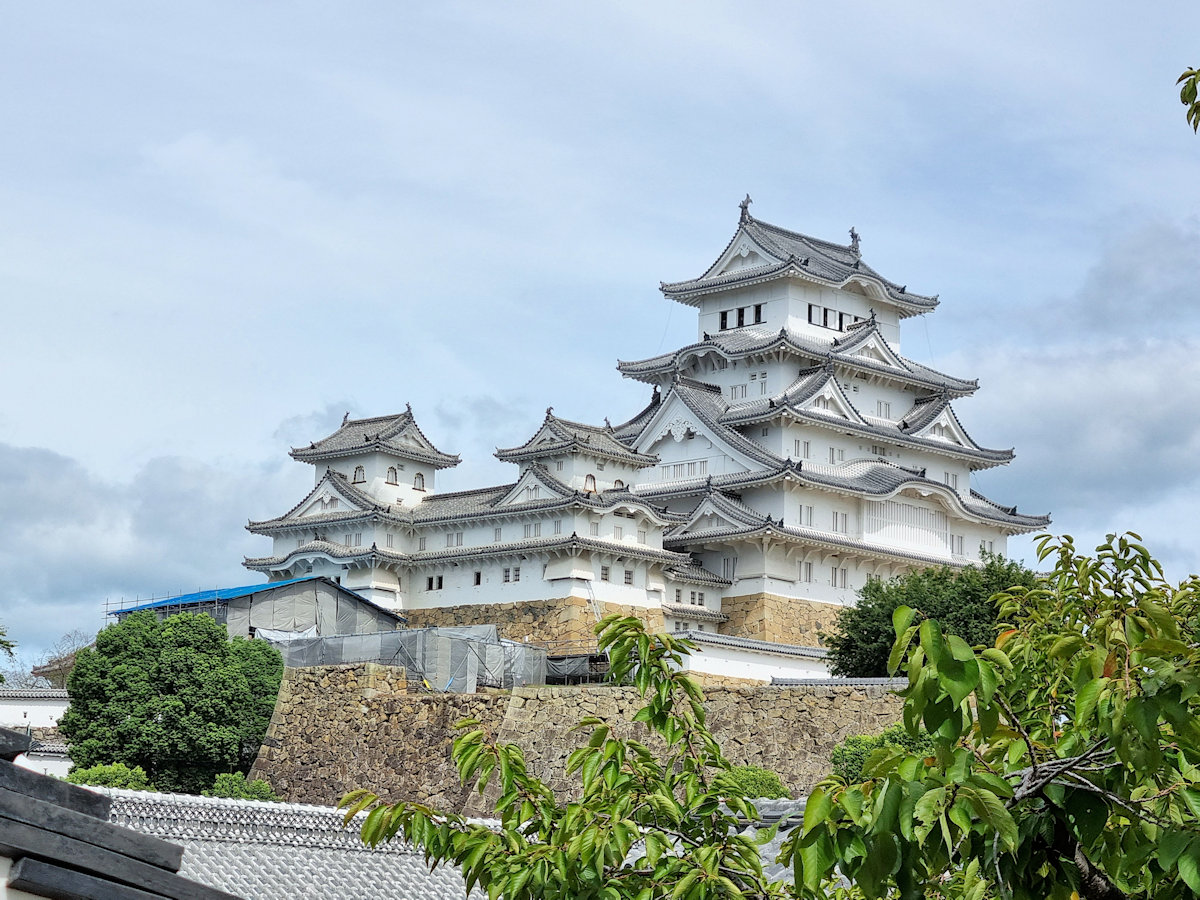
Himeji Castle
Himeji Castle is one of Japan’s most impressive historical landmarks and a magnificent example of traditional Japanese architecture. Located in Himeji, in Hyōgo Prefecture, the castle is famous for its brilliant white walls and elegant appearance, earning it the nickname “White Heron Castle.” It is considered one of the finest surviving castles in Japan and was designated a UNESCO World Heritage Site in 1993.
The castle’s origins date back to 1333, when a fortification was established on the site. Over the centuries, it was expanded and developed by several powerful feudal lords. Its most significant transformation occurred in the early seventeenth century under Ikeda Terumasa, who oversaw major construction between 1601 and 1609.
Himeji Castle has many interesting defensive features including winding pathways, narrow passages, imposing gates and high stone walls. The main keep, with its distinctive white exterior and layered roofs, rises above the surrounding landscape. Inside, wooden staircases and traditional architectural details provide a glimpse into the lives of samurai and feudal rulers.
It is amazing that, Himeji Castle has survived for centuries without being destroyed by war. It escaped the widespread devastation of the Second World War, despite air raids on the surrounding city. Extensive restoration work has helped preserve its original structures which will ensure future generations can see it as well.
The castle grounds are also famous for their natural beauty. In spring, hundreds of cherry trees blossom around the complex, creating a spectacular contrast with the castle’s white walls.
How to Get There
We visited Himeji as a day trip from Kyoto. We caught the train from Kyoto Station to Himeji Station. This took around 90 minutes with a cost of JPY 2,110 (September 2026).
What to Expect
The most remarkable part of our visit was the outside view of the castle. Despite the crowds, it was easy to to move around and see the castle from different angles.
Once inside however, the crowds became larger. At several points, the queue stopped for 10 to 15 minutes to allow people on the upper floor to leave. With only narrow staircases to go up, the attendants restricted how many people could access the upper floor. This also ensured everyone had the same time on this floor.
Apart from some great views, going inside allowed us to see the internal structure. There is, however very little else inside, with only a few displays.
After visiting the castle we walked through the adjacent Koko-en Garden before returning to Kyoto.


To find out more about Japan, see our blogs here
Leave a Reply