
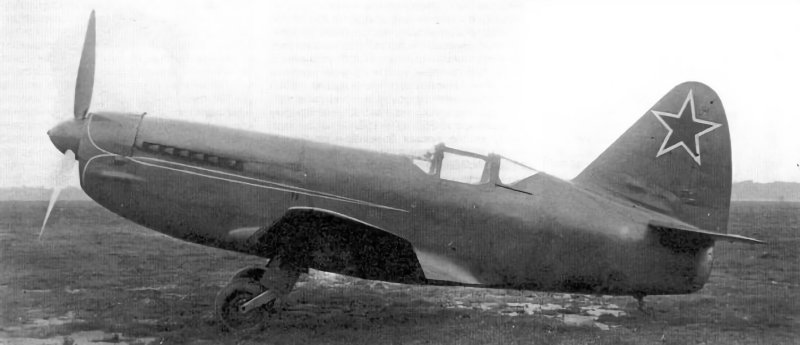
Mikoyan-Gurevich I-250
The Mikoyan-Gurevich I-250, (often called the MiG-13), was a Soviet experimental fighter developed during the final stages of the Second World War. It combined a conventional piston engine with a motorjet propulsion system to achieve higher speeds.
Development began in 1944 as Soviet engineers sought an aircraft capable of competing with emerging German jet fighters. However, Soviet turbojet technology remained immature, prompting Mikoyan-Gurevich to investigate an alternative propulsion system.
The I-250 used a 1,650-horsepower Klimov VK-107A piston engine to drive both a conventional propeller and a compressor for the VRDK motorjet. When activated, the motorjet provided additional thrust for approximately ten minutes, increasing the aircraft’s speed significantly.
The prototype first flew on 3 March 1945. During subsequent testing, the aircraft achieved approximately 820 km/h, making it one of the fastest Soviet fighters of its period. Armament consisted of three 20 mm cannons.
However, development encountered numerous difficulties. Mechanical failures, engine reliability problems and accidents delayed testing. The first prototype crashed during 1945 following a structural failure.
Despite these setbacks, ten aircraft were ordered. Several underwent evaluation with Soviet Naval Aviation, although they never saw combat.
By 1948, advances in turbojet technology had rendered the complicated mixed-power arrangement obsolete. Consequently, the Soviet authorities abandoned further development.


