
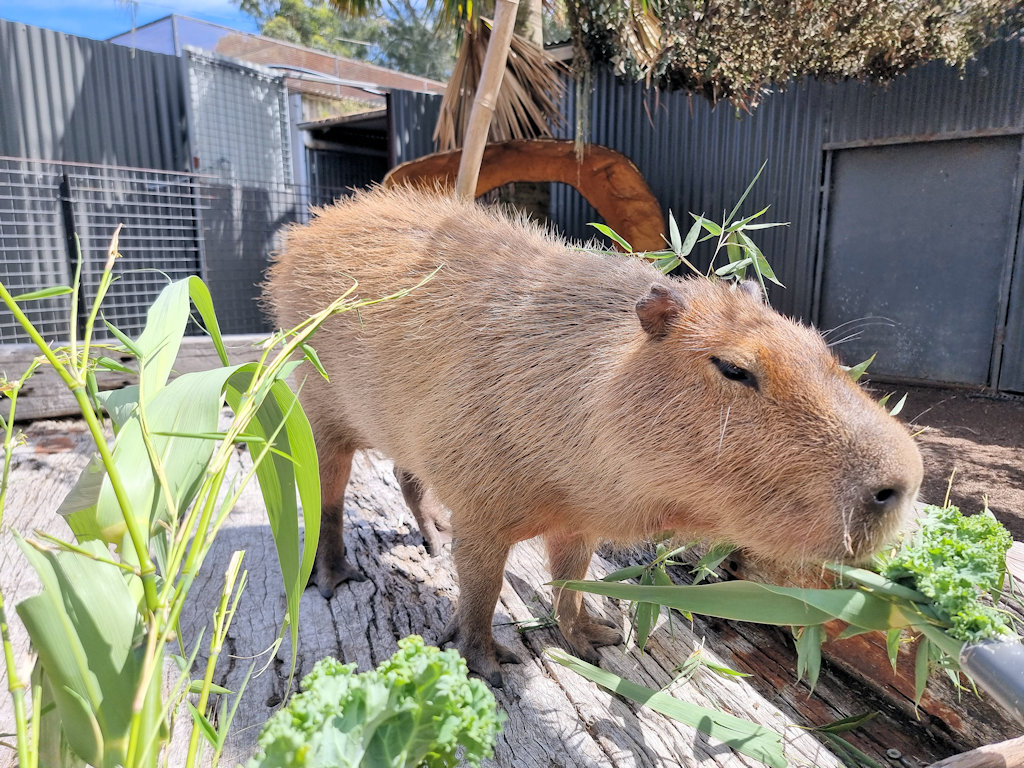
Capybara Encounter Hunter Valley Wildlife Park
In addition to the usual zoo exhibits, the Hunter Valley Wildlife Park offers a close encounter with a capybara.
The capybara is the world’s largest rodent and is native to South America. It lives in groups near rivers, lakes, swamps and other wetlands, where it benefits from abundant vegetation and easy access to water. Its body is barrel-shaped, with short limbs and a small head, giving it a distinctive and compact appearance. Although it is large for a rodent, it moves efficiently on land and swims with confidence.
Capybaras are highly social and often gather in groups that can reach several dozen individuals during the dry season. Because they rely on group structure for protection, they communicate through barks, chirps and whistles to alert one another to potential threats. Their semi-aquatic lifestyle is supported by partially webbed feet and eyes, ears and nostrils positioned high on the head, allowing them to stay mostly submerged while remaining alert.
Their diet consists mainly of grasses and aquatic plants, and they graze for long periods each day. They also practise coprophagy, which allows them to extract additional nutrients from their food. Predators include caimans, jaguars and large birds of prey, although capybaras rely on vigilance and water escape to reduce risk.
The Encounter
Our ranger ran through a quick briefing when we met, so that the experience would be at its best, safe and not stressful for the capybara. Because they can be flighty, we were to keep movements slow, so that we would not frighten her. Also, as we could feed her, holding the food so as not to be bitten was important. Their teeth are sharp and powerful which could result it nasty bites.
Once we entered the enclosure, we sat near a feeding platform while the ranger enticed Isabelle (Izzy) a female capybara to join us. As we were holding some of her favourite snacks she didn’t take long to come over.
We then spent around 20 minutes feeding her. This was great fun as see was so close we were able to pat her too.
Taking photos was permitted and the ranger was happy to take some for us too. This was a great experience especially as capybaras are not native to Australia and this was the first one we had seen.


Other Places to Visit in New South Wales
To see what else there is to do in New South Wales, click here.
Our photos are available for purchase on


Leave a Reply