
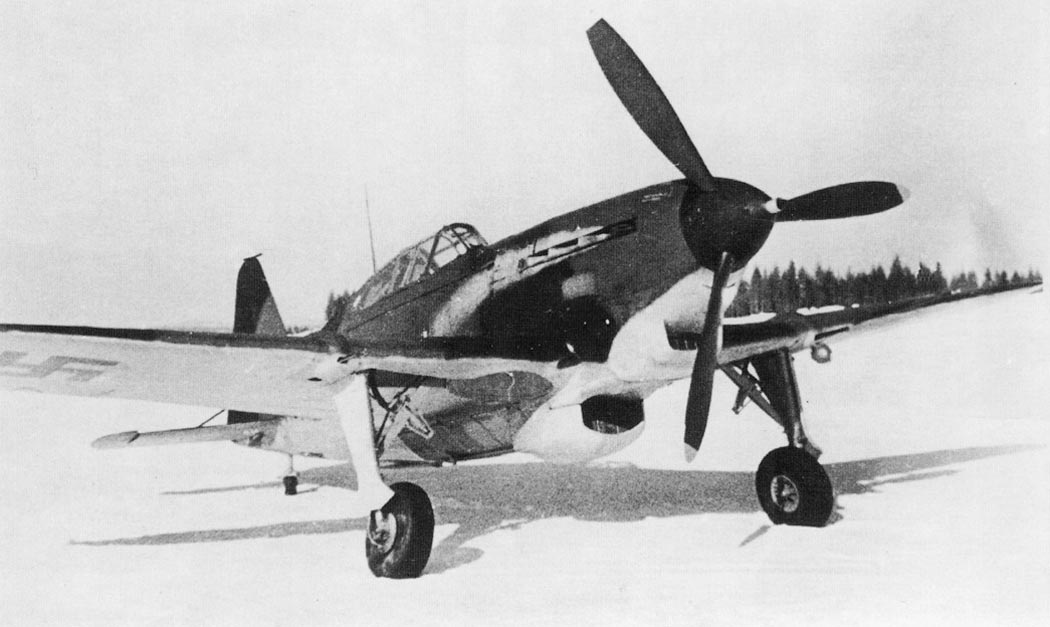
Finnish Mörkö-Morane Fighter Aircraft
The Mörkö-Morane was a Finnish-engineered upgrade of the French Morane-Saulnier M.S.406 fighter during WWII. Faced with rising losses in 1942, Finnish commanders (led by Col. Richard Lorenz) decided to re-engine their obsolete Moranes with captured Soviet Klimov M-105P V-12 engines (1,100 hp) and aerodynamic refinements. Under designer Aarne Lakomaa, the first prototype (MS-631) flew on 25 January 1943. Testing in the summer and autumn of 1943 showed that the Mörkö-Morane performed far above the original. It’s top speed reached 525 km/h and climb 25 m/s. Despite these gains, the Conversion Programme was slow. Only 3 examples (including the prototype) saw combat by the September 1944 end of the Continuation War. Lieutenant Lars Hattinen, Finland’s youngest ace, scored all three of Mörkö-Morane’s air-to-air victories in mid‑1944. After the war, Finland completed all remaining conversions (totalling 41 aircraft) for training use by 1948. The last Finnish Moranes were scrapped by 1952.
Technical Modifications
The Mörkö-Morane combined the MS.406 airframe with a Soviet engine and new subsystems. Key changes included:
- Engine: The 860 hp Hispano-Suiza 12Y-31 was replaced by the 1,100 hp Klimov M-105P (HS 12Y-31 derivative) driving a three-blade fully-adjustable propeller. The new engine required a slimmer, pointed cowling (for the supercharger intake) and minor airframe reinforcement around the nose. Total empty weight increased 10–15% (roughly 200–300 kg) and armament added weight, but pilots found the heavier fighter still very agile.
- Cooling: The original MS.406 radiator proved insufficient for the hotter Klimov engine. The modification program designed a new coolant radiator and oil cooler. Finnish engineers adopted the oil cooler from the Bf 109G, fitted under the nose.
- Armament: Retaining firepower was critical. The Mörkö-Morane’s nose cannon was replaced by a 20 mm MG 151/20. This was superior to the old Hispano-Suiza HS.9/404 cannon in rate of fire and reliability. However, MG 151s were in short supply, so some conversions used captured Soviet 12.7 mm UB machine guns in the nose. In addition, most aircraft kept the wing guns from the MS.406/410: the Finnish conversions typically had four 7.5 mm machine guns (belts-fed Colt-Browning or Berezin guns) in the wings, matching the MS.410 armament. (The first prototype briefly flew with only two wing guns, but series conversions had four.)
- Aerodynamics: Aerodynamic refinements came chiefly from the engine installation: besides the sleeker cowling, work was done on the exhaust stack and supercharger intake. There was no major change to wing or tail planform. Finnish records note minor corrections to centre-of-gravity (forward ballast) due to the heavier engine. The undercarriage and canopy remained standard MS.406.
Performance gains: The modifications gave dramatic speed and ceiling improvements. Official measurements showed a 40–64 km/h increase in top speed; cruise speed rose from 375 to 435 km/h at sea level, and maximum speed to 525 km/h. Service ceiling climbed from 8,500 m to 12,000 m. Climb rate doubled to 25 m/s. Its heavier weight (loaded 2,850 kg vs MS.406 2,600 kg) reduced agility slightly, but by most accounts the Mörkö remained highly manoeuvrable and recovered well in dives. Finnish pilots typically regarded the Mörkö-Morane as vastly superior to the stock Morane, second only to the new Bf 109G.
Specifications Comparison
The table below compares key specifications of the original Morane-Saulnier M.S.406 (as used by Finland) versus the Mörkö-Morane:
| Specification | MS.406 C.1 (standard) | Mörkö-Morane (MSv) |
| Engine | 12Y-31 Hispano-Suiza V12, 860 hp | Klimov M-105P V12, 1,100 hp |
| Max Speed | 449 km/h at 5,480 m | 510–525 km/h (best alt.) |
| Climb Rate | 14 m/s | 17–20 m/s (measured up to 25 m/s) |
| Service Ceiling | 8,500–9,000 m | 11,800–12,000 m |
| Wing Loading | 153 kg/m² (loaded) | 167 kg/m² (loaded) |
| Empty/Loaded Weight | 2,000 kg / 2,600 kg | 2,100 kg / 2,849 kg |
| Wing Span | 10.62 m | 10.62 m (unchanged) |
| Armament (nose) | 1×20 mm Hispano HS.404 | 1×20 mm MG 151/20 (or 12.7 mm UB) |
| Armament (wings) | 2×7.5 mm MAC (or 4× on MS.410) | 4×7.5 mm Colt/Browning (Rechambered) |
Operational Service
Units: Mörkö-Moranes served primarily with LeLv (Flyng Squadron) 28, then in 1945 with LeLv 14 as trainers. In the Continuation War they flew alongside Bf 109s and Brewster Buffaloes intercepting Soviet aircraft on the Finnish front. After the armistice, they saw use in the Lapland War (Oct 1944 – Apr 1945) in reconnaissance and ground-attack roles. By 1945 the type was almost exclusively used as a trainer. Post-war, the dozen or so Mörkös remaining active were used by Reserve Squadrons (LeLv 14) until retirement in Sep 1948.
Combat Record: Finnish Mörkös scored a handful of confirmed kills. On 16 July 1944, Kersantti (Sgt.) Lars “Lasse” Hattinen took off in a Mörkö from Värtsilä airfield on alert. He intercepted six Il-2 Sturmovik ground-attack aircraft escorted by Yak fighters. In the ensuing 15-minute fight he claimed a Yak-1 shot down (driving off the remaining escorts). According to official logs, this was the first Mörkö kill and first by any Finnish pilot in the type. Hattinen later flew two more Mörkös in July 1944, scoring one enemy aircraft kill in each. These three victories were Mörkö-Morane’s only credited air-to-air kills in Finnish service. (Hattinen, with six total victories, became Finland’s youngest ace.)
Losses in combat were negligible: no Finnish records attribute any Mörkö as “lost in air combat”. One Mörkö (MS-638) was destroyed in a ground collision in spring 1945, and a few were lost to accidents post-war. After the war, operational data shows Mörkö flights mainly over Lapland and training areas, with no further combat claims.
Photographs of Mörkö Moranes


