
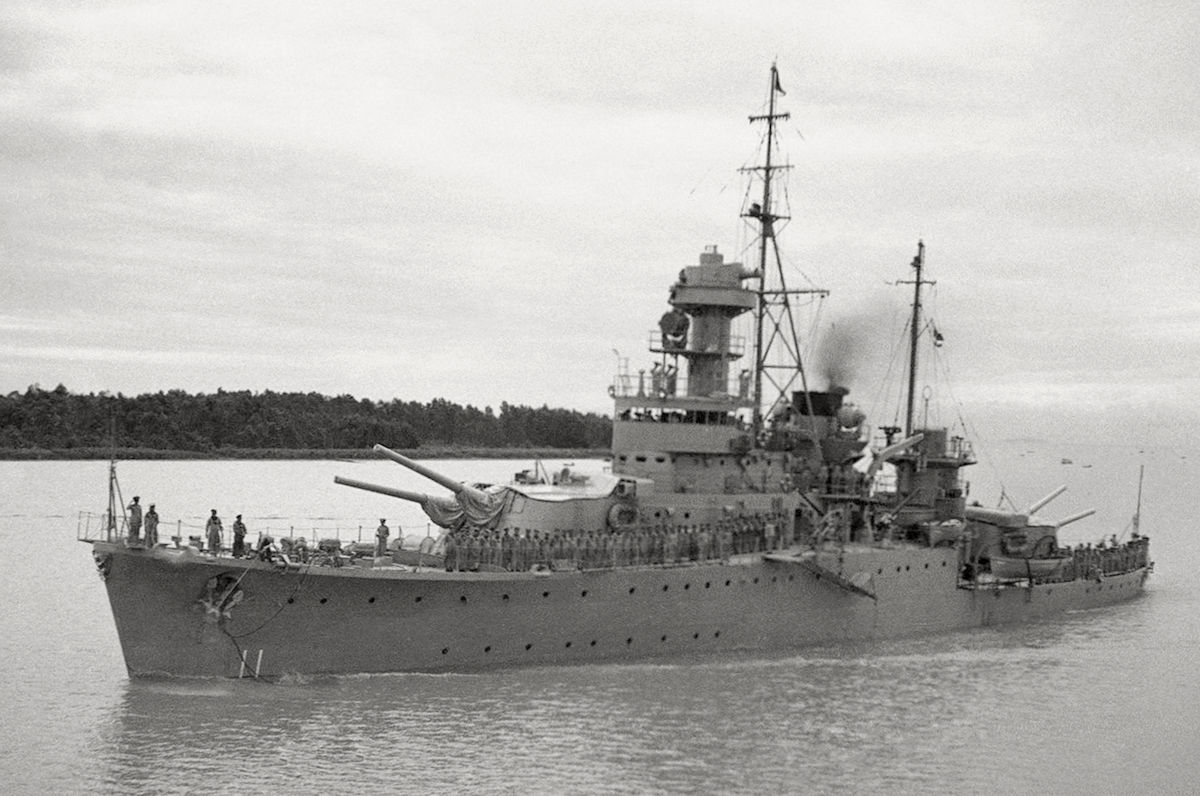
HTMS Thonburi
HTMS Thonburi (เรือหลวงธนบุรี) was a coastal defence ship of the Royal Thai Navy, named after the historic Kingdom of Thonburi.
Thonburi and her sister ship, HTMS Sri Ayudhya, were designed following the incorporation of the earlier Rattanakosindra-class gunboats into the Siamese Navy in the 1920s. Under Plaek Phibunsongkram’s command, the Siamese Navy began a series of modernisation efforts, with protecting the extensive Thai coastline identified as the top priority. Several foreign firms offered designs, but the Japanese company Kawasaki ultimately won the tender.
The ships were laid down at Kawasaki’s facilities in Kobe in 1936, and Thonburi was launched on 31 July 1937. Displacing 2,265 tons, the vessel featured increased armour protection over her predecessors and was powered by twin MAN diesel engines from Germany. Her main armament consisted of four 8-inch (203 mm) guns mounted in two twin turrets — the same type fitted to early Imperial Japanese Navy heavy cruisers, and reportedly surplus weapons left over from Japanese modernisation efforts. She was commissioned into the Royal Thai Navy on 31 January 1938, with a complement of 234 officers and men.
The Battle of Koh Chang
On 17 January 1941, during the Franco-Thai War, a French squadron commanded by Capitaine de Vaisseau Régis Bérenger, comprising the light cruiser Lamotte-Picquet and several avisos, approached the Ko Chang anchorage at dawn, splitting into three groups to maximise firepower while blocking Thai escape routes.
At 06:38, lookouts aboard Lamotte-Picquet spotted Thonburi heading northwest at a range of 10,000 metres. A running battle ensued, with fire from both ships frequently obscured by the towering islets. The Thai ship’s fire was heavy but inaccurate. Early in the engagement, a lucky shot from Lamotte-Picquet killed Thonburi’s captain, Commander Luang Phrom Viraphan, throwing her operations into disarray.
By 07:15, fires were visible on Thonburi. She eventually reached the safety of shallow water, which the French ships could not enter for fear of grounding, but Thonburi was already burning fiercely and listing heavily to starboard. The fire crept dangerously close to the ship’s magazine, forcing the crew to flood it to prevent an explosion. Unable to contain the blaze, the decision was made to have HTMS Chang tow Thonburi and run her aground at Laem Ngob. The official death toll aboard Thonburi was 20 crew members killed.
Thonburi was later raised and repaired by the Japanese, survived the war, and was subsequently used as a training ship until she was retired. She was formally stricken from the naval register on 19 June 1959.
Part of her bridge and forward gun turret are preserved as a memorial at the Royal Thai Naval Academy, while other relics are spread across various museums around the country. For her conduct in battle, the ship was awarded the Bravery Medal.


