
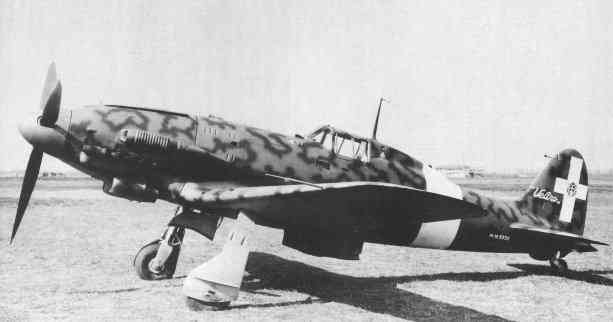
Macchi C.205
Development
The Macchi C.205 Veltro was a direct development of the earlier Macchi C.202 Folgore, itself a refined evolution of the C.200 series. The main design change was the adoption of the German Daimler-Benz DB 605 engine, licence-built in Italy as the Fiat RA.1050 R.C.58.
Because the DB 605 shared similar dimensions with the earlier DB 601 used in the C.202, engineer Mario Castoldi was able to retain much of the existing airframe aft of the firewall. This allowed rapid development and a relatively straightforward transition to production. The prototype first flew on 19 April 1942 and quickly demonstrated a top speed of approximately 640 km/h, placing it on par with contemporary fighters such as the Supermarine Spitfire and North American P-51.
The Macchi C.205 formed part of Italy’s “Serie 5” fighters, alongside the Fiat G.55 and Reggiane Re.2005, all designed around the DB 605 engine. Despite excellent performance, production was constrained by industrial limitations, particularly engine shortages, resulting in only about 262 aircraft being built between 1942 and 1944.
Variants
C.205V Veltro
The primary production version. Early Serie I aircraft retained two 12.7 mm machine guns and lighter wing armament, while later Serie III aircraft incorporated two 20 mm MG 151/20 cannons, improved armour, and self-sealing fuel tanks.
C.205N Orione
A significantly redesigned version intended as a high-altitude interceptor. It featured a new wing, revised fuselage, and heavier armament including additional cannon. Only two prototypes were completed before cancellation due to shifting priorities and industrial constraints.
C.205S
A projected development focused on speed optimisation, reportedly intended to omit wing armament to reduce weight and drag. This variant did not progress beyond the proposal stage.
Operators
Australia (Captured)
During the Allied invasion of Sicily in mid-1943, No. 3 Squadron Royal Australian Air Force (RAAF) encountered abandoned Axis aircraft on captured airfields. Among these was a Macchi C.205 (MM9377), found on 24 August 1943 at Catania Main airfield and taken to Agnone in Sicily. RAAF ground crews restored it to flying condition and gave in the squadron code CV-V.
At least one Australian pilot, Flying Officer A. Dawkins, flew the aircraft in September 1943.

Croatia
A small batch of Macchi C.205s were in service with the Air Force of the Independent State of Croatia, Zrakoplovstvo Nezavisne Države Hrvatske (ZNDH) in 1944.
Egypt
Post-war, the C.205 found a significant export customer in the Egyptian Air Force. Between 1948 and 1949, Egypt acquired approximately 62 refurbished aircraft, many converted from C.202 airframes.
These aircraft saw limited combat during the 1948 Arab–Israeli War. Although they represented a modern piston-engined fighter, their impact was modest due to the rapid advent of jet aircraft and logistical limitations. The type remained in Egyptian service until around 1950.

Germany
A small number of Macchi C.205s were evaluated and used by the Luftwaffe. German interest stemmed from the aircraft’s high performance, particularly its ability to intercept heavy bombers.
II./JG 77 operated C.205Vs for two months, from October until December 1943 after which they re-equipped with Messerschmitt Bf109s. The Germans found the C.205Vs radio unreliable, causing difficulties co-ordinating interceptions. Additionally, they found re-arming to take too long, making it difficult to turn-around aircraft quickly.

Italy
Regia Aeronautica
The Macchi C.205 entered frontline service with the Regia Aeronautica in February 1943. It quickly proved to be one of Italy’s most capable fighters of the war, excelling in interception and air superiority roles.
Early operations included convoy escort and defensive missions over the Mediterranean, particularly during the fighting around Pantelleria and Tunisia. Following the Armistice, only six C.205Vs were left in the south to join the Co-Belligerent Air Force. All other C.205Vs were in the north and fought with the ANR.

Aeronautica Nazionale Republicana
Following the Italian armistice in September 1943, surviving Macchi C.205s were divided between opposing factions. Aircraft located in German-controlled northern Italy were incorporated into the Aeronautica Nazionale Repubblicana.
Approximately 29 aircraft initially reached ANR units, with additional production continuing under German oversight until Allied bombing halted manufacturing in 1944.
ANR-operated C.205s were primarily tasked with defending northern Italian industrial centres against Allied strategic bombing. Despite limited numbers, they achieved some success, including interceptions of Boeing B-17 and B-24 bombers. Their operations were often coordinated with German radar systems, enhancing interception effectiveness.

Co-Belligerent Air Force
Aircraft that remained in southern Italy after the armistice were taken over by the Italian Co-Belligerent Air Force. These units operated alongside Allied forces, primarily in secondary roles such as reconnaissance, training, and limited air defence.
Operational use was constrained by dwindling spare parts and logistical fragmentation, but the type continued to serve effectively until replaced by Allied-supplied aircraft.

Italy – Post War
After the war, surviving aircraft were retained by the newly formed Italian Air Force (Aeronautica Militare Italiana). Production and refurbishment continued into 1948, often involving the conversion of older C.202 airframes to C.205 standard.
These aircraft served primarily in training and transitional roles during the immediate post-war years before being phased out in favour of jet-powered fighters.
