
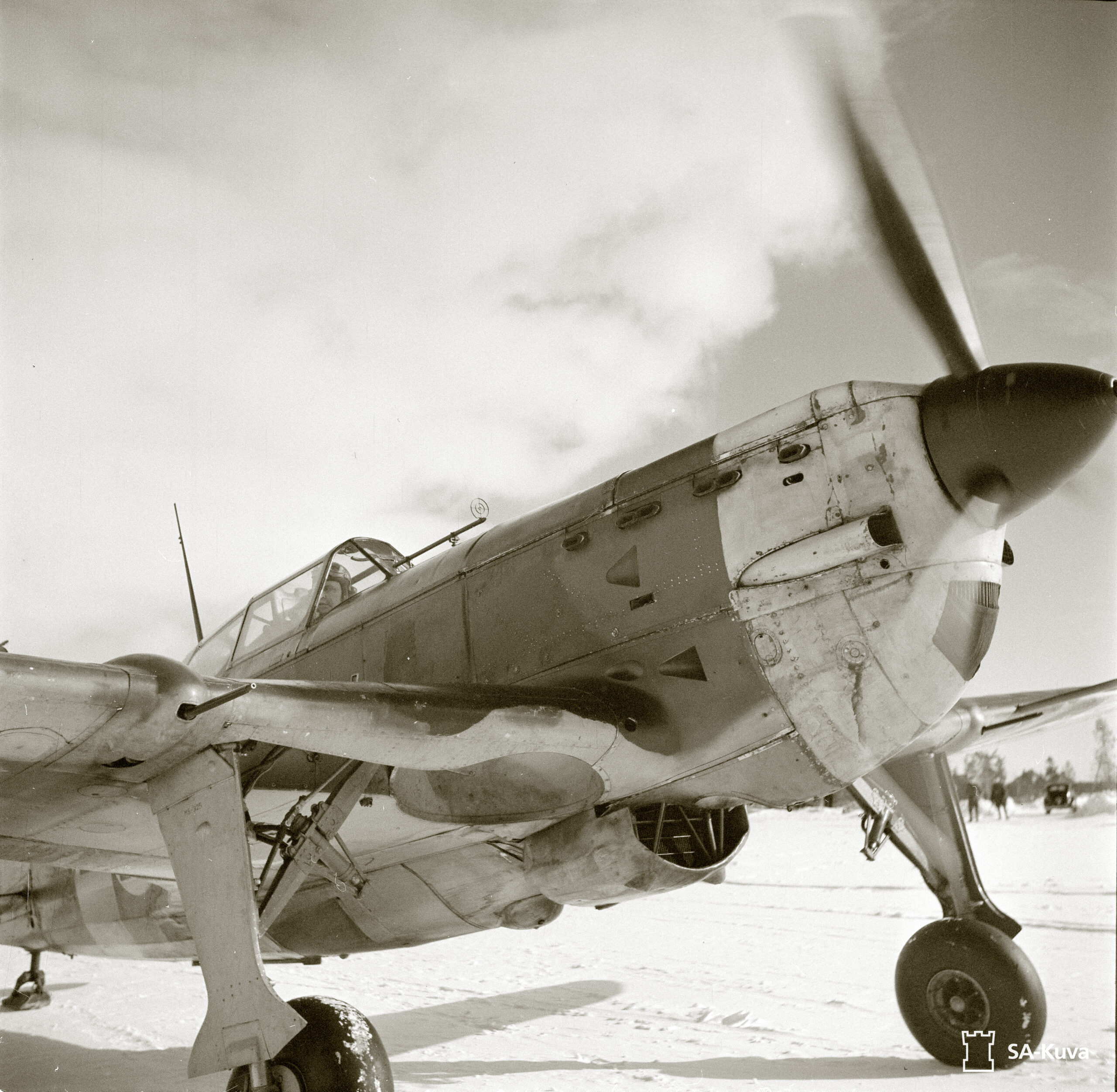
Morane-Saulnier M.S.406 In Finnish Service Page 1
During the early years of World War II, Finland found itself in urgent need of modern fighter aircraft to defend its skies against the Soviet Union. One of the more unusual solutions to this shortage was the acquisition of the French-built Morane-Saulnier M.S.406, a radial-engined monoplane that had seen extensive service with the Armée de l’Air in 1939–1940. Despite being technologically outclassed by mid-war standards, the type played a significant role in the Finnish Air Force.
The Finnish M.S.406s were obtained after France’s collapse in 1940. Finland, struggling to rearm after the Winter War, arranged through Germany—then occupying France—to acquire a number of M.S.406s and related airframes from captured French stocks. The first examples arrived in 1941, and eventually around 87 aircraft reached Finland. These comprised both standard M.S.406s and M.S.410s (a later version with improved armament and cooling), along with spare parts sufficient to assemble several hybrid machines.
In combat, Finnish pilots found the M.S.406 and its Mörkö-Morane derivative to be rugged and reliable. Although still inferior in speed and firepower to newer Soviet types like the Yak-1 or LaGG-3, its manoeuvrability and light handling made it effective in skilled hands. Finnish ace Urho Lehtovaara scored several victories flying the type, while other pilots praised its agility and stability as a gun platform. The aircraft served in front-line squadrons such as LeLv 28, LeLv 14, and LeLv 24, seeing continuous combat during the Continuation War (1941–1944).
Armament varied: most Finnish examples retained the 20 mm Hispano cannon firing through the propeller hub and two 7.5 mm wing-mounted machine guns, although some Mörkö-Moranes received heavier armament when parts permitted. The aircraft’s wooden construction and retractable undercarriage required careful maintenance, but Finnish ground crews adapted well, often improvising repairs with local materials.
By 1944, as newer German and domestic aircraft like the Messerschmitt Bf 109G entered service, the Morane gradually moved to second-line duties, including reconnaissance and training.
- Finnish Morane-Saulnier M.S.406 Photos Page 1
- Finnish Morane-Saulnier M.S.406 Photos Page 2
- Finnish Morane-Saulnier M.S.406 Undergoing Maintenance
- Righting a Finnish Morane-Saulnier M.S.406 After a Crash Landing
- Mörkö Morane


