
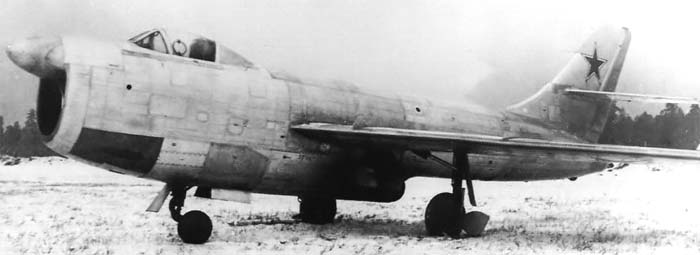
Sukhoi Su-15 (1949)
The Sukhoi Su-15 was an early Soviet jet fighter prototype developed by the Sukhoi Design Bureau in the immediate post-war period. It must be distinguished from the later supersonic interceptor that shared the same designation. The 1949 aircraft represented an ambitious effort to produce a high-performance, swept-wing fighter capable of operating effectively in the emerging transonic regime.
One of the most distinctive aspects of the Su-15 lay in its propulsion arrangement. It was powered by two Klimov RD-45 turbojets, derived from the British Rolls-Royce Nene. Unlike most twin-engine fighters of the era, which placed engines side-by-side, the Su-15 mounted its engines in tandem along the fuselage centreline. This unusual configuration was driven largely by the relatively large diameter of centrifugal-flow turbojets. The forward engine was positioned low in the fuselage, with its exhaust exiting beneath the midsection, while the second engine was located behind it, exhausting at the extreme rear of the fuselage.
This arrangement imposed further unconventional design solutions. In order to provide airflow to the rear engine, complex intake ducting had to be routed past the cockpit. As a result, the cockpit itself was offset slightly to the port side rather than being centred on the fuselage axis. This asymmetrical layout was highly unusual for a fighter aircraft and reflected the compromises required to accommodate the tandem engine installation.
Armament followed standard Soviet practice of the period, consisting of heavy cannon intended for bomber interception, typically a mix of 23 mm and 37 mm weapons. In theory, the aircraft promised strong performance, with projected speeds approaching the transonic region and a powerful offensive capability.
Flight testing began in 1949 but quickly revealed serious shortcomings. Stability and control issues became apparent, particularly at higher speeds where swept-wing aerodynamics were not yet fully understood. These problems culminated in the loss of the prototype in June 1949 during a test flight, bringing the programme to an abrupt end.


