
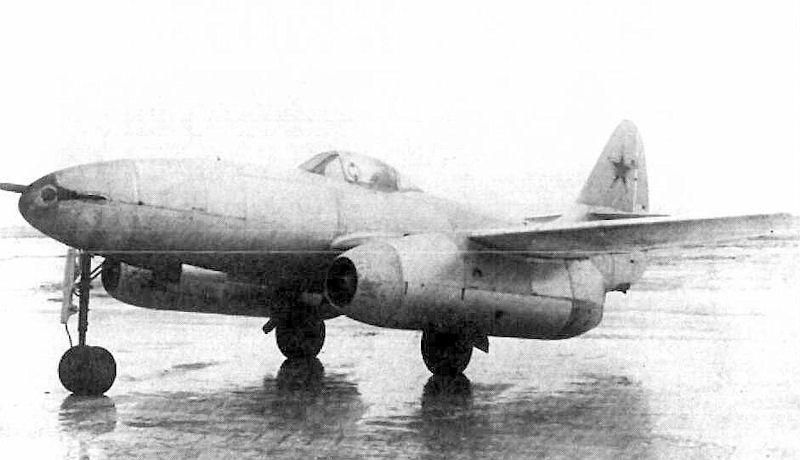
Sukhoi Su-9 (1946)
The Sukhoi Su-9 (1946) was an early postwar Soviet jet fighter prototype developed by the Sukhoi Design Bureau during the immediate aftermath of the Second World War. It should not be confused with the later supersonic interceptor of the same designation introduced in the late 1950s. The 1946 Su-9 belonged to the first generation of Soviet turbojet fighters, reflecting both indigenous design work and the significant influence of captured German technology.
The aircraft was broadly comparable in concept to the Messerschmitt Me 262, particularly in its twin-engine configuration. The Su-9 was powered by two Soviet-built copies of the German Junkers Jumo 004 turbojet, known as the RD-10. These engines were mounted in nacelles beneath straight wings, giving the aircraft a conventional layout for the period. The fuselage was relatively slender, with a nose intake arrangement and tricycle landing gear, indicating a rapid transition from piston-engine to jet-era design principles.
Armament was planned to be heavy, in line with Soviet emphasis on bomber interception. The Su-9 was designed to carry a combination of 23 mm and 37 mm cannons, providing substantial firepower against large aerial targets. However, as with many early jet projects, development was constrained by engine reliability, limited thrust, and aerodynamic challenges associated with transonic flight regimes.
The prototype first flew in 1946, at a time when Soviet aviation was rapidly evaluating multiple competing jet designs. Despite showing generally acceptable performance for its class, the Su-9 did not represent a decisive improvement over contemporaries. Aircraft such as the Mikoyan-Gurevich MiG-9 and especially the more advanced Mikoyan-Gurevich MiG-15 soon rendered straight-wing, Jumo-powered fighters obsolete.
As a result, the Su-9 (1946) did not enter serial production. A modified version with different engines and a revised wing became the Su-11 (Samolyot KL), but this did not enter production either.


