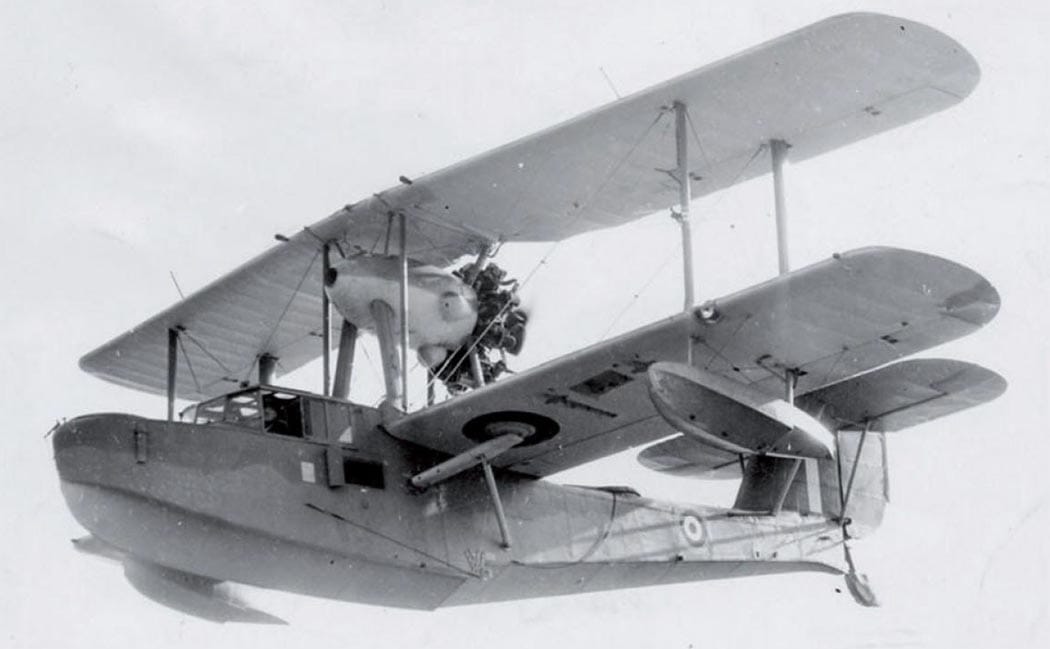
The Supermarine Walrus was operated by both the Royal Air Force (RAF) and the Royal Navy during the Second World War. Designed by R. J. Mitchell of Supermarine, the amphibious biplane first flew in 1933 and entered British service in 1935. Although originally intended as a fleet reconnaissance and gunnery-spotting aircraft, the Walrus proved adaptable to a wide variety of roles and became an invaluable asset throughout the war. Approximately 740 aircraft were built.
In Royal Navy service, the Walrus was primarily operated by the Fleet Air Arm from cruisers, battleships, and seaplane tenders. The aircraft could be launched by catapult from warships and recovered from the sea after landing alongside the ship. During the early years of the war, Walruses served aboard numerous vessels, including Town-class and County-class cruisers as well as battleships. Their duties included reconnaissance, artillery spotting, anti-submarine patrols, convoy escort work and communications flights.
Although naval gunnery spotting had been the aircraft’s original purpose, opportunities to perform this role in combat were limited. Walruses nevertheless took part in major naval operations, including the Battles of Cape Spartivento and Cape Matapan, where they directed gunfire and provided reconnaissance. The aircraft also conducted anti-submarine patrols and, from 1941, some were equipped with Air-to-Surface Vessel (ASV) radar, enhancing their ability to detect enemy submarines and surface raiders. In secondary roles, Walruses attacked shore targets during operations in Norway, East Africa and the Mediterranean.
By 1943, improvements in shipborne radar reduced the need for catapult-launched aircraft aboard major warships. As catapults and aircraft handling equipment were removed, many naval Walruses transferred to other duties. The aircraft continued to operate from Royal Navy aircraft carriers, where its exceptionally low landing speed allowed it to land safely despite lacking a tailhook. Walruses were frequently employed for communications and air-sea rescue tasks in support of fleet operations.
The RAF found an equally important use for the Walrus in the air-sea rescue role. Operating with specialist Air Sea Rescue squadrons around the British Isles, the Mediterranean and the Indian Ocean, Walruses were tasked with recovering downed airmen from the sea. Their amphibious design enabled them to land directly on the water and pick up survivors, often under hazardous conditions. Other aircraft such as Spitfires, Defiants and Ansons located survivors or dropped emergency supplies, while the Walrus completed the rescue. During the war, RAF Walruses rescued well over a thousand Allied airmen, with No. 277 Squadron alone credited with nearly 600 recoveries.
Crew of HMS Anson watch the arrival of their new aircraft, a Supermarine WalrusA Supermarine Walrus being hoisted on board, a view from inside one of the hangers June 1942HMS Anson in a turn to port as she recovers one of her Supermarine Walrus
A Supermarine Walrus being brought out of the hangar on to the lift 1940A Supermarine Walrus comes up from the hanger and is prepared for flight 1940Supermarine Walrus planes lined up on the flight deck of HMS Argus in 1940A Supermarine Walrus comes up from the hanger and is prepared for flight 1940Ground staff run out of the way as a Supermarine Walrus prepares to take off 1940A Supermarine Walrus takes off at dawn from HMS Argus. The silhouetted figure with the flag on the left is the Flight Deck OfficerSupermarine Walrus taking off from HMS Argus in 1940Bombing up the port wing of a Supermarine Walrus on HMS Argus before she goes on patrol over the Atlantic. She carries anti-submarine bombsThe crew; pilot, observer, and air gunner, report on getting out of their Supermarine Walrus aircraft on HMS ArgusThe crew of a Supermarine Walrus disembarking.Air gunner adjusts the .303 machine gun in the bows of a Supermarine Walrus.Some of the Fleet Air Arm photographed on the flight deck of HMS Argus with a Supermarine Walrus behind.HMS Argus with a Supermarine Walrus 1940
The single Walrus Air Sea Rescue aircraft from 1700 squadron which operated from HMS Ameer
HMS Belfast
In an Icelandic fjord, a Supermarine Walrus of HMS Belfast (not visible) is being paddled in to approach the craneGroup photograph of members of the HMS Belfast flight of 700 Squadron, Fleet Air Arm in front of a Walrus
HMS Bermuda
Supermarine Walrus moments after being launched from HMS Bermuda in 1943
Supermarine Walrus returning from an anti-U-boat patrol, taxi-ing alongside HMS Cumberland to be hoisted aboard. 4 December 1942HMS Cumberland’s Supermarine Walrus aircraft being hoisted aboard
HMS Edinburgh
Supermarine Walrus being launched by catapult from HMS Edinburgh
HMS Exeter’s Supermarine Walrus amphibian aircraftSupermarine Walrus flying boats aboard HMS Exeter in the 1930sSupermarine Walrus Mk.I on the catapult of HMS ExeterSupermarine Walrus being hoisted on HMS ExeterHMS Exeter during the First Battle of the Java SeaSupermarine Walrus K8343 coded 769, suspended from a crane, Vancouver, British Columbia, ca 1940Supermarine Walrus K8343 coded 769, Vancouver, British Columbia, ca 1940.Supermarine Walrus K8343 coded 769, Vancouver, British Columbia, ca 1940.
In advance of Operation Dracula, HMS Khedive embarked a Supermarine Walrus flying boat for rescue dutiesLieutenant (A) S Lawrence landing his Supermarine Walrus safely on HMS Khedive after rescuing the pilot of a Grumman Hellcat which had been shot down while attacking Japanese positions on the Nicobar Islands. During the rescue Lt Lawrence landed on the sea under heavy machine gun fire.The rescued pilot being helped out of the rescuing Supermarine Walrus on the return HMS Khedive
Supermarine Walrus on HMS King George V 1941Supermarine Walrus on HMS King George V 1941Supermarine Walrus being prepared for catapulting on HMS King George V March 1941Supermarine Walrus with wings folded, is being hauled into its hangar on HMS King George V March 1941Supermarine Walrus on the catapult deck of HMS King George V 1941.Supermarine Walrus on the catapult deck of HMS King George VCatapult crew at work on the Supermarine Walrus on HMS King George V 1941.Hoisting a Supermarine Walrus on HMS King George V 1941.Hoisting a Supermarine Walrus on HMS King George V 1941.Loading a Supermarine Walrus onto the catapult trolley HMS King George V 1941.Preparing HMS King George V’s Supermarine Walrus aircraft for catapulting March 1941Fleet Air Arm crew prepare the Supermarine Walrus for catapulting off HMS King George V March 1941Preparing HMS King George V’s Supermarine Walrus aircraft for catapulting March 1941Pilot in the cockpit of HMS King George V’s Supermarine WalrusPilot of a Supermarine Walrus aboard the HMS King George V in 1941HMS King George V’s Supermarine Walrus revving up before a flightSupermarine Walrus takes off from HMS King George V March 1941A Walrus is catapulted from HMS King George V, March 1941.A Supermarine Walrus aircraft returning from patrol is picked up and hoisted aboard HMS King George V February 1941Hoisting a Supermarine Walrus aboard the HMS King George V after it had completed a patrol over Northern waters during convoy duty.
HMS Mauritius
Supermarine Walrus at the end of its catapult, about to be launched from HMS MauritiusSupermarine Walrus leaving the catapult of HMS Mauritius. Several troopships can be seen on the horizon.Supermarine Walrus leaving the catapult of HMS Mauritius.Supermarine Walrus of HMS Mauritius on patrol over a convoy.Supermarine Walrus amphibious aircraft from HMS Mauritius lands on the sea after her patrol flightHoisting the Supermarine Walrus of HMS Mauritius back on board 20 May 1942
HMS Norfolk
Supermarine Walrus K5775 on the catapult of HMS Norfolk
HMS Pegasus
A Supermarine Walrus hanging from a crane and about to be fitted to a catapult so it can be launched from HMS Pegasus during catapult training for Fleet Air Arm pilots at Lamlash, Scotland.A Supermarine Walrus of HMS Pegasus during Fleet Air Arm catapult training at Lamlash Scotland September 1942A Supermarine Walrus being hoisted aboard HMS Pegasus during Fleet Air Arm catapult training at Lamlash Scotland September 1942A Supermarine Walrus amphibious aircraft practising a towed recovery during catapult training for Fleet Air Arm pilots at Lamlash, Scotland.An aircraft handling party learning to handle a Supermarine Walrus on HMS Pegasus at Lamlash Scotland September 1942
Supermarine Walrus is hoisted on HMS Prince of Wales, 1941A Supermarine Walrus being lowered into the water from the catapult deck of HMS Price of Wales 1941Hoisting one of the Supermarine Walrus planes on board Apr 1941Supermarine Walrus amphibious aircraft being hoisted from the catapult deck Apr 1941A Supermarine Walrus being catapulted from HMS Prince of Wales
A Supermarine Walrus landing alongside HMS ResolutionA Supermarine Walrus landing alongside HMS ResolutionSupermarine Walrus being hoisted aboard HMS Resolution
Supermarine Walrus being hoisted on HMS RodneyA Supermarine Walrus aircraft taking off from HMS Rodney 1941Supermarine Walrus being hoisted on HMS RodneySupermarine Walrus on HMS RodneyHMS Nelson, leading the aircraft carrier HMS Formidable in the Mediterranean, March 16, 1943, as seen from HMS Rodney. Supermarine Walrus in the foregroundSupermarine Walrus is catapulted from HMS Rodney to carry out spotting during gunnery practice in the western Mediterranean
Walrus Air Sea Rescue plane W3022 of 1700 squadron landing on to return rescued aircrew. This aircraft operated from SHAH 8-26 August 1945
HMS Sheffield
Supermarine Walrus L2180 aircraft is moved into the hangar of HMS SheffieldSupermarine Walrus (“Spotter of Spartivento”) about to be launched from HMS SheffieldSupermarine Walrus about to be launched from HMS SheffieldA Supermarine Walrus from HMS Sheffield in flight May 1941A Supermarine Walrus from HMS Sheffield taxi-ing in to be hoisted after a flight May 1941Supermarine Walrus waits to be hoisted on board HMS Sheffield after a flight
HMS Shropshire
Supermarine Walrus being catapulted from HMS Shropshire 12 March 1942
HMS Suffolk
Supermarine Walrus of HMS Suffolk is out on the catapult deck receiving attention from the maintenance staff whilst the ship is on Arctic Patrol.The Supermarine Walrus aircraft of HMS Suffolk being lowered into the water during the chase of the German battleship Bismarck, which Suffolk spotted and shadowed. One of the aircraft’s crew can be seen stood in the hatch at its front whilst two others can be seen in the cockpitThe Supermarine Walrus seaplane of HMS Suffolk being hoisted inboard after a flight June 1941The Supermarine Walrus aircraft of HMS Suffolk being manoeuvred on to the flight deck at dusk June 1941Left to right: Petty Officer Air Gunner, Petty Officer Pilot, and the Sub Lieut Observer, who is in charge of the air division of the ship. June 1941The air gunner is also a wireless operator of HMS Suffolk’s Supermarine Walrus. He also works the Aldis lamp when necessary. Here he is at the radio set. June 1941The interior of a Fleet Air Arm Supermarine Walrus of HMS Suffolk. A Sub Lieut observer works at his chart board. in the background the pilot in his cockpit. June 1941
HMS Unicorn
A repaired Supermarine Walrus being lowered into the sea for trials from the repair carrier HMS Unicorn at Trincomalee. Note the crew member sat on the top wing
Supermarine Walrus amphibious aircraft from HMS Warspite is catapulted at the start of an anti-submarine patrol off the SeychellesSupermarine Walrus amphibious aircraft with HMS Illustrious and HMS Lookout in the backgroundSupermarine Walrus amphibious aircraft taxiing up to HMS WarspiteSupermarine Walrus amphibious aircraft being hoisted on board HMS Warspite
Fleet Air Arm Supermarine Walrus based at Arbroath, flying in close formation.
Royal Naval Air Station Donbristle HMS Merlin
Wrens carry out repairs to the aerial on a Supermarine Walrus at NAS Donbristle June 1942Wrens carry out repairs to the aerial on a Supermarine Walrus at NAS Donbristle June 1942
Royal Naval Air Station Hatston HMS Sparrowhawk
A Supermarine Walrus coming up the slipway at HMS Sparrowhawk. March 1942Supermarine Walrus at HMS Sparrowhawk March 1942Naval air gunner in the nose of a Supermarine WalrusFleet Air Arm gunner in position at the nose of a Supermarine Walrus March 1942Rear Admiral C Moody, Rear Admiral Naval Air Stations, in a Supermarine Walrus at Royal Naval Air Station Hatston HMS SparrowhawkThe King inspecting a Supermarine Walrus and its crew during his visit to the Royal Naval Air Station Hatston February 1943
Royal Air Force 276 Squadron
Personnel and aircraft of 276 Sqn RAF at Harrowbeer, Devon, show the resources needed to mount a single air-sea rescue
Royal Air Force 277 Squadron
Walrus Mk I K8554 BA-T of 277 Sqn RAF based at Hawkinge KentWalrus Mark I of Nos. 276 or 277 Squadrons RAF, on the ground at Warmwell, Dorset.
Royal Air Force 284 Squadron
Personnel of No. 284 Squadron RAF, an air/sea rescue unit, standing in front of one of their aircraft, Supermarine Walrus, X9506 ‘C’, at Cassibile, Sicily.Supermarine Walrus, X9498 ‘B’, of No. 284 Squadron RAF undergoing maintenance at Cassibile, Sicily. Parked behind them and partly obscured is Hawker Hurricane Mark IIC, KW980, of the Mediterranean Air Command Communications Unit based at Maison Blanche, Algeria, while in the background can be seen the medieval tower which served as the airfield control tower.Supermarine Walrus, X9498 ‘B’, of No. 284 Squadron RAF undergoing maintenance at Cassibile, Sicily. Hawker Hurricane Mark IIC, KW980, of the Mediterranean Air Command Communications Unit based at Maison Blanche, Algeria, can also be seen, parked in front of the medieval tower which served as the airfield control tower.
Royal Air Force 293 Squadron
Warrant Officer J R Berry (wireless operator) and Flight Sergeant E J Holmes (pilot), an experienced air-sea rescue crew, stand in front of their Supermarine Walrus Mark I, X9506 ‘C’, of ‘C’ Flight, No. 293 Squadron RAF Detachment at Nettuno, Italy. Berry and Holmes were both recipients of the Distinguished Flying Medal for their work with No. 284 SquadronSupermarine Walrus Mark Is of ‘C’ Flight No. 293 Squadron RAF Detachment, on the ground at Nettuno, Italy: X9506 C is parked in front of R6547 X. In the foreground an American water bowser is sprinkling the surface of the landing ground in order to suppress the dust. Behind the Walruses, are Supermarine Spitfire Mark IXs of No. 93 SquadronSupermarine Walrus Mark I, R6547 X, of ‘C’ Flight, No. 293 Squadron RAF Detachment, taxying to its dispersal at Nettuno, Italy, following a search and rescue sortie off Anzio. Behind it is parked a Supermarine Spitfire Mark IX of No. 93 Squadron
Royal Air Force 624 Squadron
Supermarine Walrus crews of ‘C’ Flight, No. 624 Squadron RAF, in conference prior to a mine-reconnaissance flight from Leghorn, Italy. The unit was supporting operations carried out by the 12th Minesweeping Flotilla for marking the boundaries of enemy minefields in the Gulf of Genoa.Supermarine Walrus aircraft of 624 Squadron at Grottaglie, Italy, early 1945Supermarine Walrus HD908 BA-D of 277 Air Sea Rescue Sqn
Interior Photos of the Supermarine Walrus
A Fleet Air Arm pilot at the controls of a Supermarine WalrusA Fleet Air Arm pilot at the controls of a Supermarine WalrusThe cockpit of the Supermarine Walrus.Supermarine Walrus Mk.I cabinSupermarine Walrus Mk.I cabinLieut Cdr Sir George Lewis-Bart, RNVR, Officer Commanding 781 Squadron, pays a flying visit to HMS Victorious. He is seen looking up at the camera from on the nose of a Supermarine Walrus Amphibious aircraft as it comes alongside HMS Victorious.
Miscellaneous Walrus Photos
Supermarine Walrus K5772Supermarine Walrus K5772Supermarine Walrus K5772Supermarine Walrus K5773Supermarine Walrus Mk.I K5773 The second production aircraftSupermarine Walrus K8343Supermarine Walrus K8552Supermarine Walrus K5783Supermarine Walrus W3006Supermarine Walrus Z1768 of No. 1 Naval Gunnery School, RN, Oct 1944Supermarine Walrus with an impressive tally of rescues marked on the noseSupermarine WalrusSupermarine WalrusSupermarine WalrusSupermarine Walrus being craned aboard a shipSupermarine WalrusSupermarine Walrus with Yagi anti-aircraft radar antennas mounted on wing struts. The aircraft was tested in 1941 but never put into productionSupermarine WalrusThe crew of a Supermarine Walrus that rescued the crew of a Halifax despite 15′ waves.The crew of a Supermarine Walrus which attacked a U-boat with machine-gun fire that was subsequently torpedoed by a Fairey Albacore.Supermarine Walrus Mk.II X1045An elephant pulling a Supermarine Walrus into position at a Fleet Air Arm station.A Supermarine Walrus taking off on patrol passing a hospital ship anchored off Mers-el-Kebir.