
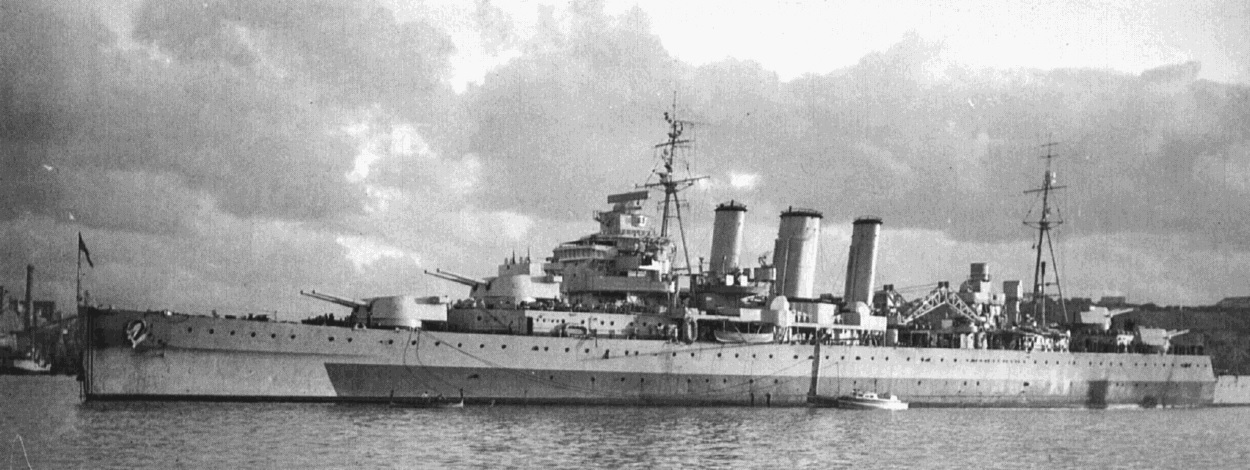
HMS Cumberland (1928) British Heavy Cruiser
HMS Cumberland (57) was a British heavy cruiser of the County-class, launched on 26 March 1926 for the Royal Navy. Built during the interwar period under the restrictions of the Washington Naval Treaty, Cumberland was designed to combine heavy firepower with long-range cruising ability while remaining within treaty displacement limits. She carried eight 8-inch guns mounted in four twin turrets, along with smaller anti-aircraft weapons and torpedo tubes. Her strong armour and reliable machinery made her one of Britain’s most capable cruisers of the era.
Before the Second World War, Cumberland served extensively across the British Empire, undertaking patrol duties and representing British naval power overseas. At the outbreak of war in 1939, she was assigned to the South Atlantic Station, where she participated in the hunt for German commerce raiders threatening Allied shipping routes.
Cumberland became most famous for her involvement in the aftermath of the Battle of the River Plate in December 1939. Although undergoing repairs in the Falkland Islands during the battle itself, she quickly sailed to join the British cruisers shadowing the damaged German pocket battleship German cruiser Admiral Graf Spee off Montevideo, Uruguay. Her arrival strengthened the British naval presence and contributed to the pressure that ultimately led Captain Hans Langsdorff to scuttle Graf Spee rather than face renewed combat.
Throughout the war, Cumberland served in several theatres, including the Arctic, the Atlantic, and West Africa. She escorted convoys, hunted enemy raiders, and supported Allied operations. Later in the war she was refitted with improved radar and anti-aircraft armament, reflecting the changing nature of naval warfare.
After 1945, Cumberland continued in service as a training and experimental vessel before being decommissioned in the 1950s. She was eventually scrapped in 1959.


HMS Cumberland’s Aircraft

