
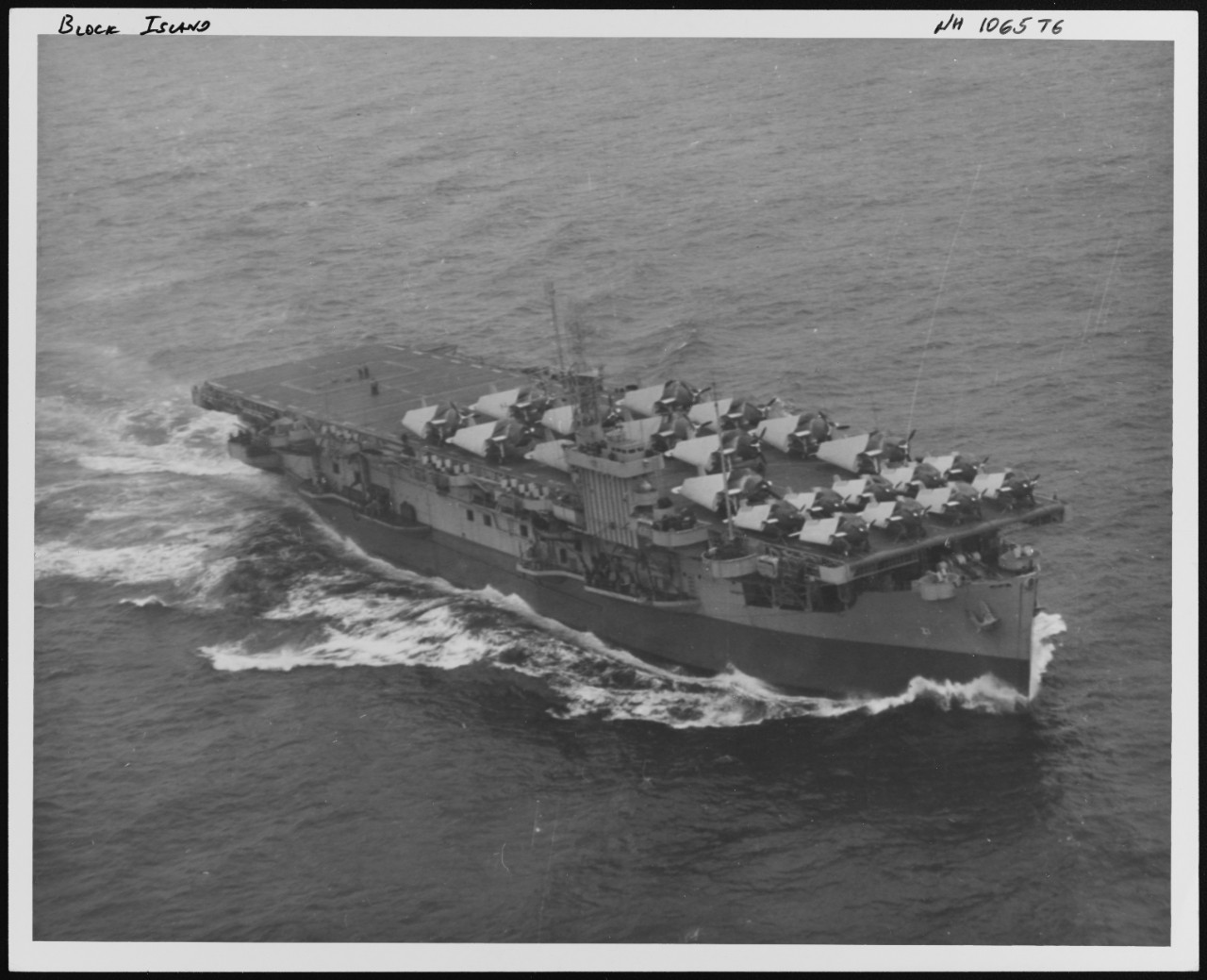
US Navy Escort Carrier USS Block Island CVE-21
USS Block Island (CVE-21) was a Bogue-class escort carrier, commissioned into the U.S. Navy in March 1943 during a period of accelerated naval construction driven by anti-submarine warfare (ASW) requirements in the Atlantic. Escort carriers—converted from merchant or support hulls—were optimized for convoy defence and hunter-killer operations rather than fleet air operations. They traded speed and armour for aviation capacity, endurance, and low-cost producibility, thereby filling a critical operational gap during the Battle of the Atlantic.
Block Island displaced roughly 15,000 tons (full load) and measured approximately 495 feet in length, with a beam of 69 feet on the hull and more across the flight deck. Propulsion was via turbo-electric machinery, yielding speeds near 18 knots, sufficient for convoy pacing and ASW sprinting. Her air group typically consisted of a composite squadron of Grumman Wildcats for fleet air defence and Grumman Avengers configured for anti-submarine attacks with depth charges, acoustic torpedoes, and radar or sonobuoy equipment. Bogue-class carriers also integrated progressively improved radar suites, enhancing detection and vectoring in low-visibility conditions.
From mid-1943 Block Island operated with hunter-killer groups centered on escort carriers and screened by destroyers or destroyer escorts. Rather than remain tethered to convoys, these groups aggressively patrolled U-boat operating zones, exploiting airborne search to drive German submarines into disadvantageous engagements. Block Island’s task group achieved notable success; her aircraft and escorts accounted for several U-boat sinkings and forced many others to desist from offensive action. The ship’s operational tempo reflects the doctrinal shift toward offensive ASW, facilitated by radar, HF/DF (high-frequency direction finding), sonobuoys, and improved coordination between ships and aircraft.
On 29 May 1944, while operating west of the Canary Islands, Block Island was torpedoed by U-549. The submarine managed to penetrate the destroyer screen and launched multiple torpedoes, two of which struck the carrier. Despite crew damage-control efforts, progressive flooding and loss of power proved decisive. Block Island was abandoned and eventually sank, becoming the only American escort carrier lost to submarine action in the Atlantic. The destroyer escorts of the screen rapidly counterattacked and sank U-549, underscoring the lethal reciprocity of ASW engagements in the mid-war period.
Casualties were comparatively light given the scale of the damage, attributable to disciplined evacuation protocols and the proximity of escorts able to recover survivors. The sinking did not materially alter Atlantic ASW strategy, as escort carriers had already demonstrated decisive strategic value by sharply reducing U-boat operating freedom. Indeed, by mid-1944 German wolf packs were increasingly constrained by air coverage, improved convoy routing, and degradation of the U-boat force through attrition.


